LendStack First Look: Is This India-Focused Micro-Lending Platform Worth a Demo?
By Day Zero Guides Editorial · How we produce guides
Some links in this guide are affiliate links. If you sign up through them, Day Zero Guides may earn a commission at no extra cost to you. This never affects which products we cover or what we say about them. See our affiliate disclosure for details.
Who this is actually for
This isn't a platform for a large bank replacing its core loan origination system. It's built for:
- An NBFC running gold loans or personal micro-loans in semi-urban India that currently manages KYC and collections across spreadsheets, WhatsApp, and a basic CRM.
- A fintech startup building an embedded lending product (buy-now-pay-later, merchant cash advance) that needs disbursement and repayment tracking without building it in-house.
- A microfinance institution (MFI) doing group lending that needs faster E-KYC turnaround to reduce onboarding drop-off.
- A regional lender that needs collections and customer communication in a local language rather than English-only tooling.
If you're a large bank or a multinational lender needing multi-currency, multi-geography core banking, this isn't the right category of tool — see the comparison below.
What LendStack actually is
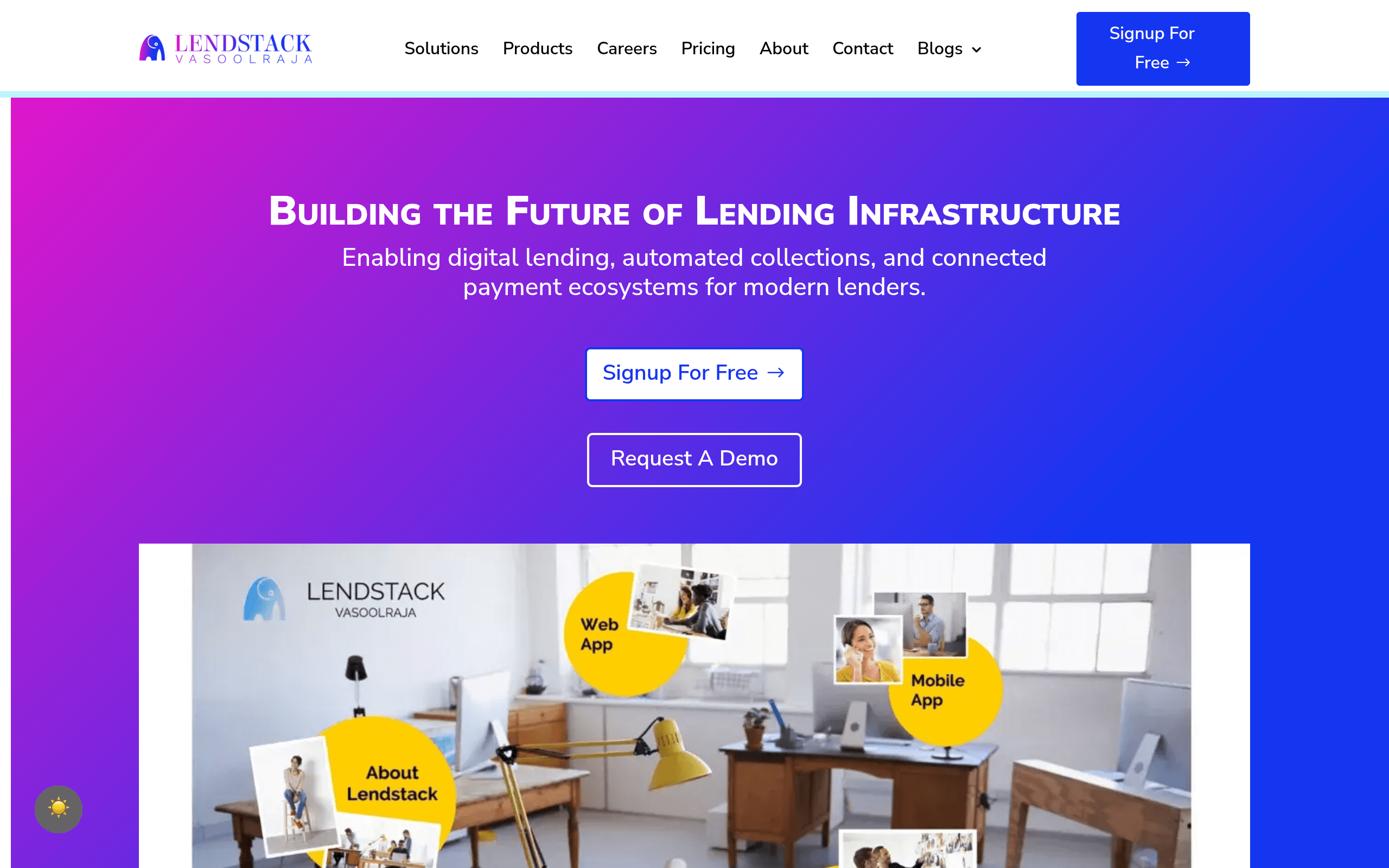
LendStack (lendstack.in) is a lending management platform built specifically for micro-lenders, NBFCs, and fintech lending startups operating in India. It's not trying to be a global core banking suite — the pitch is narrower and more useful for a specific buyer: someone running a digital lending book in India who needs E-KYC, collections, disbursement, and reporting handled in one place without stitching together five vendors.
The core feature set as it stands today:
- Automated E-KYC verification — digital identity checks built for the Indian regulatory environment (Aadhaar-based and document-based verification flows), meant to cut manual onboarding time.
- Loan disbursement workflows — configurable rules for approval, disbursal, and payout tied into payment wallet rails.
- Collections management — tracking repayments, delinquency status, and follow-up workflows, which is usually the most operationally painful part of running a micro-loan book.
- Reporting — portfolio and performance reporting aimed at compliance and internal MIS needs rather than investor-grade analytics.
- Multi-language support — relevant for lenders whose collections and customer-facing teams operate outside English/Hindi-only markets, a detail that matters a lot for tier-2/tier-3 city lending operations.
- Payment wallet and credit verification integrations — the site references integration with wallets and credit-check systems, positioning LendStack as a connective layer rather than a standalone bank-grade core.
Pricing: what's actually published (not much)
LendStack does not publish pricing on its site. There's no visible per-loan fee, per-seat SaaS tier, or setup cost listed anywhere public as of this writing. To get a number, you'll need to book a demo and go through a sales conversation.
What this tells you, practically:
- Expect a custom quote model, which is standard for lending infrastructure vendors in this segment — pricing is usually driven by loan volume, number of active borrowers, or number of user seats, not a flat SaaS sticker price.
- Because this is a newer product without a public pricing page, you should ask directly during the demo about: implementation/setup fees, whether pricing is per-loan-originated or flat monthly, and what happens if your loan volume scales 5x in a year.
- Don't assume it's cheap because it's not enterprise-branded. Compliance-heavy fintech infrastructure (E-KYC, credit checks) usually carries per-transaction costs passed through from third-party verification providers, on top of whatever LendStack charges for the platform itself.
If pricing transparency matters to you today, that's a real friction point — you can't budget against this without a sales call, which is worth knowing before you invest time in a demo.
How it stacks up against established players
It's worth being upfront: Fiserv, Temenos, and LoanDepot's LMS operate in a different weight class — they're established, enterprise-grade platforms with global client bases. LendStack is a newer, India-focused challenger. The comparison below is about fit, not parity.
| LendStack | Fiserv Lending Solutions | Temenos Fintech | LoanDepot LMS | |
|---|---|---|---|---|
| Pricing model | Not published; custom quote via demo | Enterprise contract, typically 6-figure+ annual deals | Enterprise/licensing model, negotiated per institution | Proprietary, primarily used internally by LoanDepot; limited external licensing |
| Target market | Indian micro-lenders, NBFCs, fintech lending startups | Banks, credit unions, large lenders globally | Banks and large financial institutions globally | Mortgage and consumer lending at LoanDepot scale |
| KYC/compliance focus | Built-in automated E-KYC tuned to Indian ID verification (Aadhaar/document-based) | Broad compliance modules, US/global regulatory frameworks | Broad regulatory coverage across multiple countries | US mortgage compliance specifically |
| Deployment speed | Positioned as fast to onboard for smaller lending teams | Long enterprise implementation cycles (months) | Long enterprise implementation cycles (months) | Not externally deployable in most cases |
| Best for | A regional Indian NBFC or lending startup that needs KYC + collections + disbursement in one lightweight platform | A bank needing a mature, globally proven lending core | A large financial institution needing a full core banking + lending suite | Not really an option for outside companies — it's LoanDepot's internal system |
The practical takeaway: if you're evaluating Fiserv or Temenos for a micro-lending operation in India, you're likely over-buying — those platforms are built for institutions with far larger compliance and multi-market complexity, and the implementation timelines and costs reflect that. LoanDepot's LMS isn't a real option for outside companies at all. LendStack's advantage is being purpose-built for the Indian micro-lending regulatory and payments environment specifically, not a scaled-down version of a global platform.
Concrete scenarios where this makes sense
- A two-year-old NBFC doing ₹50,000–₹2 lakh personal loans in tier-2 cities, currently losing borrowers during onboarding because manual KYC takes 2-3 days — automated E-KYC could directly reduce drop-off.
- A merchant lending fintech embedding short-term working capital loans into a merchant app, needing disbursement tied to a payment wallet without building that integration from scratch.
- An MFI running group lending in a state where field staff and borrowers communicate in a regional language, where English-only software creates friction with collections agents.
- A collections team of 5-10 people manually tracking overdue accounts in Excel who need a system that surfaces delinquency risk automatically rather than reactively.
Where it's probably not a fit: if you're a bank with existing core banking infrastructure and need deep integration with legacy systems, or if you need multi-country/multi-currency support — LendStack's positioning is India-specific and lightweight, not a core banking replacement.
Should you book a demo today?
If you're running or building a micro-lending operation in India and your current process involves spreadsheets, manual KYC checks, and WhatsApp-based collections follow-up, LendStack is worth a serious look — the feature set maps directly onto that pain. The catch is pricing opacity: you won't know if it fits your budget until you talk to sales, so go into the demo with specific questions about per-loan costs, third-party verification pass-through fees, and contract minimums before you get attached to the feature list. Given it's a newly launched product, also ask directly about current customer count and reference customers — that's the fastest way to gauge how battle-tested the collections and E-KYC workflows actually are in production today, versus how they look in a sales demo.