Agent Verify: A First Look at the New AI Agent Security Scanner
Some links in this guide are affiliate links. If you sign up through them, Day Zero Guides may earn a commission at no extra cost to you. This never affects which products we cover or what we say about them. See our affiliate disclosure for details.
What Agent Verify Actually Does
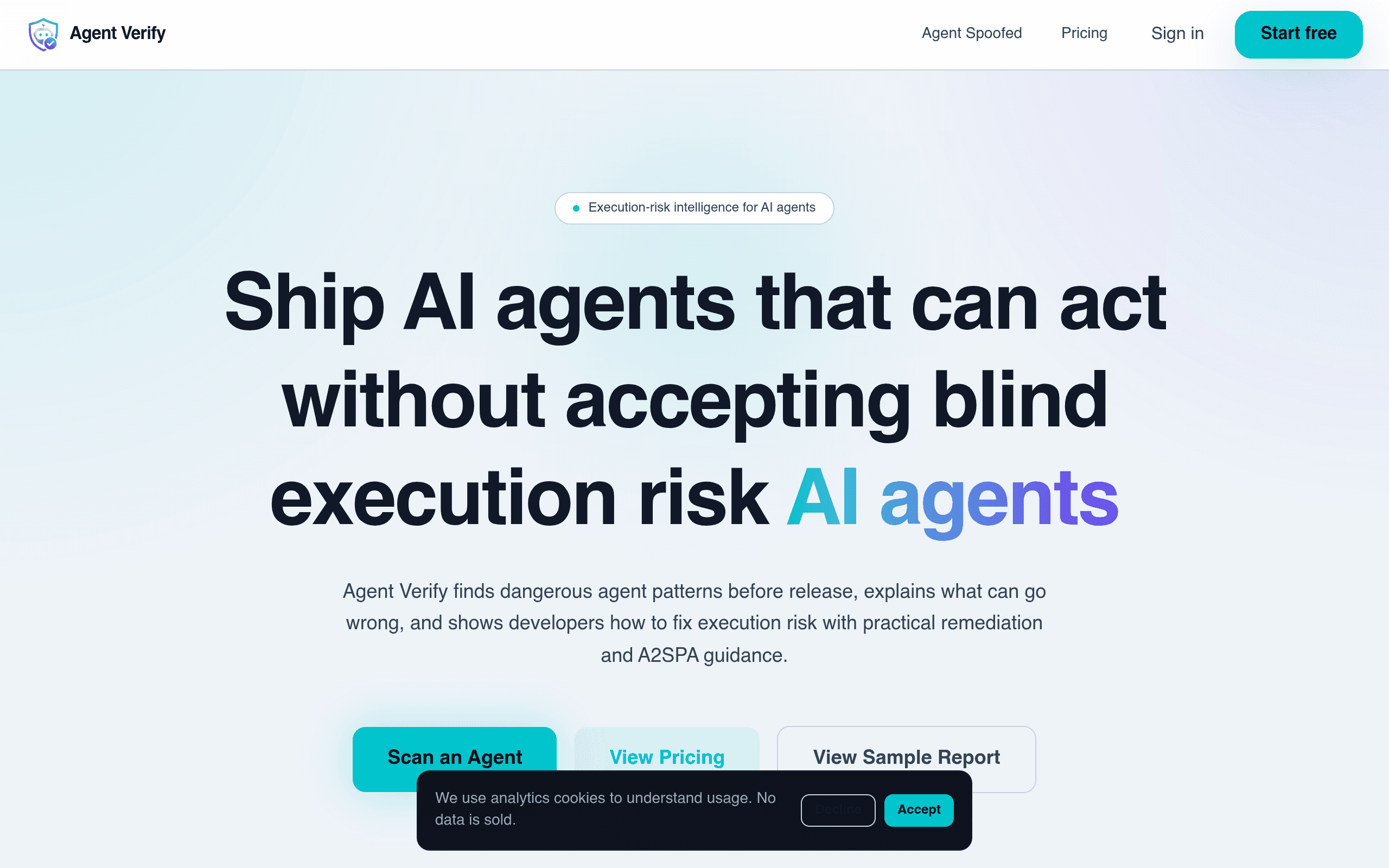
Agent Verify (from AI Modularity) is a purpose-built scanner for AI agent code and configuration — not general application code. It's designed to catch the failure modes that show up specifically when you wire an LLM up to tools, memory, and autonomous decision-making: prompt injection paths, tools that grant more access than the agent's task requires, unsafe chaining between tool calls, and privilege boundaries that get quietly erased when an agent is given "do whatever it takes" instructions.
Instead of just flagging code smells, it outputs a risk score per agent and maps findings back to the OWASP LLM Top 10 — so a finding isn't just "this is bad," it's tagged as, say, LLM01 (Prompt Injection), LLM06 (Sensitive Information Disclosure), or LLM08 (Excessive Agency), with remediation guidance attached. Reports can be kept private for internal review or shared publicly, which matters if you're trying to prove to a customer or auditor that your agent was actually checked before it shipped.
Who This Is For, Concretely
- A team shipping a LangChain or LlamaIndex customer-support agent that has access to a refund tool and a CRM lookup tool — Agent Verify checks whether the agent's instructions and tool permissions could let a crafted user message trigger the refund tool without proper gating.
- An internal platform team building an "agent factory" where multiple teams spin up agents from templates — running a scan as a pre-merge check catches privilege creep before an agent goes from read-only to read/write without anyone noticing.
- A vendor selling an AI agent to enterprise buyers who ask for a security review as part of procurement — a shareable public report gives you something concrete to hand over instead of a slide deck claim.
- A solo developer prototyping a multi-tool agent (browser access + code execution + file system) who wants a sanity check before connecting it to a real API key with real spend limits.
Pricing: What's Actually Published
As of launch, the only pricing detail on the homepage is the free tier:
| Tier | Price | What You Get |
|---|---|---|
| Free | $0 | 10 scans/month, basic findings |
| Paid tiers | Not listed publicly | Presumably deeper findings, higher scan volume, team/org features — not disclosed on the site as of this writing |
That's worth flagging plainly: there's no visible pricing page breaking out a Pro or Team tier, no per-seat cost, and no enterprise contact-sales details on the homepage. If you're evaluating this for anything beyond a personal project, budget time to actually talk to them before assuming a number. Ten scans a month is enough to trial it against a couple of real agents, but not enough to run as a CI gate on an active repo.
How It Compares
Agent Verify isn't really a swap-in replacement for the tools most security teams already run — it's a different layer. Snyk and SonarQube scan your codebase and dependencies broadly; OWASP ZAP tests running web applications for vulnerabilities via traffic interception. None of them were built to reason about agent-specific risks like tool-use chains or prompt injection surfaces. That's the gap Agent Verify is aiming at.
| Agent Verify | Snyk | SonarQube | OWASP ZAP | |
|---|---|---|---|---|
| Primary target | AI agent code & config (prompt injection, tool misuse, privilege) | Dependencies, containers, IaC, some SAST | Code quality & general SAST | Running web app traffic (DAST) |
| Framework mapping | OWASP LLM Top 10 | CWE, CVE databases | OWASP Top 10 (web), CWE | OWASP Top 10 (web) |
| Free tier | 10 scans/month, basic findings | Free tier for individual devs, limited scans | Community Edition (self-hosted, free, unlimited) | Fully free, open source |
| Report sharing | Private or public shareable reports | Dashboard-based, org-internal | Dashboard-based, org-internal | Manual export (HTML/XML/JSON) |
| Best for | Teams shipping LLM agents with tool access | Dependency/container vulnerability management | Ongoing code quality & maintainability | Pen-testing live web apps |
| Pricing transparency | Free tier only; paid tiers undisclosed | Public tiered pricing (Free/Team/Enterprise) | Free (Community) + paid Developer/Enterprise editions | Free, always |
The honest takeaway: if you already run Snyk for dependency scanning and SonarQube for code quality, Agent Verify isn't redundant — it's covering a blind spot neither of them addresses. If you're doing web app pen-testing with ZAP, that's still a separate concern from agent-specific logic flaws. Where Agent Verify will earn or lose trust is in finding-quality and false-positive rate on real multi-tool agents, which is hard to judge without running it against your own codebase.
Should You Try It Today?
Yes, if you're currently deploying any agent with tool access and haven't had a security review of the agent's permission boundaries — the free tier costs nothing and 10 scans is enough to test-drive it against your actual agent code this week. Go in with the expectation that you're evaluating a genuinely new category of tool, not a mature product with years of false-positive tuning behind it, and that pricing beyond the free tier isn't public yet, so don't plan a team rollout budget around it until you've talked to them directly.