Ai Acta Est: A First Look at WordPress's New AI Disclosure Badge Plugin
Some links in this guide are affiliate links. If you sign up through them, Day Zero Guides may earn a commission at no extra cost to you. This never affects which products we cover or what we say about them. See our affiliate disclosure for details.
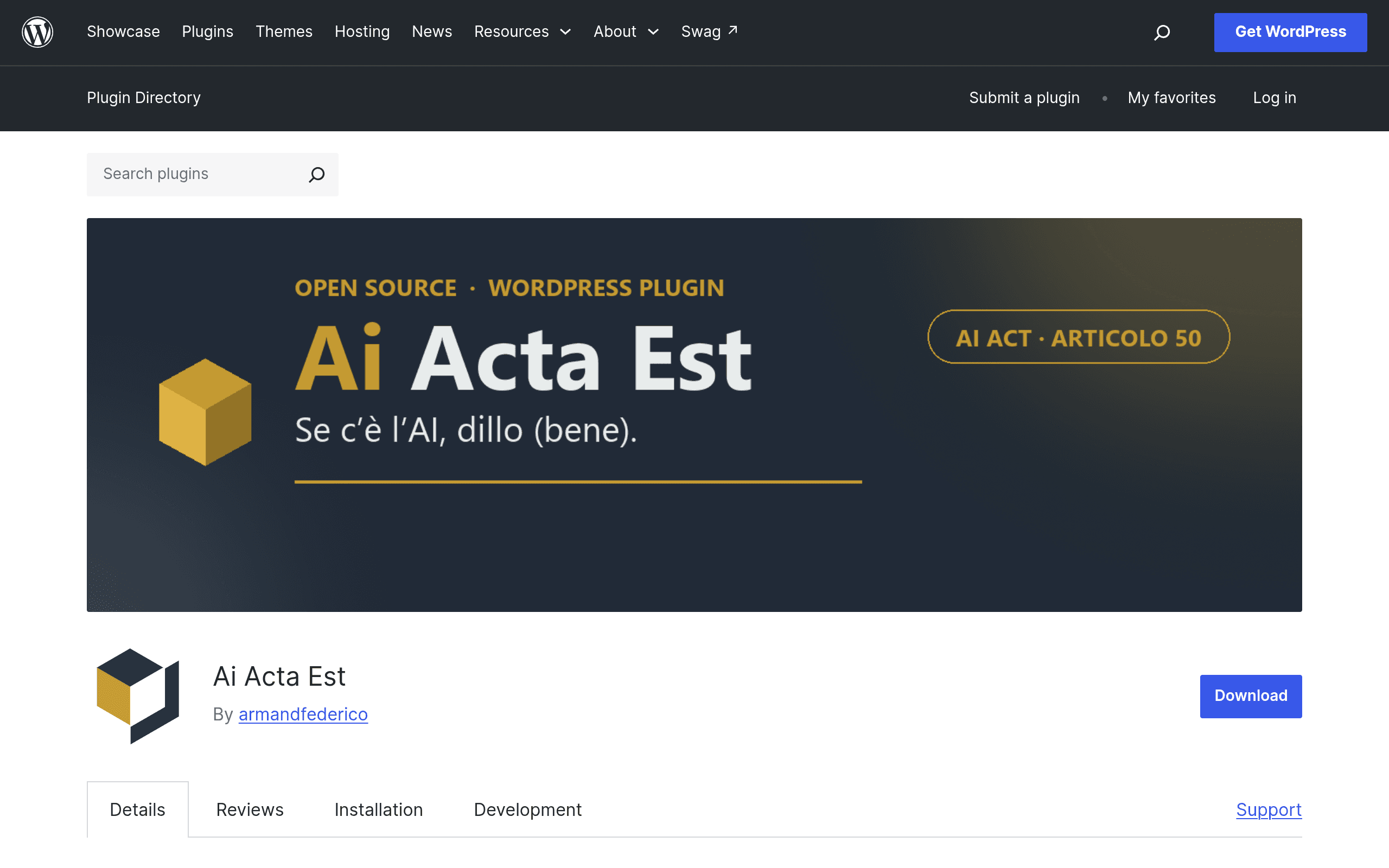
What Ai Acta Est Actually Does
Ai Acta Est is a WordPress plugin built around a simple premise: readers increasingly want to know whether a human, an AI, or some combination wrote what they're reading, and right now most sites have no standardized way to say so. The plugin lets you tag individual posts or pages with one of three declared states — Not Declared, AI-Assisted, or AI-Generated — and then surfaces that state as a visible badge on the front end, plus an aggregated transparency page that lists your disclosure policy site-wide.
It's not a detection tool. It doesn't scan your text and guess whether ChatGPT wrote it. It's a self-disclosure and labeling system — closer to a nutrition label than a lie detector. You (the publisher) tell the plugin what happened during content creation, and it handles the display, translation, and record-keeping.
The plugin explicitly disclaims that it provides any legal certification or regulatory compliance guarantee. If you're publishing in a jurisdiction with emerging AI disclosure laws (the EU AI Act's transparency provisions, for instance, or state-level rules in the US), Ai Acta Est gives you a mechanism to disclose — it does not certify that your disclosure satisfies any specific law. That distinction matters and the developers are upfront about it in the plugin description.
Setup and What You Get on the Free Tier
Installation is standard WordPress plugin territory: search it in Plugins > Add New, install, activate. Once active, it adds a meta box to the post/page editor where you set the declaration state per piece of content. From there:
- Badges: A visual indicator (customizable text/style) appears on the frontend for any post marked AI-Assisted or AI-Generated. Posts left as Not Declared show nothing, which functionally means silence is itself a declaration if you don't actively use the plugin.
- Transparency page: An auto-generated page aggregates your site's disclosure policy and can list which content falls into which category, giving readers a single place to understand your AI usage practices.
- Multi-language support: Badge text and transparency page copy can be localized, which matters if you run a multilingual publication and don't want to hand-translate disclosure language yourselves.
A Pro add-on is referenced in the plugin's materials, but as of this writing there's no published pricing page, tier breakdown, or feature comparison chart available — WordPress.org's listing and the plugin's own site don't spell out what Pro unlocks or what it costs. That's a real gap if you're trying to budget before installing. In practice this means: install the free version today, evaluate whether per-post declaration and a transparency page meet your needs, and treat Pro as a future maybe rather than a factor in your decision right now.
Concrete Use Cases
- A news blog running AI-assisted headline generation: Editorial staff write the body copy but use an LLM to draft headline variants for A/B testing. Marking these posts AI-Assisted (rather than AI-Generated) lets you be honest without overstating AI's role.
- A content marketing site publishing AI-drafted, human-edited articles: If your workflow is "AI generates a first draft, an editor rewrites 60%," AI-Assisted is the more defensible label than AI-Generated, and having a documented state per post protects you if a reader or client asks how a piece was made.
- An affiliate or SEO content farm cleaning up its practices: Sites that have published a mix of fully AI-generated and human-written content over the past two years can use the bulk-tagging capability to retroactively label back-catalog content rather than leaving everything undeclared.
- A publication responding to platform or advertiser pressure: Some ad networks and syndication partners are starting to ask publishers about AI content ratios. A visible transparency page gives you something concrete to point to rather than an email explaining your policy from scratch each time.
Where It's Thin
The three-state model (Not Declared / AI-Assisted / AI-Generated) is coarse. It doesn't let you disclose which AI tool was used, what percentage of the piece was AI-authored, or whether AI was used for research versus drafting versus editing — distinctions that more sophisticated disclosure frameworks (like C2PA Content Credentials) are built to capture through embedded metadata rather than a front-end label. If your audience or legal team wants granular provenance data, this plugin's badge-and-page approach won't get you there alone.
How It Compares
| Ai Acta Est | Generative AI Disclosure (plugin category) | Content Origin Declaration tools | Manual/custom disclosure (a footer note or custom field) | |
|---|---|---|---|---|
| Price | Free, with an unpriced Pro add-on | Typically free with donation-based or freemium models | Varies; often bundled into broader content-governance suites, sometimes paid-only | Free (your dev time only) |
| Granularity | 3 fixed states (Not Declared / AI-Assisted / AI-Generated) | Usually similar tiered labeling, occasionally binary (AI or not) | Often more detailed metadata (tool used, % contribution) aimed at provenance tracking | Fully custom — as detailed or vague as you write it |
| Legal/compliance claims | Explicitly disclaims certification or legal guarantee | Varies by plugin; most make similar disclaimers | Some position closer to compliance-readiness for emerging AI regulations | None — you own all liability and wording |
| Multi-language support | Built in | Inconsistent across plugins in this category | Sometimes, depends on vendor | Only what you build |
| Best for | Publishers wanting a fast, no-cost, visible disclosure badge without building anything custom | Sites wanting a lightweight, similarly simple labeling approach | Organizations needing detailed provenance/audit trails, possibly for compliance prep | Developers who want full control over wording and placement without plugin overhead |
Should You Install It Today
If you're a small-to-mid-size WordPress publisher who wants to start disclosing AI involvement in your content without hiring a developer or waiting on a compliance framework to mature, Ai Acta Est is a reasonable, zero-cost way to start today. The three-state model is simple enough to actually get used, which matters more than a sophisticated system nobody maintains.
If you need audit-grade provenance tracking, embedded content credentials, or anything resembling a legal compliance guarantee, treat this as a labeling layer on top of whatever real documentation and legal review your situation requires — not a substitute for it. And budget some patience around the Pro tier: until pricing is published, there's no way to know if it's worth waiting for.