GenomeNarrator First Look: A $12.99 Browser-Based DNA Risk Analyzer That Never Uploads Your Genome
Some links in this guide are affiliate links. If you sign up through them, Day Zero Guides may earn a commission at no extra cost to you. This never affects which products we cover or what we say about them. See our affiliate disclosure for details.
What GenomeNarrator Actually Does
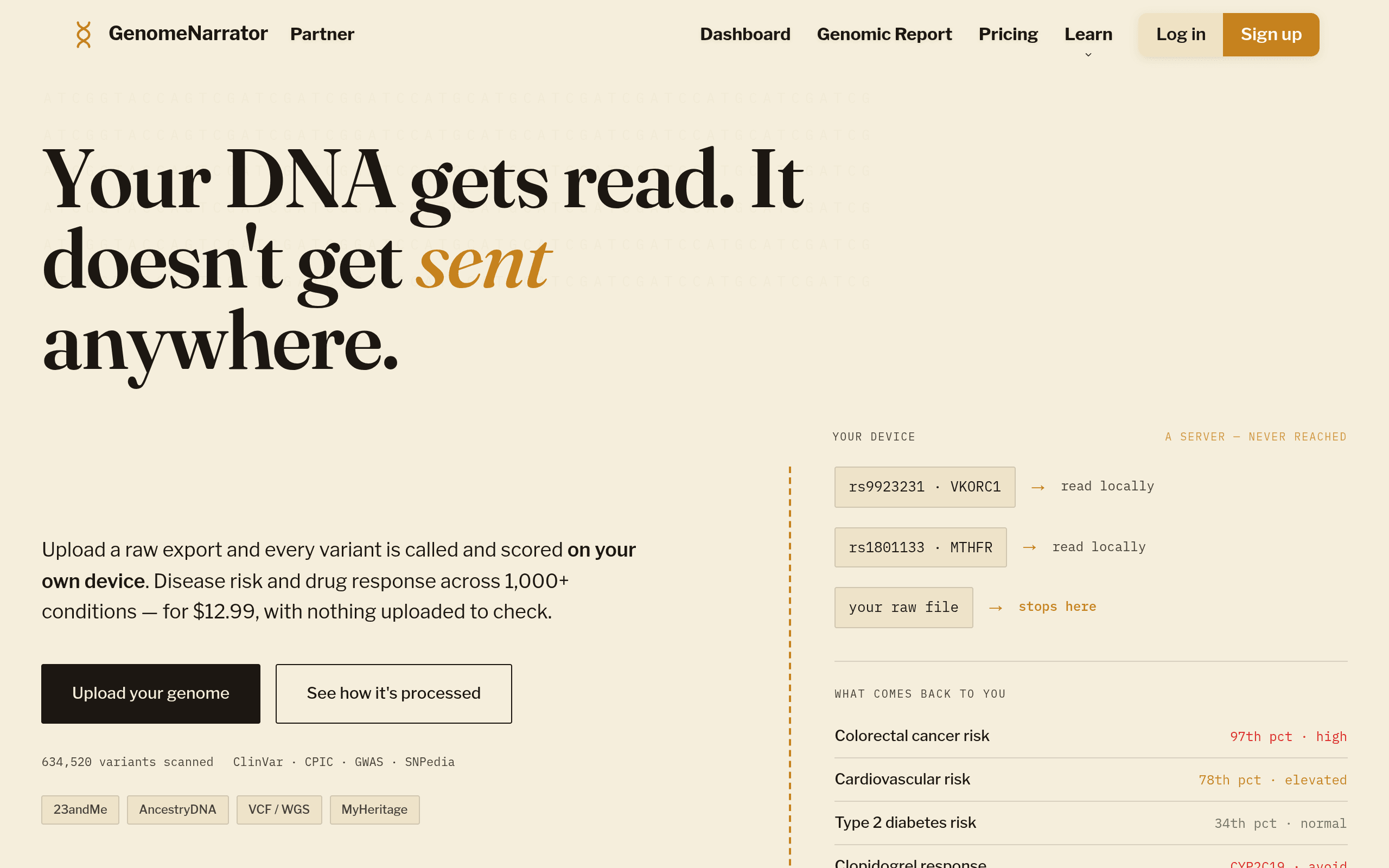
GenomeNarrator isn't a DNA testing kit — you don't spit in a tube. It's a web tool that takes a raw data file you already own (exported from 23andMe, AncestryDNA, MyHeritage, or a whole-genome sequencing provider like Nebula Genomics) and runs it through a local analysis engine directly in your browser using WebAssembly. The company's core pitch: your genome never touches a server. No upload, no cloud processing, no third-party data broker relationship — the raw file is parsed and scored client-side, and only aggregate results (not raw genotype data) ever leave your machine, if at all.
The engine cross-references your SNPs against four established clinical and research databases:
- ClinVar for pathogenic/likely pathogenic variant classifications
- GWAS Catalog for polygenic disease-risk associations
- CPIC (Clinical Pharmacogenomics Implementation Consortium) for drug-metabolism and dosing guidance
- SNPedia for broader trait and wellness-adjacent variants
GenomeNarrator says it scores risk and pharmacogenomic response across 1,000+ conditions, and it refreshes its reference databases monthly, so a report you generate today should reflect newer ClinVar reclassifications than one generated six months ago — assuming you rerun the analysis.
Pricing: $12.99, One Time, Per Analysis
There's no subscription. You pay $12.99 per analysis, and that unlocks lifetime access to the report, including the monthly database updates going forward. In practice this means:
- Upload your raw DNA file once, pay once, get a report.
- You can apparently return to your existing report as underlying databases get updated, without paying again — though it's worth confirming during checkout whether "monthly updates" means the report auto-refreshes or you need to re-run the file manually.
- If you want to analyze a second person's raw file (a parent's, a partner's), that's a separate $12.99 analysis.
Compared to a $99–$199 DNA test kit, this is a low-stakes way to get clinical-style variant screening on data you already paid to generate once.
Who This Is Actually For
People who already tested with 23andMe or AncestryDNA years ago and want a second opinion. If you did a 23andMe Ancestry+Traits kit (their cheaper tier that doesn't include health reports) and just want disease-risk scoring without paying for their $229 Health+Ancestry upgrade, exporting your raw data into GenomeNarrator for $12.99 is dramatically cheaper.
Pharmacogenomics-curious users. If you're on or considering medications with known CPIC guidelines — SSRIs, clopidogrel, statins, warfarin-class anticoagulants — GenomeNarrator's CPIC-referenced scoring could surface metabolizer status (poor/intermediate/rapid/ultrarapid) that your consumer DNA kit never reported in the first place. This is arguably the strongest, most actionable use case here, though any dosing decision still needs a doctor or pharmacist to interpret it.
Privacy-sensitive users who refuse cloud-based genetic analysis. If your objection to 23andMe was ever "I don't want my genome sitting on a corporate server" (a reasonable concern after 23andMe's 2023 data breach affecting 6.9 million users), local browser-based processing genuinely changes the risk calculus — there's no server-side database of your genotype to be breached in the first place.
Who it's not for: anyone without an existing raw DNA file. GenomeNarrator doesn't sequence anything; you need a prior test to feed it. It's also not an ancestry or relative-matching tool — there's no DNA relative database, ethnicity breakdown, or family tree building here.
Comparison: GenomeNarrator vs. 23andMe, AncestryDNA, MyHeritage DNA
| GenomeNarrator | 23andMe | AncestryDNA | MyHeritage DNA | |
|---|---|---|---|---|
| Price | $12.99 per analysis (one-time, lifetime report access) | $119 (Ancestry) to $229 (Health+Ancestry), plus optional $69/yr membership | $99–$119 for kit; health add-on discontinued in most regions | $79 kit; health insights require added subscription |
| Requires a physical test kit | No — works from raw data you already have | Yes | Yes | Yes |
| Where your genome is processed | Locally, in your browser | Uploaded to 23andMe servers | Uploaded to Ancestry servers | Uploaded to MyHeritage servers |
| Disease risk / pharmacogenomics | 1,000+ conditions via ClinVar, GWAS, CPIC, SNPedia | Limited to their own curated health reports (~40+ conditions) | None (ancestry-focused) | Minimal; mostly ancestry and DNA matches |
| Ancestry / ethnicity estimate | Not offered | Yes, core feature | Yes, core feature | Yes, core feature |
| DNA relative matching | Not offered | Yes | Yes, large user database | Yes |
| Update cadence | Monthly database refresh (ClinVar/GWAS/CPIC) | Occasional report updates, no fixed schedule | N/A | N/A |
| Best for | Cheap, private, clinically-referenced risk/drug-response scoring on existing data | All-in-one ancestry + basic health from a single kit | Ancestry research and family tree building | Ancestry research with European-heavy user base |
The Real Tradeoffs
GenomeNarrator is not a replacement for 23andMe or AncestryDNA — it's a companion tool that only works if you already have raw autosomal DNA data sitting in a .txt or .csv export. It also isn't a diagnostic device; like every consumer genomics product referencing ClinVar and GWAS, it's giving you probabilistic risk information, not a diagnosis, and CPIC-based drug metabolizer results should be confirmed with an actual clinical pharmacogenomic test before anyone changes a prescription based on it.
The honest pitch is narrower than "decode your genome": it's a $12.99, privacy-preserving way to re-run data you already paid for through better, more clinically current disease-risk and drug-response scoring than the consumer kit you originally bought probably gave you. For that specific job, it's hard to find a cheaper or more private alternative on the market right now.