AbilityMic: First Look at the New Cross-Platform AAC App With 3,400+ Offline Symbols
By Day Zero Guides Editorial · How we produce guides
Some links in this guide are affiliate links. If you sign up through them, Day Zero Guides may earn a commission at no extra cost to you. This never affects which products we cover or what we say about them. See our affiliate disclosure for details.
What AbilityMic Actually Is
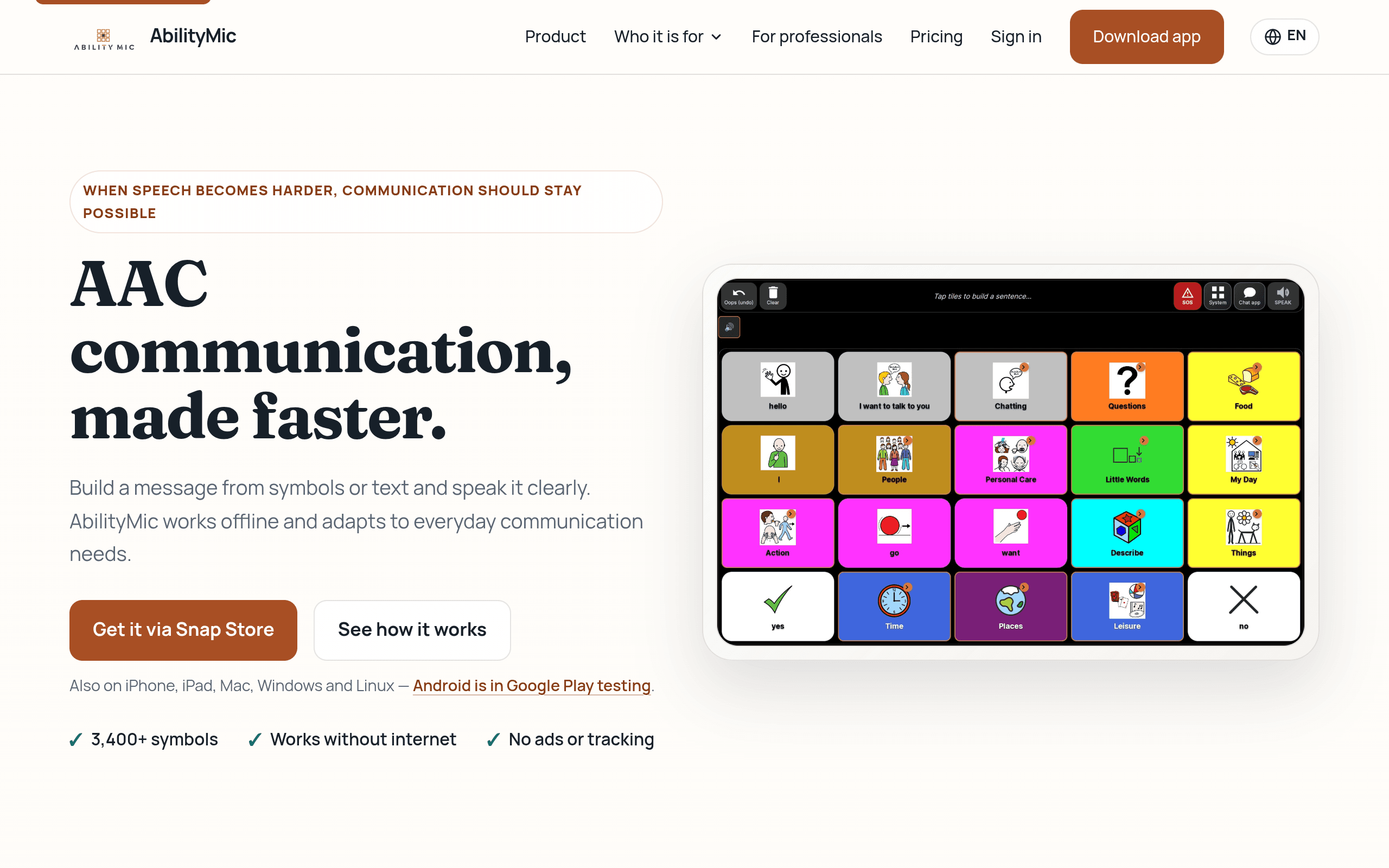
AbilityMic is a newly launched augmentative and alternative communication (AAC) app aimed at people with speech difficulties — including individuals with apraxia, autism, ALS, aphasia after stroke, and other conditions that affect verbal communication. Its pitch is straightforward: a large offline symbol library, text-to-speech output, customizable communication boards, and management tools built for therapists and caregivers who oversee multiple users.
What sets it apart on paper from a lot of AAC apps is platform reach. Instead of locking users into one ecosystem, AbilityMic runs on iOS, Android, Mac, Windows, and Linux, so a kid using an iPad at school and a Windows laptop at home (or a Chromebook-adjacent Linux machine at a clinic) can theoretically use the same boards and vocabulary set across devices.
Core Features Worth Knowing About
- 3,400+ offline symbols — the library works without an internet connection, which matters for classrooms, cars, and anywhere Wi-Fi isn't guaranteed.
- Text-to-speech (TTS) for constructing spoken sentences from symbols or typed text.
- Customizable boards — caregivers and therapists can build or edit vocabulary sets per user rather than relying only on preset boards.
- Therapist/caregiver management tools — a layer for SLPs or family members to configure boards, track usage, and adjust vocabulary as a user's needs change.
- 16 languages supported, which is notable for multilingual households or clinics serving diverse populations — most AAC apps top out at a handful of languages.
- True cross-platform support — Mac, Windows, and Linux desktop support is rare in this category, where most competitors are iOS- or Android-first.
What's Missing From the Picture: Pricing
As of this writing, AbilityMic has not published pricing on its site. There's no visible tier breakdown, no trial terms, and no indication of whether it's a one-time purchase, subscription, or institutional licensing model (common in AAC software sold to schools and clinics). If you're evaluating this for a client, student, or family member today, budget for an extra step: contacting AbilityMic directly to get a quote or trial access before you commit to switching a user's entire communication system over to it.
This matters more in AAC than in most software categories — switching a user's primary communication tool has a real cost in retraining time, and price uncertainty makes it harder to plan for at a school district or clinic budget level.
Concrete Use Cases
- A speech-language pathologist managing 15 pediatric clients who need different vocabulary sets per child, wants one dashboard to build and adjust boards instead of managing separate devices per kid.
- A stroke survivor with aphasia who needs a simple, fast symbol-to-speech setup on an iPad at home and a Windows desktop at a rehab clinic, without re-learning a different app on each device.
- A nonverbal autistic child in a bilingual household where boards need to switch between, say, Spanish and English vocabulary depending on which parent is present.
- A person with ALS with progressively limited hand mobility who needs a system that can eventually pair with alternate access methods and doesn't require constant internet connectivity for core vocabulary.
- A school district piloting AAC tools across a mix of Chromebooks, iPads, and Windows machines where a single cross-platform license (if AbilityMic offers one) would simplify IT support versus juggling multiple platform-specific apps.
How It Compares
| AbilityMic | Proloquo4Text | JABtalk | Predictable | |
|---|---|---|---|---|
| Price | Not published — contact vendor | ~$79.99 one-time (iOS App Store) | Free core app with paid upgrade options (varies by platform) | ~$179.99 one-time (iOS App Store), among the pricier AAC apps |
| Platforms | iOS, Android, Mac, Windows, Linux | iOS/iPadOS only | iOS and Android | iOS only (historically) |
| Symbol/vocabulary approach | 3,400+ offline symbols, board-based | Text-based with word prediction, not symbol-grid focused | Grid-based symbol boards | Predictive text engine layered with word/phrase suggestions, less symbol-heavy |
| Language support | 16 languages | Primarily English | Limited, varies by region | English-focused, some regional variants |
| Therapist/caregiver management | Built-in management tools for multi-user oversight | Manual board editing, no dedicated multi-client dashboard | Basic customization, limited clinical management layer | Editable vocabulary, but not built around multi-client caseloads |
| Best for | Multi-device households/clinics needing offline symbols + one system across platforms | Literate AAC users who prefer typing and word prediction over symbol grids | Budget-conscious individual users wanting a simple grid-based app | Users who rely heavily on predictive text over symbol boards |
The Honest Verdict
AbilityMic's platform coverage and offline symbol count are genuinely differentiated — most competitors pick a lane (iOS-only, or text-prediction-only, or budget-and-basic) and stay there. The multilingual support and therapist management layer suggest it's being built with clinics and multi-child caseloads in mind, not just individual home use.
But the missing pricing is a real gap for anyone trying to make a decision today. AAC is not an app category where you casually try five options — switching costs are high for the end user, and clinics need to budget in advance. If you're a therapist, caregiver, or SLP evaluating this now, the realistic next step is to request a demo or trial directly from AbilityMic before assuming it fits your budget, and to compare it hands-on against whichever of Proloquo4Text, JABtalk, or Predictable your client is already partially trained on — since retraining cost is often the deciding factor, not feature lists.