Alkademy Press: A First Look at the New All-in-One Journal Management Platform
By Day Zero Guides Editorial · How we produce guides
Some links in this guide are affiliate links. If you sign up through them, Day Zero Guides may earn a commission at no extra cost to you. This never affects which products we cover or what we say about them. See our affiliate disclosure for details.
The scenario that makes this click
Picture a managing editor at a small university-affiliated journal — say, a regional law review or a niche open-access biology journal — who currently runs everything through a shared inbox and a spreadsheet. Submissions come in as email attachments, reviewer assignments get tracked in a color-coded Google Sheet, decision letters are copy-pasted from a template doc, and the journal's website is a static WordPress page someone's grad student set up three years ago and nobody wants to touch. Every issue, something falls through the cracks: a reviewer never responds and nobody notices for six weeks, or a manuscript gets sent out for review twice because two editors didn't sync up.
This is exactly the editor Alkademy Press is built for. You sign up, create one journal, and within an afternoon you have a submission portal, a reviewer pool with assignment tracking, a decision workflow (revise/accept/reject with templated letters), and a public-facing journal page — all living in one dashboard instead of five disconnected tools. The AI screening step runs on incoming manuscripts before they ever reach a human editor, flagging obvious issues (missing sections, out-of-scope topics, formatting that doesn't match journal guidelines, likely plagiarism overlap) so the editor isn't the first line of defense on every single submission. For a journal doing 10-30 submissions a month with a volunteer editorial board, that triage alone can save hours a week.
What Alkademy Press actually is
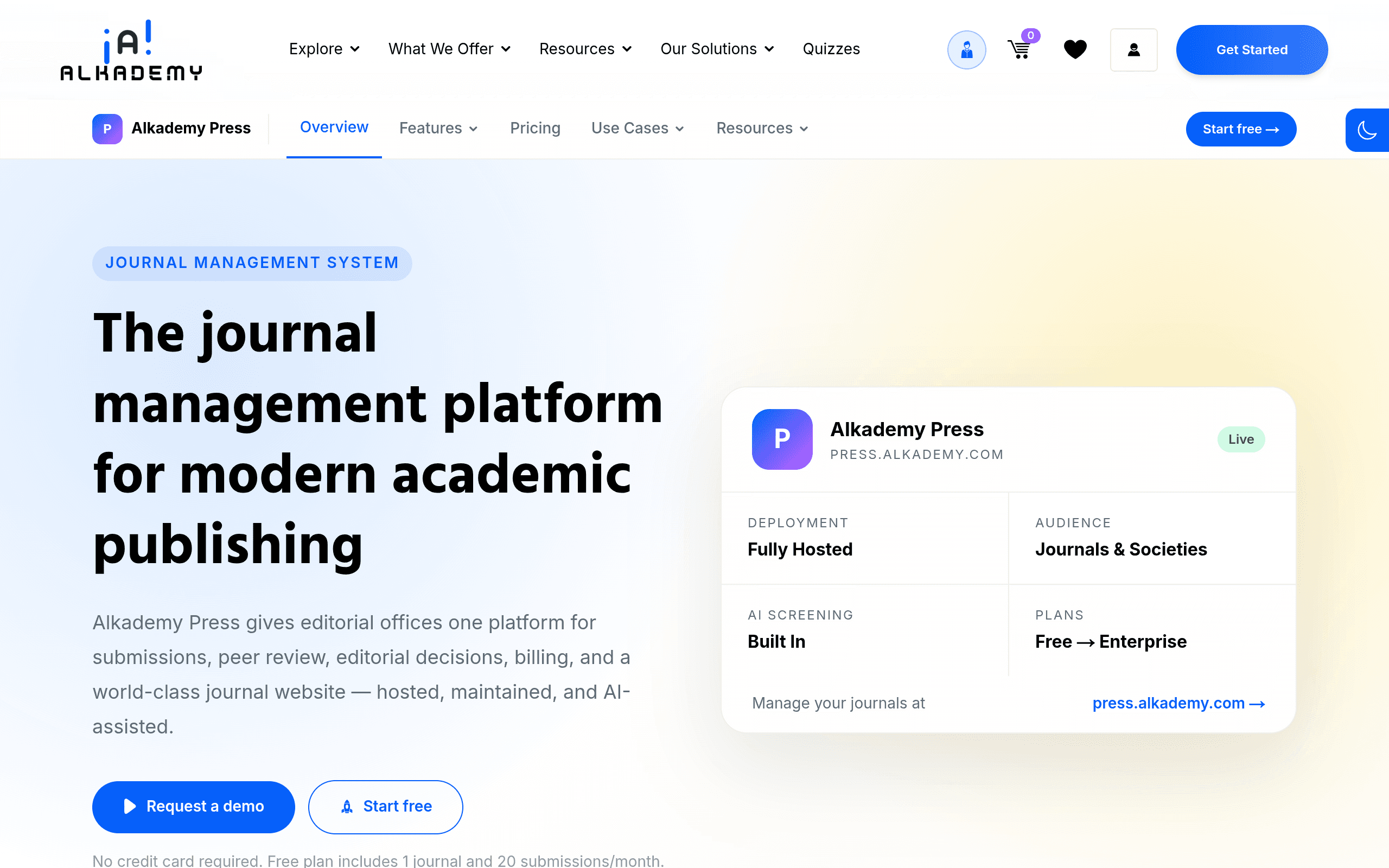
Alkademy Press is a hosted (SaaS) journal management platform that bundles four things that are traditionally separate: submission intake, peer review coordination, editorial decision tracking, and journal website publishing, with billing and subscriber management layered on top for journals that charge APCs or run subscriptions. It's explicitly positioned as a modern, maintained alternative to running your own instance of Open Journal Systems (OJS) or cobbling together a workflow out of email and shared documents. The headline differentiator is AI-assisted manuscript screening baked into the intake step, rather than bolted on as a separate plagiarism-checker integration.
Because it's hosted, there's no server to patch, no PHP version to worry about, and no plugin ecosystem to manage — which is the single biggest practical difference from OJS for a small editorial team without dedicated IT support.
Pricing, as it stands today
Alkademy Press uses a four-tier model, and as of launch the paid tiers are quote-based rather than published flat rates:
- Free — £0/month. 1 journal, 100 submissions/month... actually capped at 20 submissions/month, 5 AI screenings/month. This is enough to run a genuinely small or early-stage journal, or to pilot the platform on one issue before committing.
- Starter — Contact for pricing. 3 journals, 100 submissions/month. Aimed at a small press or department running a couple of related journals.
- Pro — Contact for pricing. 10 journals, 500 submissions/month. This is the tier most university presses or society publishers with a portfolio of titles would land on.
- Enterprise — Custom pricing. Unlimited scale, presumably with SSO, custom contracts, and dedicated support, aimed at large publishers or consortia.
The lack of published pricing above the free tier is worth flagging directly: you cannot currently budget for Starter or Pro without booking a sales call, which is a meaningful difference from Scholastica, which lists its pricing openly. If you're evaluating this today, start on the Free plan to test the actual workflow before you get into a sales conversation — it's generous enough (20 submissions/month) to run a real pilot issue.
How it stacks up against the alternatives
| Alkademy Press | Open Journal Systems (OJS) | Scholastica | EditFlow | |
|---|---|---|---|---|
| Price | Free tier available; Starter/Pro quote-based; Enterprise custom | Free, open-source (self-hosted; hosting/dev costs extra) | Peer Review from ~$3,200/year per journal; Production and OA Publishing priced separately | WordPress plugin, free and open-source |
| Hosting | Fully hosted/managed by Alkademy | Self-hosted (you run the server or pay a third party like PKP | PS) | Fully hosted/managed by Scholastica |
| AI manuscript screening | Built in (5 free screenings/month, more on paid tiers) | None natively; requires third-party integration | None natively | None |
| Journal website included | Yes, built into every plan | Yes, via OJS's own templating (dated out of the box) | Yes, on Peer Review + Production plans | No — uses your existing WordPress site/theme |
| Best for | Small-to-mid journals wanting a modern all-in-one tool without server management | Publishers needing full customization/control and willing to maintain infrastructure | Established journals wanting a polished, support-backed hosted workflow | Academic teams already living in WordPress who just need editorial workflow, not a new system |
A few honest caveats from this comparison. OJS is free and has a 20-year head start — thousands of journals run on it, and if you need deep customization or have in-house technical staff, it still gives you more control than any hosted option. Scholastica has a transparent price (roughly $3,200/year for its Peer Review product as publicly listed) and a longer track record with established scholarly societies, which matters if your editorial board wants proof of stability before migrating. EditFlow is the right call only if your journal already lives inside WordPress and you don't want a full platform migration — it adds editorial workflow on top of what you have rather than replacing it.
What Alkademy Press is betting on is the gap between those three: journals that find OJS too heavy to self-host, find Scholastica's pricing opaque until you're already a lead, and have outgrown a WordPress-plus-plugin setup.
Concrete use cases worth trying it for
- A new open-access journal launching its first issue. Start on Free, run your call for papers and first round of submissions through the portal, and use the AI screening to catch incomplete submissions before your editorial board wastes review cycles on them.
- A university press consolidating 4-6 small journals currently run by different departments with different (or no) systems. The Pro tier's 10-journal, 500-submission ceiling covers this without needing Enterprise pricing.
- A society journal migrating off a self-hosted OJS instance because the IT person who maintained it left and nobody wants to touch the server. Moving to a hosted platform removes that single point of failure, though migrating existing submission history and reviewer records is a real project to scope out before committing.
- A journal that charges article processing charges (APCs) and wants billing handled in the same system as peer review, instead of reconciling a separate payment processor against editorial records by hand.
The practical verdict
If you're currently running a journal on email and spreadsheets, Alkademy Press's Free plan is a low-risk way to see whether a unified workflow actually changes your day-to-day — 20 submissions and 5 AI screenings a month is real usage, not a crippled demo. If you're already on OJS and reasonably happy with it, the case to switch has to come from wanting to offload server maintenance, not from feature parity alone, since OJS still does more out of the box. And if budget transparency matters before you'll even start a conversation, Scholastica's published pricing currently gives it an edge — Alkademy Press needs to publish Starter and Pro numbers to compete on that front rather than relying on a sales call.