Mozzy: First Look at the AI-Verified Secondhand Marketplace for Your Neighborhood
By Day Zero Guides Editorial · How we produce guides
Some links in this guide are affiliate links. If you sign up through them, Day Zero Guides may earn a commission at no extra cost to you. This never affects which products we cover or what we say about them. See our affiliate disclosure for details.
Pricing: What Mozzy Costs Today
Mozzy has not published a pricing page, fee schedule, or subscription tier as of this writing. The app is free to download, free to create listings, and free to message other users — there's no paywall gating the core buy/sell/browse functionality during this early period. There's also no visible "boost my listing" or "featured seller" upsell yet, which several competitors lean on heavily.
That means the actual value proposition right now isn't "pay X to get Y" — it's "use it free, but you're trading on a smaller, newer, more curated network in exchange for the AI verification layer." If you've been burned by a sketchy Facebook Marketplace meetup or ghosted by an OfferUp buyer, that trade-off is the entire pitch. There's nothing stopping Mozzy from introducing seller fees, promoted listings, or a premium verification tier later (most hyperlocal marketplace apps eventually monetize through local business ads, job postings, or transaction fees), but at launch there is zero cost to try it.
What Mozzy Actually Does
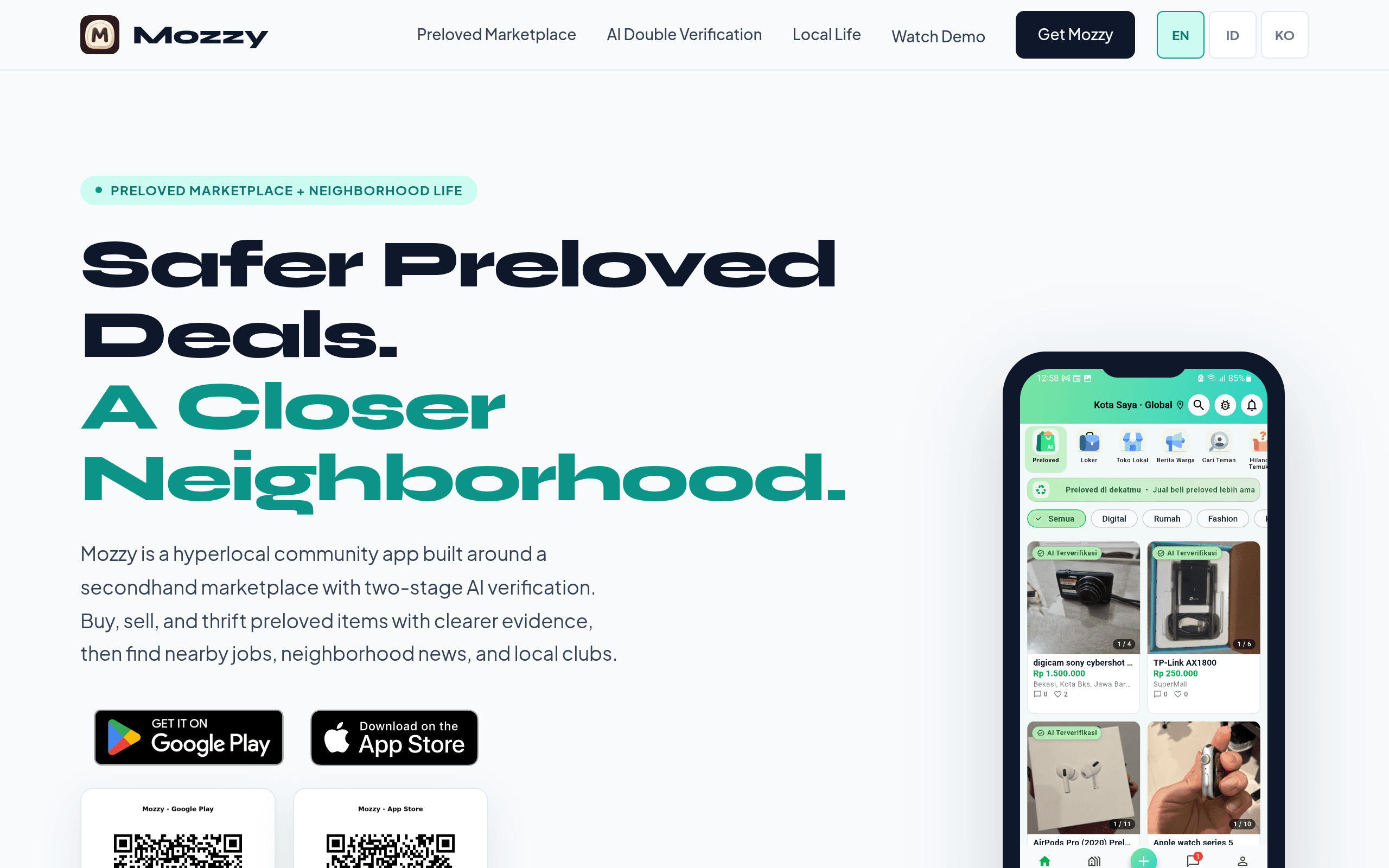
Mozzy is a hyperlocal app built around a secondhand marketplace, with neighborhood-level community tools wrapped around it. The marketplace is the anchor feature: you list used items — furniture, electronics, clothing, kids' gear — the way you would on any classifieds app, but Mozzy inserts AI checkpoints at two specific moments in the transaction instead of leaving verification entirely up to buyer and seller judgment.
The Two-Stage AI Verification, Explained
- Listing analysis. When a seller posts an item, Mozzy's AI reviews the listing — photos, description, pricing context — before it goes live or gets flagged to other users. The intent is to catch obvious mismatches (stock photos instead of the real item, descriptions that don't match images, pricing that signals a scam) before a buyer ever messages the seller.
- Handover comparison. At the point of the actual in-person exchange, the app compares the item being handed over against the original listing (again using image/AI comparison) to confirm the buyer is getting what was advertised. This is the more novel piece — most marketplace apps have zero mechanism for verifying the actual handoff, only the listing.
In practice, this means Mozzy is trying to close the gap that causes most secondhand-marketplace complaints: not fraud at the listing stage, but the "this isn't what I was shown" moment that happens in a parking lot after the buyer has already shown up.
Beyond the Marketplace: Neighborhood Features
Mozzy layers in several non-marketplace features aimed at building offline, geographic community ties rather than just transactions:
- Local jobs — a jobs feed scoped to your immediate area, positioned closer to gig/local hiring than LinkedIn-style job boards.
- News feeds — hyperlocal updates relevant to a neighborhood or small radius.
- Clubs — interest-based groups meant to connect neighbors around hobbies or shared activities.
- Community services — a directory/feed for local services (think: the stuff people usually ask about in a Nextdoor comment thread — recommendations for a plumber, a dog walker, a tutor).
The bet here is that a marketplace alone has a ceiling on engagement (you open it when you need something), while a bundled set of neighborhood tools gives people a reason to open the app daily, which in turn makes the marketplace more active.
Concrete Use Cases
- Selling a couch before a move, and wanting the buyer to actually get the couch pictured (not a bait-and-switch), with AI checking the handover against the listing photos.
- Buying kids' gear secondhand (car seats, strollers) where condition and authenticity actually matter for safety, and a listing-analysis pass adds a layer of scrutiny beyond "trust the stranger's photos."
- Finding a local part-time or gig job without scrolling a national job board full of remote listings that don't apply to your area.
- Getting a recommendation for a local service provider (electrician, cleaner) through the community-services feed instead of posting in a Facebook group and hoping for replies.
- Joining a hobby-based club in your immediate area as a lower-friction alternative to Meetup.com, bundled into an app you're already opening to check marketplace listings.
How Mozzy Compares
| Mozzy | Facebook Marketplace | OfferUp (incl. former Letgo) | Nextdoor | |
|---|---|---|---|---|
| Price | Free; no published fees or tiers at launch | Free to list; Facebook may charge for shipping/boosted listings | Free to list locally; paid "Promote" option (~$1.99–$19.99 per listing depending on category/duration) | Free; Nextdoor Ads and local business tools exist for businesses, not individual users |
| Fraud/scam protection | Two-stage AI verification (listing analysis + in-person handover comparison) | Basic Facebook account reporting, no item-level verification | Seller ratings, TruYou identity verification (optional), but no handover-matching | Verified neighborhood addresses for membership, but no marketplace-specific item verification |
| Core focus | Secondhand marketplace + hyperlocal community (jobs, news, clubs, services) | General marketplace layered on existing social graph | Dedicated buy/sell app, marketplace-only | Neighborhood social network; marketplace is a secondary feature |
| Geographic scope | Hyperlocal by design | City/regional, as wide as Facebook's location radius settings | City/regional | Strictly neighborhood-boundary-based |
| Non-marketplace features | Local jobs, news feed, clubs, community services | Groups, events (not localized to marketplace use) | None — marketplace only | Neighborhood news, recommendations, safety alerts, local business directory |
| Best for | Buyers/sellers who want built-in handover verification and don't mind a newer, smaller user base | Reach — largest existing user base for fast sales | Dedicated resale sellers who want app-specific tools and optional ID verification | Neighborhood information and recommendations more than transactions |
Who Should Try Mozzy Today
If you've had a bad secondhand-marketplace experience — an item that didn't match photos, a no-show buyer, general unease about meeting strangers for cash handoffs — Mozzy's handover-comparison step is the single feature worth testing it for. It's free, so there's no financial downside to trying it alongside Facebook Marketplace or OfferUp rather than instead of them.
The honest caveat: verification only works if there's enough listing volume and buyer density in your specific area, and as a new app, Mozzy's network effects aren't there yet in most markets. Expect thinner selection than Facebook Marketplace for at least the first several months. It's a reasonable app to open in addition to your existing marketplace habits right now, not necessarily a replacement yet.
Bottom Line
Mozzy isn't trying to out-scale Facebook Marketplace on raw inventory, and it isn't trying to be Nextdoor's neighborhood-news clone either. Its actual differentiator is narrow and concrete: AI verification at the moment of the physical handover, which no major competitor currently does. Combined with free pricing and zero listing fees at launch, there's little reason not to create an account and list a couple of items to see whether the verification flow holds up in your area — just don't delete your other marketplace apps yet.