AlgoDeploy: First Look at the Python Platform That Backtests and Deploys Straight to Alpaca
By Day Zero Guides Editorial · How we produce guides
Some links in this guide are affiliate links. If you sign up through them, Day Zero Guides may earn a commission at no extra cost to you. This never affects which products we cover or what we say about them. See our affiliate disclosure for details.
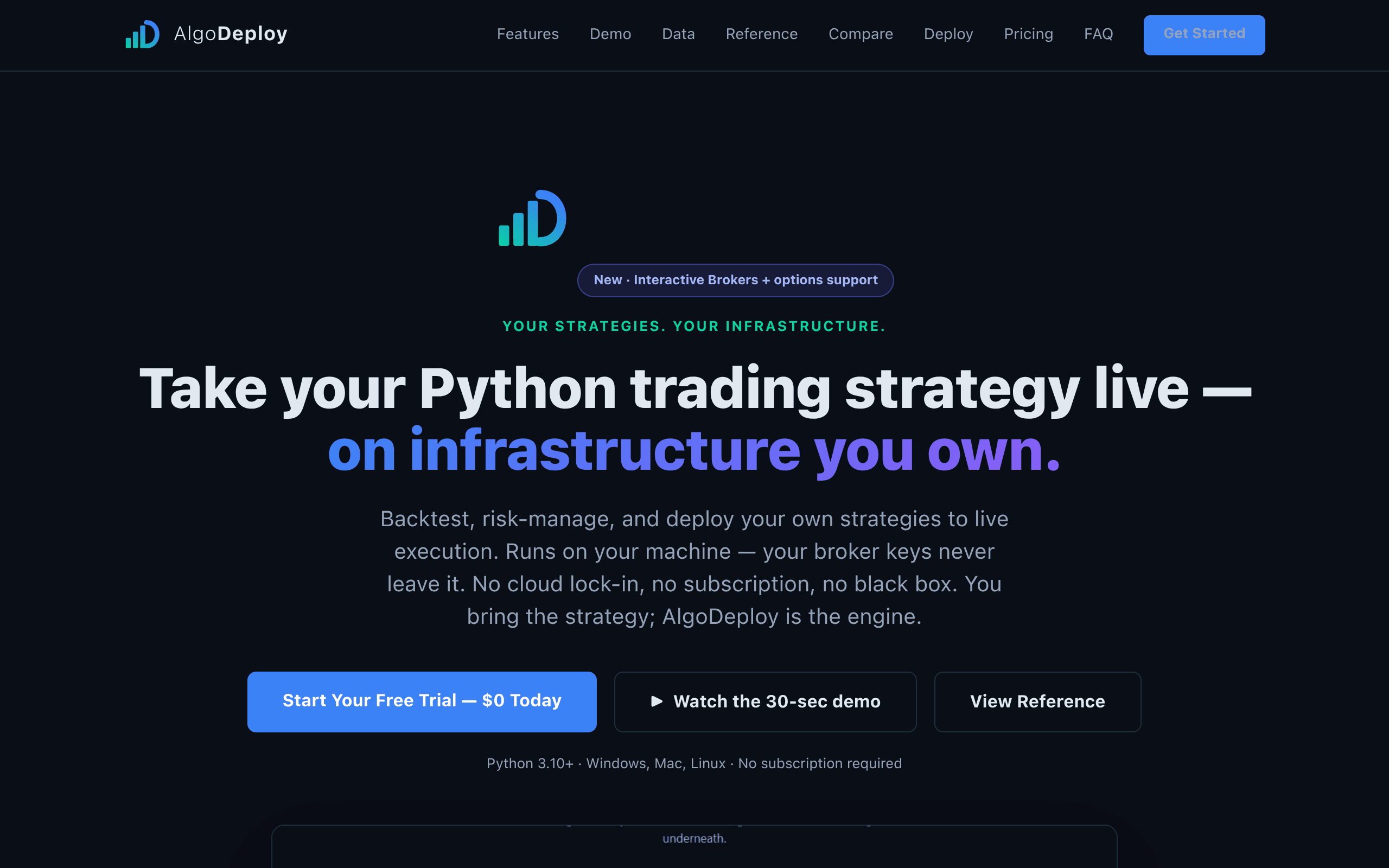
AlgoDeploy showed up with a pitch that's narrower than most backtesting tools: don't try to be everything, just make the path from "I wrote a strategy in Python" to "it's live on Alpaca" as short as possible. If you've ever backtested something in Backtrader or Zipline and then spent a weekend wiring up order execution, risk checks, and monitoring by hand, that's the exact gap AlgoDeploy is trying to close.
Concrete use cases
- A student building a mean-reversion equity strategy for a class project can use the free Student tier to backtest against historical data and paper-trade it on Alpaca without paying anything, as long as they've got a .edu address.
- A solo trader running a crypto momentum strategy who wants config-based rule changes (adjusting thresholds, position size caps) without touching code every time market conditions shift — the configuration-based mode is built for exactly this.
- Someone who already has a Backtrader strategy and is tired of manually wiring it to a broker: rewriting the logic in AlgoDeploy's code mode buys you the built-in Alpaca deployment, dashboard, and alerting for a one-time $99 rather than building that layer themselves.
- A part-time algo trader who wants to walk away from their desk and still get notified if a position breaches a risk threshold, thanks to the real-time alerting rather than needing to babysit a terminal.
What AlgoDeploy actually does
AlgoDeploy is a Python-based backtesting and live-trading platform built specifically around Alpaca Markets as the execution venue, covering both equities and crypto. Two things stand out from the first look:
- Dual strategy definition. You can write strategies as raw Python code (for people who want full control over indicators, entry/exit logic, and custom signals) or define them through a configuration-based system — think YAML/JSON-style rules — for people who want a repeatable strategy without maintaining a code file for every variant.
- Deployment is the product, not an afterthought. Backtest a strategy, then push the same logic live to your Alpaca paper or live account without rewriting it for a different execution engine. That's the part most DIY setups (Backtrader, raw Alpaca SDK) don't give you out of the box.
It also ships with built-in position sizing and risk management (stop-loss/exposure-type controls baked into the strategy layer rather than something you bolt on yourself), plus a real-time dashboard and alerting so you're not tailing log files to know if your bot is still breathing.
Pricing, as of this look
AlgoDeploy's pricing page lists three tiers, though not all of it renders cleanly:
| Tier | Price | Notes |
|---|---|---|
| Student | Free | Requires a valid .edu email address |
| Starter | $99 one-time | Lifetime license — no recurring subscription |
| Pro | Not fully disclosed | Pricing details were truncated on the site at time of writing; expect it to gate higher account limits, more concurrent strategies, or advanced monitoring — worth confirming directly before assuming what's included |
The one-time $99 Starter license is the headline here — it's a meaningfully different model from the monthly-subscription approach most cloud backtesting platforms use. If AlgoDeploy holds that pricing as it matures, it's a real differentiator. Just don't buy the Starter tier assuming it matches whatever Pro turns out to be — go check current Pro pricing on their site before you commit, since it wasn't fully visible during this review.
How it compares
| AlgoDeploy | QuantConnect | Backtrader | Alpaca SDK (raw) | |
|---|---|---|---|---|
| Price | Free (Student/.edu), $99 one-time (Starter), Pro TBD | Free community tier; paid cloud compute tiers roughly $8–$48/mo plus brokerage fees for live trading | Free, open source | Free, open source |
| Strategy definition | Python code or config-based rules | Python or C# in QuantConnect's LEAN engine | Python code only | Python code only — you build the strategy runner yourself |
| Live deployment | Built-in, direct to Alpaca (equities + crypto) | Built-in, supports multiple brokers (Interactive Brokers, Tradier, others) | Not built-in — you must integrate a broker API yourself | You are the deployment layer; Alpaca connectivity but no strategy framework |
| Risk management / position sizing | Built-in | Available but you configure it within LEAN | DIY — you write your own risk logic | None provided — fully manual |
| Monitoring/alerts | Dashboard + alerts included | Cloud dashboard on paid tiers | None — you'd pair it with your own logging/alerting stack | None — raw API calls only |
| Best for | Traders who want backtest-to-Alpaca-live without stitching pieces together | Traders who want broker flexibility and a mature, heavily-used backtesting engine | Developers who want full control and don't mind building the execution layer themselves | Developers who want to talk directly to Alpaca's API with zero framework overhead |
Where it's genuinely useful — and where to be careful
The honest pitch for AlgoDeploy is narrowness: it doesn't try to support ten brokers like QuantConnect, and it doesn't hand you a bare API like Alpaca's own SDK. If Alpaca is your execution venue and you don't need multi-broker flexibility, that narrowness is a feature — less integration work, less to configure wrong.
Where to be careful: this is a new product, so there's no long track record of live-trading reliability under real market stress (fast-moving crypto especially), and the Pro tier's actual limits weren't visible during this review. Before committing money beyond the $99 Starter tier, get the Pro pricing and feature list in writing, and run any strategy on Alpaca's paper account for a meaningful stretch before flipping it to live capital — the same rule that applies no matter which platform you use.
If you're deciding whether to try it today: the Student tier costs nothing if you qualify, and the Starter tier is a $99 one-time bet rather than a subscription commitment. That's a low-enough bar to justify running one real backtest and one paper-trade deployment before judging whether it earns a spot over Backtrader-plus-manual-wiring or QuantConnect's broader but heavier platform.