Apiarium: First Look at the Solo-Built Unified API Layer for GPT-4o, Claude, and Gemini
Some links in this guide are affiliate links. If you sign up through them, Day Zero Guides may earn a commission at no extra cost to you. This never affects which products we cover or what we say about them. See our affiliate disclosure for details.
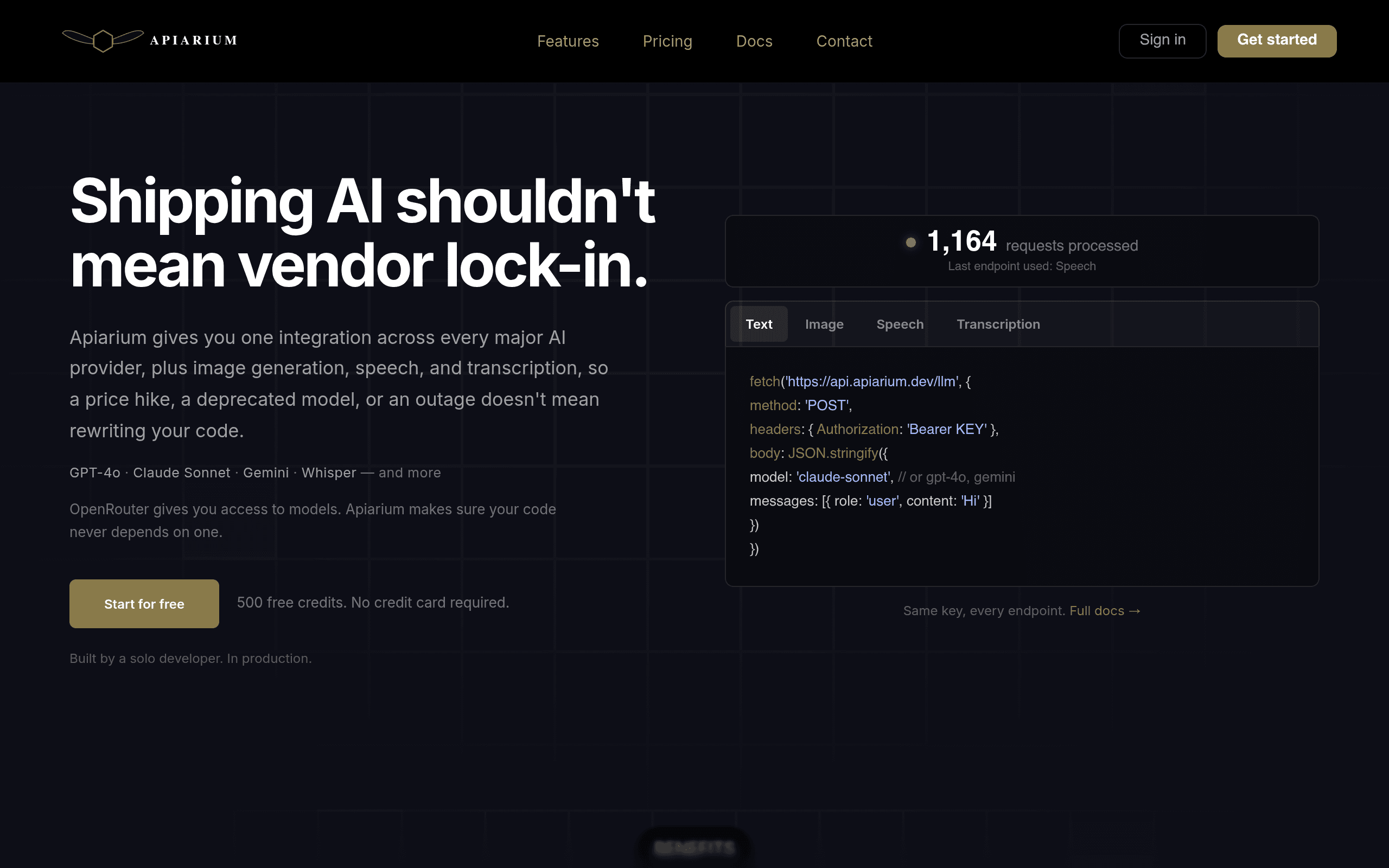
What Apiarium Actually Is
Apiarium is a routing and abstraction layer that sits between your application and the AI providers you actually want to use — OpenAI, Anthropic, Google, and a handful of others for text, image generation, speech synthesis, and transcription. Instead of holding four different SDKs, four different auth schemes, and four different rate-limit behaviors in your codebase, you send everything to one REST endpoint with one API key, and Apiarium handles the provider-specific translation on the back end.
It's built and maintained by a single developer, and it shows in the best way: the docs are terse and direct, the pricing page has no sales calls or "contact us" tiers, and the product does one job — normalize AI API calls — without trying to also be an observability platform, a prompt IDE, or an agent framework.
Who This Is Actually For
Apiarium makes sense in a few concrete situations:
- You're prototyping and don't want to commit to a provider yet. You can build against GPT-4o today and swap to Claude 3.5 Sonnet next week by changing a model string, not rewriting your request/response handling.
- You're shipping a product that mixes modalities. A single app that needs text generation, image generation, and transcription (say, a content tool that transcribes audio, summarizes it, and generates a cover image) can hit one endpoint instead of stitching together OpenAI Whisper, a separate image API, and a separate chat completion call.
- You've been burned by provider outages or rate limits. If GPT-4o has a rough day, having your integration already abstracted means a provider swap is a config change, not an engineering sprint.
- You're a solo dev or small team that doesn't want to manage multiple billing relationships. One invoice, one key, one dashboard.
Where it's a worse fit: teams already deep into enterprise infrastructure with existing AWS commitments, or teams that need fine-grained provider-specific features (like OpenAI's newest function-calling quirks) the day they ship, since abstraction layers by nature lag slightly behind bleeding-edge provider features.
Pricing, In Actual Numbers
Apiarium uses a credit-based model rather than per-token billing you have to calculate yourself:
| Plan | Price | Credits | Notes |
|---|---|---|---|
| Free | $0 | 500 one-time credits | No card required |
| Starter | $21/month | 10,000 credits/month | |
| Pro | $43/month | 30,000 credits/month |
Annual billing knocks 30% off both paid tiers, which puts Starter at roughly $14.70/month equivalent and Pro at roughly $30/month equivalent if paid yearly. Subscribers can also buy pay-as-you-go top-ups at a lower per-credit rate than the base tiers, which matters if you have a usage spike in one month but don't want to upgrade your plan permanently.
The free tier's 500 credits are enough to genuinely test the integration and a few model calls across text/image/speech before you hit a wall — it's not a fake trial, but it's also not enough to run anything in production.
What It's Actually Like to Integrate
The pitch is "one endpoint, one key," and in practice that's what you get: you authenticate once, then specify the model you want per request. Switching from a GPT-4o call to a Gemini call is a matter of changing the model identifier in the request body — you're not rewriting auth headers or restructuring your payload for a different SDK's conventions. For teams that have already built internal abstraction layers by hand to deal with multiple providers, this replaces homegrown glue code with a maintained third-party service, which is a real trade: less code to maintain, but a new dependency and a credit-based cost layered on top of the underlying provider costs.
How It Compares
| Apiarium | OpenRouter | AWS Bedrock | LiteLLM | |
|---|---|---|---|---|
| Pricing model | Flat monthly credits ($21–$43/mo) + pay-as-you-go top-ups, free tier with 500 one-time credits | Pay-per-token, no subscription, marked-up provider rates | Pay-per-token via AWS billing, no markup beyond AWS pricing, but requires AWS account setup | Free and open-source (self-hosted); LiteLLM's hosted proxy has its own usage-based pricing |
| Modalities supported | Text, image generation, speech, transcription | Primarily text/chat models, some multimodal | Text, image, embeddings — provider-dependent, strong AWS-native model catalog (Titan, Claude via Bedrock) | Text-focused primarily, wraps whatever providers you configure |
| Setup complexity | Single API key, minimal config, works immediately | Single API key, similarly quick | Requires AWS account, IAM roles, region setup — meaningfully heavier | Requires self-hosting or config management; more DevOps overhead unless using their hosted proxy |
| Best for | Solo devs/small teams wanting one key and predictable monthly cost across modalities | Developers who want raw model access with no subscription and broad model selection | Enterprises already inside AWS wanting compliance/security guarantees and AWS billing consolidation | Teams that want full control/self-hosting and are comfortable managing their own infrastructure |
| Maintainer | Solo developer | Company/team-backed | AWS (enterprise-scale) | Open-source community + commercial arm |
The honest distinction: OpenRouter is the closest direct competitor in spirit — both are provider-agnostic gateways — but OpenRouter skews text/chat-heavy and bills per-token with no flat-fee option, while Apiarium's flat credit tiers make monthly cost more predictable and its modality coverage (speech, transcription, image) is broader out of the box. Bedrock is the enterprise-grade option if you're already committed to AWS and need compliance guarantees, but it's overkill and slower to set up for a solo dev shipping an MVP. LiteLLM is the right call if you want to self-host and never pay a middleman markup, but then you own the infrastructure, updates, and uptime yourself — Apiarium's whole value proposition is that a solo developer already did that work for you.
The Solo-Maintainer Risk, Said Plainly
Because Apiarium is built and run by one person, it's worth naming the obvious risk: bus-factor of one. If you're building something mission-critical, ask yourself what happens to your integration if the service goes quiet for a few weeks. For prototypes, side projects, and small production apps, this is a reasonable risk given the pricing and simplicity. For a regulated enterprise workload, it's a reason to at least keep your provider-specific fallback code on hand rather than deleting it.
Should You Try It Today
If you're currently juggling two or more AI provider SDKs in the same codebase, or you're starting a new project and don't want to lock into one model provider before you've validated your product, Apiarium's free 500 credits cost you nothing to test against your actual use case. Send it a handful of text, image, and transcription requests, see how the credit consumption maps to your expected volume, and decide from there whether $21/month buys you enough integration simplicity to be worth it over rolling your own abstraction or using OpenRouter directly.