DirectDeals Review: Pricing, SDVOSB Certification, and How It Compares to CDW and SHI
By Day Zero Guides Editorial · How we produce guides
Some links in this guide are affiliate links. If you sign up through them, Day Zero Guides may earn a commission at no extra cost to you. This never affects which products we cover or what we say about them. See our affiliate disclosure for details.
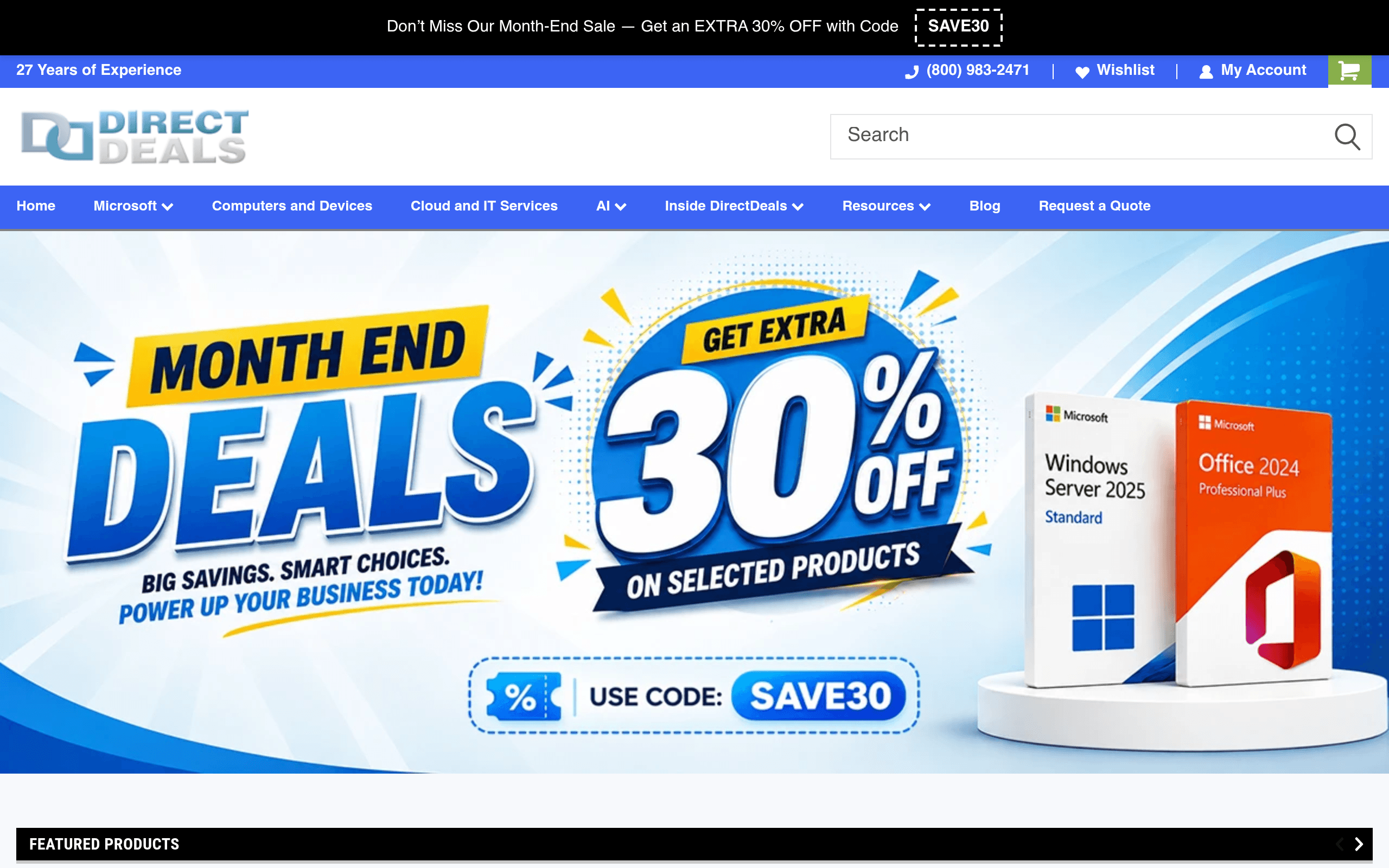
What DirectDeals Actually Is
DirectDeals is a US-based reseller of software licenses, computer hardware, components, and IT services, with a heavy emphasis on Microsoft licensing (Windows Server, Office, SQL Server, Windows OS keys) and security software. The company markets itself on longevity — it says it has been operating for 27 years — and on its Service-Disabled Veteran-Owned Small Business (SDVOSB) certification, which matters specifically for buyers who need to meet federal or state set-aside procurement requirements.
It's not a SaaS product, a subscription, or a platform you log into daily. It's a reseller/VAR (value-added reseller) — closer in function to a B2B electronics and software distributor than a tech tool. That framing matters for how you should evaluate it: the comparison isn't "is this software good," it's "is this a good vendor to buy licenses and hardware through."
Pricing: What You'll Actually Pay
DirectDeals does not publish a public price list or pricing tiers on its site for most of its catalog, which is standard practice in the VAR/reseller world but worth flagging clearly if you're comparing it to a SaaS product with transparent monthly tiers. Pricing works like this in practice:
- Individual SKUs (some hardware/software) are listed with sticker prices on product pages, similar to a standard e-commerce store.
- Volume licensing, enterprise software, and IT services are quote-based. You submit a request or call, and pricing depends on quantity, licensing program (volume licensing vs. retail), and whether you're buying under a government contract vehicle.
- No published subscription or membership pricing — this isn't a recurring-fee product, so there's no monthly/annual tier structure to evaluate the way you would with a SaaS tool.
- Government/SDVOSB set-aside pricing may differ from commercial quotes, since a portion of DirectDeals' value proposition is enabling agencies to meet small-business and veteran-owned procurement goals.
If you need a fixed number to budget against before talking to a rep, DirectDeals isn't going to give you that up front — you'll need to request a quote, which is typical for this category but is a real friction point compared to competitors who publish more contract pricing detail.
Who Actually Uses This
- Government and public-sector procurement offices that need to route a purchase through an SDVOSB-certified vendor to satisfy set-aside requirements, particularly for Microsoft licensing or general IT hardware buys.
- Small and mid-sized businesses buying Microsoft volume licenses (Windows Server, SQL Server, Office) who don't have the purchasing volume to get direct enterprise agreements from Microsoft and want a reseller to handle it.
- IT departments doing a one-off hardware refresh — desktops, components, networking gear — who want a single PO rather than splitting the order across Amazon Business, Newegg Business, and a licensing vendor.
- Organizations bundling security software licenses (endpoint protection, etc.) with a hardware or OS purchase in one transaction.
What it's not a great fit for: buyers who want self-service transparent pricing at scale, or enterprises already running Microsoft Enterprise Agreements direct with Microsoft or through a strategic partner with dedicated account management — DirectDeals competes on being a straightforward transactional reseller, not a managed IT consultancy.
How It Compares
| DirectDeals | CDW | SHI International | Inmac Wyle | |
|---|---|---|---|---|
| Pricing model | Mostly quote-based; some listed SKU pricing | Published SKU pricing plus negotiated enterprise contracts | Quote-based, contract-driven (strong in EDU/gov) | Quote-based, catalog + contract pricing |
| Company size/scale | Small reseller, ~27 years in business per company claims | Fortune 500, tens of billions in annual revenue | Large private reseller, multi-billion revenue | Mid-size reseller, longstanding in EU/US B2B hardware |
| Certifications | SDVOSB-certified | Multiple certifications incl. GSA Schedule, various set-asides | GSA Schedule, extensive public-sector contract vehicles | Standard commercial vendor, fewer set-aside certifications |
| Catalog breadth | Microsoft licensing, security software, general hardware/components | Extremely broad: hardware, software, cloud, services, staffing | Broad, strong in software asset management and licensing | Narrower — hardware, components, some software |
| Best for | Small orgs or agencies needing SDVOSB-vendor compliance on smaller licensing/hardware buys | Large enterprises and agencies needing full-scale IT procurement and managed services | Enterprises and public sector needing software license management at scale | Businesses wanting straightforward hardware/component purchasing without enterprise overhead |
The honest takeaway: CDW and SHI operate at a scale and with a breadth of services (managed services, cloud consulting, staffing augmentation) that DirectDeals doesn't attempt to match. DirectDeals' actual differentiator is narrower — it's a smaller, SDVOSB-certified option for buyers who specifically need that certification for compliance reasons, or who want a simpler transactional relationship without the account-management overhead of a CDW or SHI engagement.
Strengths
- SDVOSB certification is a genuine differentiator for government buyers with set-aside requirements — this is the clearest reason to choose DirectDeals over a larger competitor.
- Long operating history (claimed 27 years) suggests it's not a fly-by-night reseller, which matters when you're trusting a vendor with software license authenticity.
- Focused catalog (Microsoft licensing, security software, hardware) is easier to navigate than a sprawling mega-catalog if that's specifically what you need.
- Works as a single PO for combined hardware + software + basic IT service purchases for smaller organizations.
Weaknesses
- No published pricing or licensing-program transparency makes it hard to comparison-shop quickly — you have to request quotes to know if you're getting a competitive rate.
- Doesn't offer the depth of managed services, cloud migration support, or dedicated account teams that CDW and SHI provide for larger accounts.
- Smaller company scale means less negotiating leverage with manufacturers than CDW or SHI, which can translate to less aggressive volume discounts on very large orders.
- Website and self-service tooling are more basic e-commerce than the account-portal experience larger competitors provide for tracking licenses, renewals, and assets over time.
Verdict
DirectDeals makes sense in a specific, narrow scenario: you're a government agency, contractor, or small business that needs to purchase Microsoft licensing, security software, or general IT hardware through a certified SDVOSB vendor, and you don't need the managed-services layer that comes with CDW or SHI. In that case, it's a legitimate, long-running option worth getting a quote from.
If you're a larger enterprise buying licensing at scale, need software asset management tooling, or want a vendor that can also handle cloud consulting and managed services, CDW or SHI International will serve you better — they operate at a scale and with a service breadth DirectDeals doesn't try to compete with. If you're a smaller business mainly buying hardware components without the certification requirement, Inmac Wyle or even a mainstream B2B hardware retailer might get you comparable pricing with less back-and-forth than a quote-based process.
Bottom line: get a quote before assuming DirectDeals is cheaper or pricier than the alternatives — the lack of published pricing means the only way to know if it's a good deal for your specific order is to ask.