Doba Review: Pricing, Features, and How It Compares to Shopify and AliExpress
Some links in this guide are affiliate links. If you sign up through them, Day Zero Guides may earn a commission at no extra cost to you. This never affects which products we cover or what we say about them. See our affiliate disclosure for details.
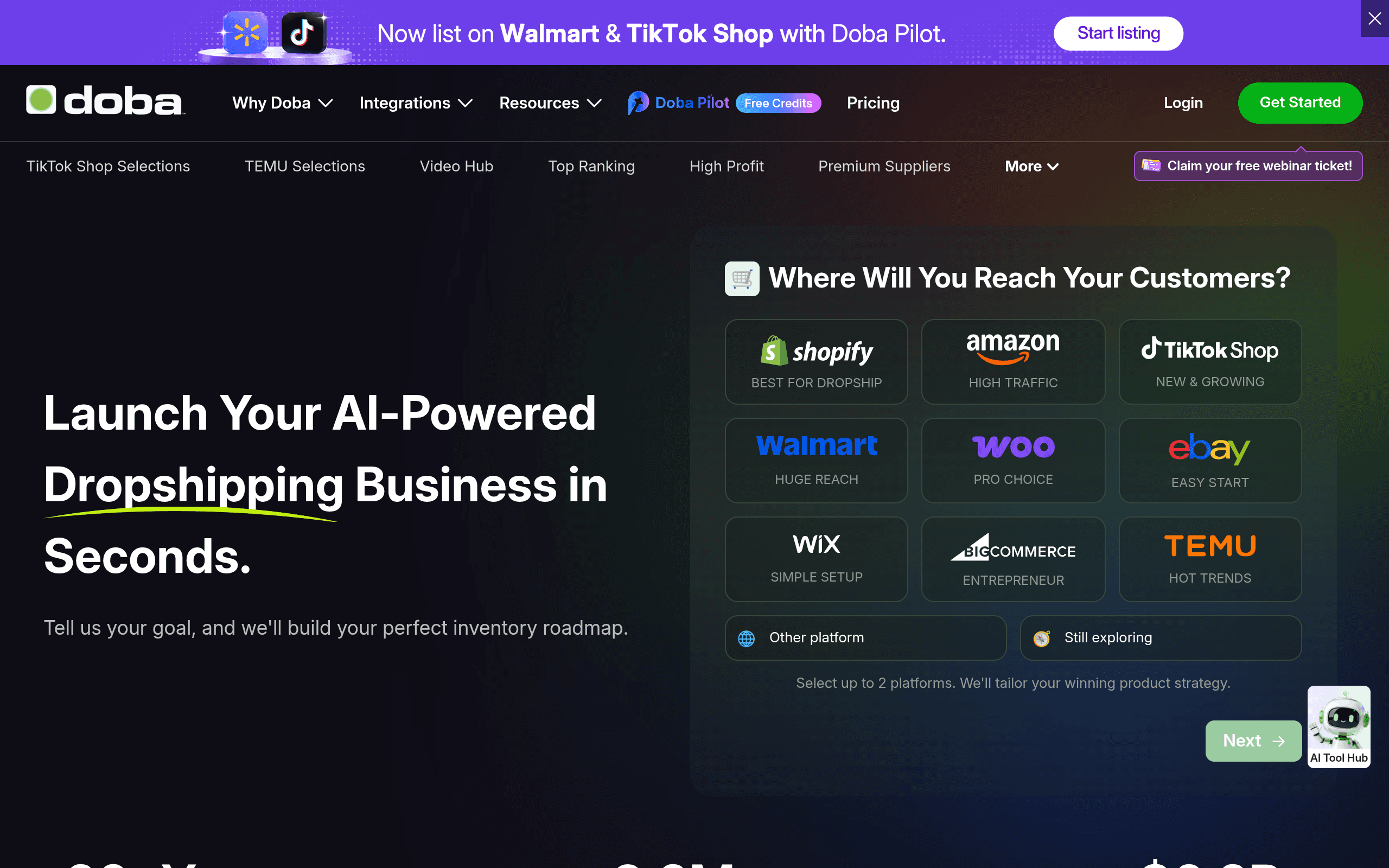
What Doba Actually Does
Doba is a supplier-aggregation and dropshipping platform that's been around since the early 2000s, long before "dropshipping" was a buzzword. It sits between you and a network of wholesale suppliers, letting you search a catalog of products, pull them into your store, and route orders to the supplier for fulfillment without you ever touching inventory. In recent years Doba has layered on AI-assisted product discovery and market reports, plus direct integrations with Shopify, TikTok Shop, and Amazon, so you're not just finding products—you're pushing them to the channels you actually sell on.
This matters because Doba isn't trying to be your storefront (that's Shopify's job) or your print-on-demand shop (that's Printful's job). It's positioning itself as the sourcing and fulfillment layer that plugs into whatever front-end you're already running.
Pricing: What You Actually Get
Doba's homepage leads with a free tier that includes 30 credits, which translates to roughly 30 product searches and 6 market/trend reports. That's enough to poke around the catalog, test the AI product discovery tool, and see whether the supplier network has products relevant to your niche—but it's not enough to run a real business on.
Beyond the free tier, Doba has historically structured its paid plans around monthly credit allotments and feature unlocks (more product searches, deeper market data, bulk export to your store, and account support at higher tiers). The exact current pricing for those paid plans isn't fully spelled out on the homepage, and Doba has changed its tier names and price points more than once over the years, so treat any specific dollar figure as something to verify on their pricing page before you commit. If you've used Doba before, don't assume the plan you remember is still priced the same way.
The practical takeaway: budget for a paid subscription if you're serious. The free tier is a sourcing sandbox, not a business tool.
Where Doba Fits in a Real Workflow
- You already have a Shopify store and need suppliers: Doba plugs in as a product sourcing layer, letting you search, price-compare, and push listings directly rather than manually vetting individual AliExpress sellers.
- You're selling on TikTok Shop and want fewer moving parts: Doba's multi-channel integration means you can list once and manage inventory/price sync across TikTok Shop and Amazon without separate spreadsheets.
- You want to avoid the AliExpress seller-quality gamble: Doba's suppliers are vetted wholesalers rather than an open marketplace of independent sellers, which can mean more consistent shipping times and product quality—though also a smaller, more curated catalog than AliExpress's tens of millions of listings.
- You need price and inventory monitoring without manual checks: Doba's built-in monitoring flags stock-outs or price changes from suppliers, which is the kind of thing that otherwise eats hours of manual checking every week.
Where Doba is a weaker fit: if you want custom-branded, print-on-demand products (mugs, apparel, phone cases with your own designs), Doba's wholesale-supplier model isn't built for that—that's squarely Printful's territory.
How Doba Compares
| Doba | Shopify | AliExpress | Printful | |
|---|---|---|---|---|
| Starting price | Free (30 credits); paid tiers not fully published, check pricing page | From $29/month (Basic plan) | Free to browse/order; no subscription | Free to connect; you pay per product produced |
| Core function | Supplier sourcing + AI product discovery + fulfillment automation | Storefront/e-commerce platform | Marketplace of individual suppliers/sellers | Print-on-demand production + fulfillment |
| Supplier vetting | Curated wholesale supplier network | N/A (you bring your own suppliers) | Open marketplace, quality varies by seller | Printful is the supplier (in-house production) |
| Best for | Multi-channel sellers wanting sourcing + inventory monitoring in one place | Anyone needing a full storefront, regardless of sourcing method | Lowest-cost, DIY sourcing with no subscription | Custom-branded merch and apparel dropshipping |
| Marketplace integrations | Shopify, TikTok Shop, Amazon | Native storefront; connects outward to marketplaces via apps | Sold through directly or imported via apps into Shopify/WooCommerce | Integrates into Shopify, Etsy, WooCommerce, and others |
A realistic setup for a lot of sellers is actually Doba plus Shopify plus Printful used together for different product categories, rather than picking just one. Doba and AliExpress compete more directly with each other since both are sourcing layers; Shopify and Printful serve different functions entirely.
Honest Pros and Cons
Pros:
- Vetted supplier network reduces the quality-control guesswork you get with an open marketplace like AliExpress
- Built-in price and inventory monitoring saves manual checking
- Multi-channel push (Shopify, TikTok Shop, Amazon) from one dashboard
- AI product discovery can surface trending items faster than manual browsing
Cons:
- Free tier's 30 credits run out fast—expect to hit a paywall quickly if you're serious about testing it
- Paid pricing isn't transparently listed up front, which makes it harder to comparison-shop before signing up
- Smaller product catalog than AliExpress, since suppliers are curated rather than open
- No print-on-demand/custom branding capability
Who Should Actually Pay for Doba
If you're running (or planning to run) a multi-channel dropshipping operation—say, a Shopify store that also lists on TikTok Shop and Amazon—and you're tired of manually checking supplier stock levels and price changes across tabs, Doba's automation earns its subscription fee. It's also a reasonable pick if you've been burned by inconsistent AliExpress sellers and want a more curated, accountable supplier base.
If you're just starting out, have a tiny budget, and want to test whether dropshipping works for you at all, AliExpress's no-subscription model is the cheaper way to experiment first. And if your product is really about your own branding and design work rather than sourcing existing products, skip straight to Printful.
Doba is a solid middle-of-the-road choice for sellers who've outgrown the trial-and-error phase and want fewer manual steps between sourcing and fulfillment—just go in expecting to pay for a plan once your free credits run out, and confirm current pricing directly before budgeting around it.