Gemini Robotics 2: First Look at Google DeepMind's Whole-Body AI for Humanoid Robots
By Day Zero Guides Editorial · How we produce guides
Some links in this guide are affiliate links. If you sign up through them, Day Zero Guides may earn a commission at no extra cost to you. This never affects which products we cover or what we say about them. See our affiliate disclosure for details.
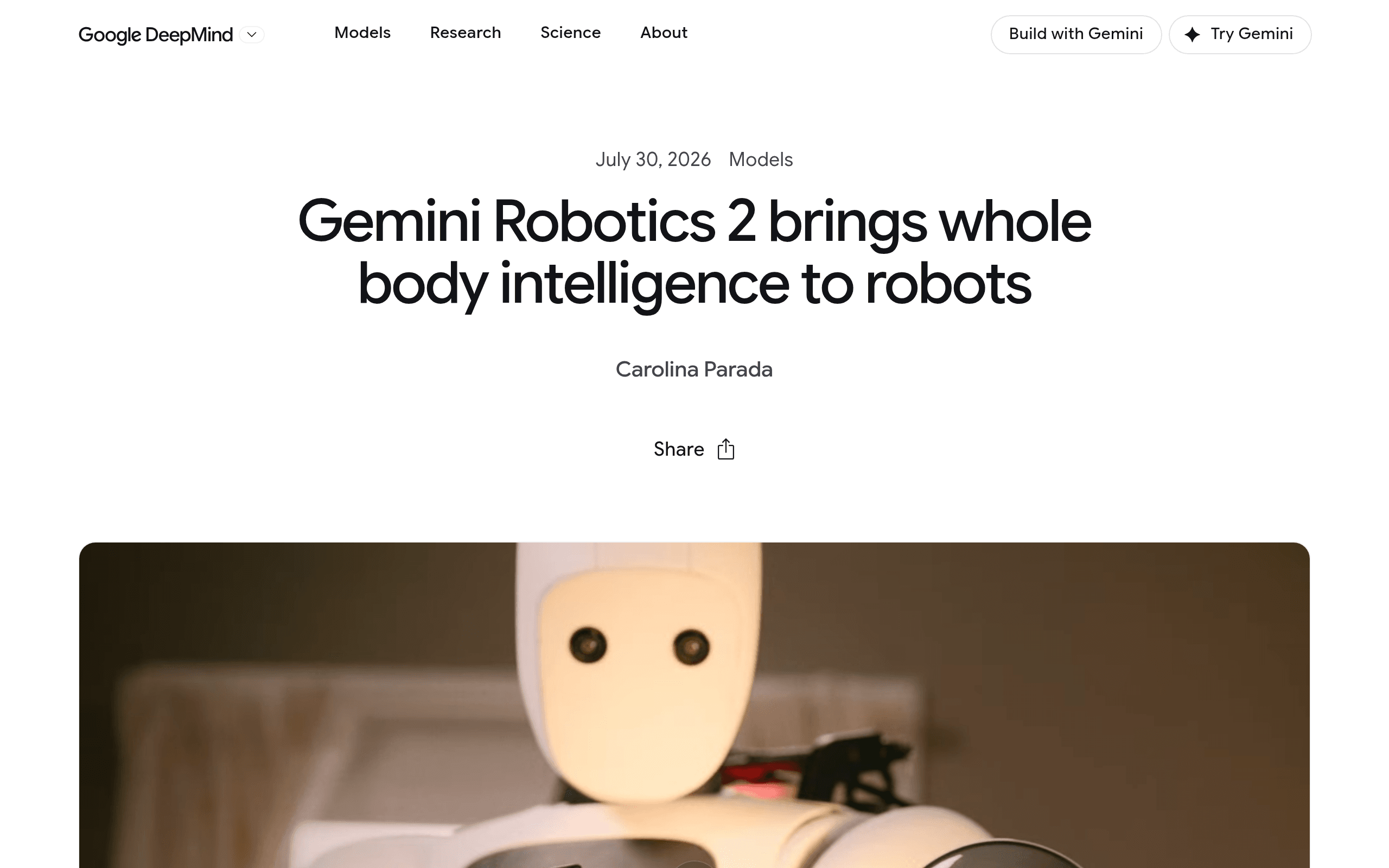
Concrete Use Cases (Where This Actually Fits)
- Humanoid robot manufacturers (the Apptronik, Agility Robotics, Figure-type companies) evaluating whether to build on a foundation model instead of training narrow, task-specific controllers from scratch.
- Warehouse and logistics R&D teams prototyping bin-picking or object-sorting tasks that need a robot to adapt its grip and path to items it hasn't seen labeled examples of before.
- Research labs studying embodied AI who want a reasoning layer that can decompose a spoken multi-step instruction ('clear the table, then wipe it') into an ordered set of physical actions.
- Multi-robot coordination research — teams testing whether one language instruction can be split across two or more physical robots performing complementary steps of the same job.
What it is not yet suited for: home robot assistants, off-the-shelf industrial pick-and-place deployment, or anything a non-robotics team could stand up without existing hardware and a Google DeepMind research relationship or partnership.
What Gemini Robotics 2 Actually Is
Gemini Robotics 2 is Google DeepMind's second-generation model system for controlling physical robots — not a robot itself, and not a consumer app. It's a pair of model types: vision-language-action (VLA) models that turn camera input and natural-language instructions directly into motor commands, and embodied reasoning models that handle the multi-step planning layer above that ("pick up the mug, but first move the plate out of the way"). The combination is what DeepMind is calling "whole-body intelligence" — the same underlying system can drive a humanoid's legs, torso, and arms in a coordinated way, rather than treating locomotion and manipulation as separate subsystems bolted together.
If you used the original Gemini Robotics model (announced by DeepMind in March 2025), the jump here is scope: version 1 was primarily about dexterous arm/gripper manipulation on a fixed or wheeled base. Version 2 extends that to full-body humanoid movement — walking, balancing, bending, reaching — and to coordinating multiple robots working on a shared task.
What It Can Actually Do
Based on DeepMind's own demonstrations, the capabilities fall into three buckets:
- Whole-body humanoid control — a humanoid platform executing tasks that require full-body coordination (crouching to reach a low shelf, stepping around an obstacle mid-task, reorienting its torso while manipulating an object) rather than manipulation from a static stance.
- Fine-grained dexterous manipulation — folding cloth, manipulating small or irregularly shaped objects with a gripper or multi-fingered hand, and adjusting grip in response to visual feedback in real time.
- Multi-step, multi-robot task reasoning — the embodied reasoning model layer can break a spoken instruction into a sequence of sub-tasks and, in demonstrated cases, allocate parts of that sequence across more than one robot working the same physical task.
This is aimed squarely at robotics labs and hardware makers, not at a plug-and-play buyer. There's no indication this ships as an app or SDK you install today the way you'd install a coding-assistant model.
Pricing and Access
Google DeepMind has not published pricing, tiers, or a self-serve signup for Gemini Robotics 2. As of launch, access has been framed around research partnerships and select robotics manufacturers rather than a public API or console signup — similar to how the original Gemini Robotics model was rolled out to partners like Apptronik before any broader release. If you want to evaluate it today, the realistic paths are: (1) be a robotics hardware partner DeepMind is already working with, (2) watch for a Vertex AI or Gemini API embodied-AI endpoint (not live at launch), or (3) track DeepMind's publications and technical reports for benchmark access. There is no credit card, free trial, or self-serve tier to point to right now — anyone claiming otherwise is speculating.
How It Compares to Real Alternatives
Gemini Robotics 2 isn't really a swap-in competitor to any single one of these — it's a model layer, while Spot, Atlas, and Optimus are full hardware+software stacks. But if you're deciding where to place attention or budget, here's how they actually differ:
| System | Price / Access | Key Feature | Best For |
|---|---|---|---|
| Gemini Robotics 2 (Google DeepMind) | Not published; partner/research access only, no public pricing | Whole-body VLA + embodied reasoning model that can drive humanoid locomotion, dexterous manipulation, and multi-robot task splitting from a single foundation model | Robotics manufacturers and research labs wanting a foundation-model brain instead of building task-specific control from scratch |
| Boston Dynamics Spot | ~$74,500 for the base robot, plus paid add-on software packages (e.g., Scout, arm) | Proven, commercially sold quadruped with mature autonomous navigation and inspection software | Companies wanting a robot they can buy and deploy for inspection/patrol today, no foundation-model integration needed |
| Boston Dynamics Atlas (electric version) | Not sold commercially; Hyundai-backed R&D platform | Extremely capable humanoid hardware body, historically paired with hand-tuned or task-specific control rather than a general foundation model | Hardware-first teams focused on humanoid mechanics/actuation research rather than model-driven generalization |
| Tesla Optimus | Not for sale yet; Musk has floated a long-term target of $20,000–$30,000 per unit | Vertically integrated hardware + software from a company with EV-scale manufacturing ambitions | Watching for eventual mass-manufactured humanoid at consumer-adjacent pricing — still pre-commercial as of now |
| OpenAI robotics work | No current commercial robotics product; OpenAI shut its in-house robotics team in 2021 and now engages mainly through investments/partnerships (e.g., Figure AI, 1X) | Foundation-model expertise applied to robotics via external hardware partners rather than an in-house robot or model release | Tracking foundation-model-for-robotics research trends without a shippable OpenAI robotics product to evaluate directly |
The Honest Verdict
Gemini Robotics 2 is a meaningful technical step — extending a VLA model from arm-level dexterity to whole-body humanoid coordination and multi-robot task splitting is a real architectural advance, not a rebrand. But it is not something you can sign up for and try today. There's no price sheet, no console, no trial. If you're a robotics manufacturer or research team with an existing DeepMind relationship, this is worth pursuing immediately. If you're evaluating robots to actually buy and deploy this quarter, Boston Dynamics' Spot remains the only system on this list with a public price tag and a robot that ships. Everyone else — Optimus, Atlas, and Gemini Robotics 2 itself — is still in the 'watch closely, can't buy yet' category.
Who Should Actually Try This Now
- Try now: Robotics hardware companies already in conversation with Google DeepMind, or research teams with humanoid platforms who can request partner access.
- Wait: Logistics/warehouse operators hoping for a deployable picking solution — there's no commercial packaging yet.
- Skip for now: Anyone expecting a home robot, consumer product, or self-serve API — none of that exists at launch.
Update — 2026-08-19
Gemini Robotics 2 now has public/early access availability: the embodied reasoning model (ER 2) is available on Google AI Studio and in private preview on Gemini Enterprise Agent Platform, while VLA and On-Device models are available to early-access partners through a signup form. The original guide stated there was no public access path or self-serve tier.