IDØ: First Look at the Tool That Tracks Whether Competitor Launches Actually Land
By Day Zero Guides Editorial · How we produce guides
Some links in this guide are affiliate links. If you sign up through them, Day Zero Guides may earn a commission at no extra cost to you. This never affects which products we cover or what we say about them. See our affiliate disclosure for details.
Concrete use cases
- A PM tracking a specific rival's roadmap sets up tracking on 3-4 direct competitors and gets a weekly digest showing which of their shipped features actually got HN traction versus which got a changelog entry and silence — useful ammunition for "we don't need to rush this" conversations with leadership.
- A dev-tools founder watches GitHub star velocity and Bluesky chatter around a competing open-source project to spot the moment a quiet competitor suddenly breaks out, instead of finding out three weeks later from a customer.
- A solo indie hacker uses the free Indie tier during the 30-day window purely to benchmark: is anyone reacting to launches in their niche at all, or is the whole category quiet on these channels (which would tell them Show HN and Bluesky aren't where their buyers live).
- An analyst prepping a competitor briefing pulls the complaint-extraction output (Team tier) to build a "what users are already frustrated with" section without manually reading hundreds of HN threads.
What IDØ is not a fit for: tracking competitors whose relevant audience doesn't live on Hacker News, Bluesky, or GitHub. A CPG brand or an enterprise SaaS selling to non-technical buyers will get a very thin signal here — the source set is heavily skewed toward developer- and tech-adjacent audiences.
What IDØ actually does
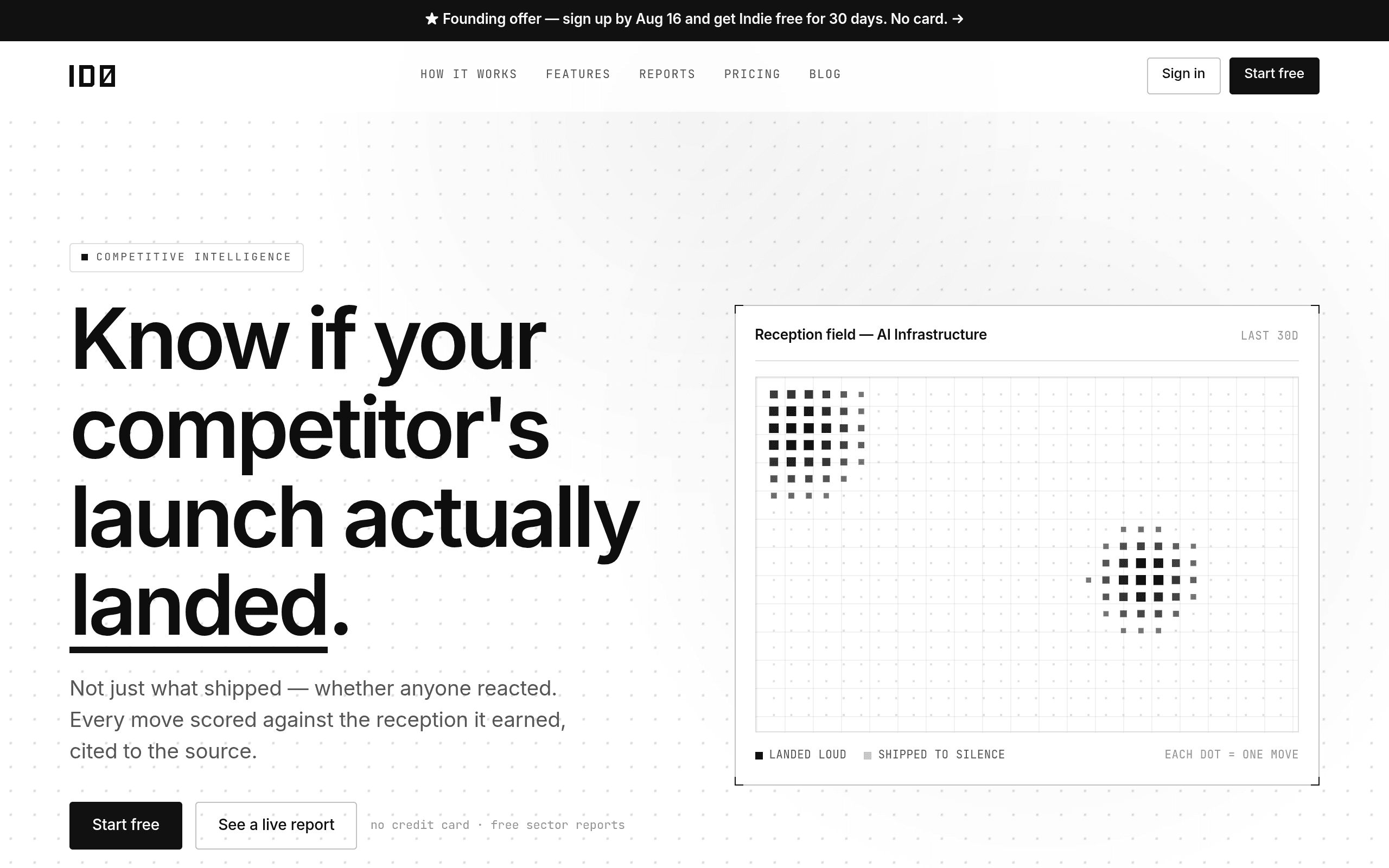
Most competitive intelligence tools tell you that a competitor shipped something. IDØ (id-null.com) is built around a narrower and more useful question: did anyone actually care?
It pulls competitor launch activity and then couples it with reaction data from Hacker News, Bluesky, and GitHub — comments, upvotes, stars, forks, quote-posts — to produce a weekly "landing report." The report separates launches into two buckets that matter a lot more than a simple activity feed:
- High-impact moves — launches that generated real discussion or adoption signal
- Quiet openings — launches that shipped with fanfare (a blog post, a changelog entry, a press mention) but got zero measurable public reaction
That second category is the actual product insight. Anyone can set up a Google Alert or an RSS scrape for "competitor + launched." What's harder to see is when a competitor's big swing landed with a thud — which tells you where they're vulnerable, and where you might not need to react as urgently as their announcement implies.
Pricing as of launch
IDØ is running a founding offer rather than a fully published price list:
| Tier | What's confirmed | Price |
|---|---|---|
| Indie | Core landing reports, HN/Bluesky/GitHub tracking | Free for 30 days, no card required, if you sign up by August 16 |
| Pro | Everything in Indie + an MCP endpoint (so you can pipe competitor signal into Claude, Cursor, or other MCP-compatible agents) | Not publicly listed yet |
| Team | Everything in Pro + complaint extraction (surfaces recurring gripes about competitor products from the same source pool) | Not publicly listed yet |
Worth being blunt about: dollar amounts for Pro and Team aren't posted on the site as of this writing. If pricing transparency matters to you, that's a real gap — you're trialing on the promise that Indie converts to something reasonable, not on a visible price. The MCP endpoint on Pro is the more interesting detail here; it suggests IDØ wants to be consumed programmatically by agent workflows, not just read as a weekly digest.
How it compares
| IDØ | Crunchbase | CB Insights | Product Hunt | |
|---|---|---|---|---|
| Price | Free 30-day Indie trial (founding offer); Pro/Team pricing unpublished | Free tier + paid plans from ~$29-49/mo (Pro), Enterprise custom | Enterprise only, custom quotes (typically five figures/year) | Free to browse; paid promotion/launch tools separate |
| Core signal | Launch reaction across HN, Bluesky, GitHub (coupled, not just aggregated) | Funding, org data, hiring, acquisitions | Market maps, funding + patent + sentiment analytics for enterprise research teams | Community upvotes/comments on the day of launch only |
| Reaction depth | Tracks reaction after launch, over time, including non-events ("quiet openings") | Minimal — mostly structured company/funding data, not real-time sentiment | Strong analytics but slow-moving, built for quarterly strategic reviews | Real-time but only on PH itself, and only if the competitor launches there |
| Best for | Teams who want to know if a competitor's launch actually resonated, not just that it happened | Sourcing deals, funding history, company vitals | Enterprise strategy/market-sizing teams with budget | Watching same-day community reaction to a PH launch specifically |
| Data sources | HN, Bluesky, GitHub | Company filings, news, crowdsourced data | Patents, funding databases, curated analyst research | Its own platform only |
The honest way to frame this: Crunchbase and CB Insights answer "what is this company doing and how much money do they have." Product Hunt shows same-day reaction on its own platform. None of them tell you whether a competitor's launch two weeks ago on their own blog actually moved anyone. That's the specific gap IDØ is trying to fill, and it's a real gap — but it also means IDØ isn't a replacement for any of the three above, just a narrow addition to a stack that might already include one of them.
Should you try it today
If your competitors ship things developers or tech-Twitter/Bluesky-adjacent audiences would plausibly react to, the free 30-day Indie window (sign up before August 16, no card required) is close to zero-risk to test for a sprint or two. Watch specifically for how it handles competitors who don't launch loudly — that's the feature that differentiates this from a glorified RSS aggregator. The open question, since Pro and Team pricing isn't public yet, is whether this stays worth paying for once the free window closes. Sign up now mainly to answer that question for yourself before you're asked to commit to a number.