Korva: First Look at the App That Turns Long-Form Content Into Insight Cards
By Day Zero Guides Editorial · How we produce guides
Some links in this guide are affiliate links. If you sign up through them, Day Zero Guides may earn a commission at no extra cost to you. This never affects which products we cover or what we say about them. See our affiliate disclosure for details.
Who This Is Actually For
The idea-collector who doesn't finish books. If your Kindle app is a graveyard of 10%-read nonfiction, Korva's card format meets you where you are — it surfaces the ideas without requiring you to commit to a full summary or the whole book.
Someone building a point of view on a topic. A founder researching pricing psychology, for example, could browse the business and psychology categories and collect insight cards from multiple sources (a Farnam Street essay, a behavioral economics podcast, a HBR piece) without reading three separate long pieces end to end.
Commute-length browsing, not deep work. Korva's card format is built for 5-10 minute sessions — waiting for coffee, riding the subway — rather than sustained reading. If you want deep, uninterrupted reading time, this is not that app.
Not a good fit for: people who already have a firehose of newsletters and saved articles they need to process (that's Readwise's and Pocket's territory), or people who want full audio/text summaries of specific named books they already know they want (that's Blinkist's core promise).
What Korva Actually Does
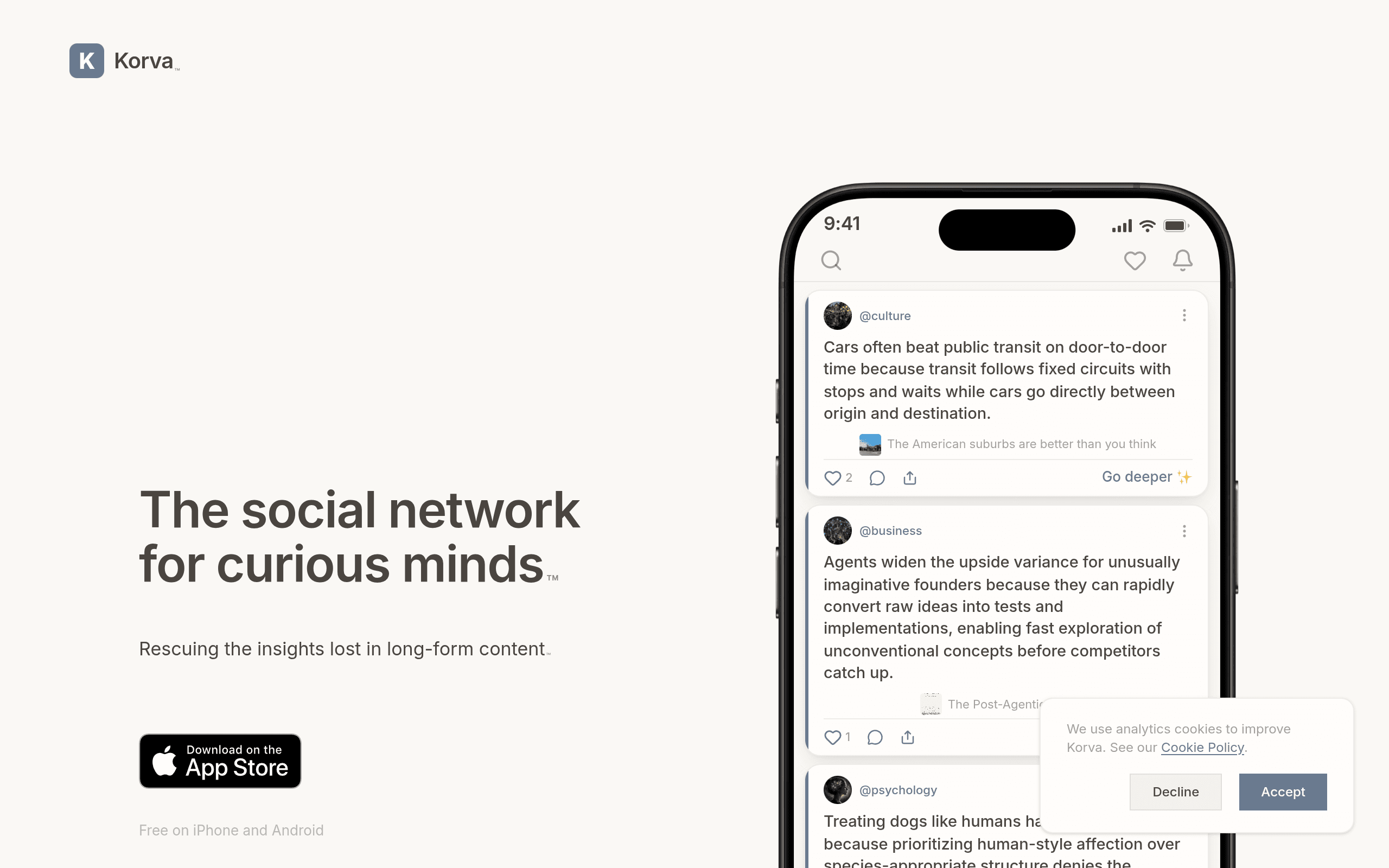
Korva is a mobile app (iOS and Android) built around a simple premise: most people don't have time to read every long-form article, book, or interview they save, but they'd still like to know what's in them. Instead of summarizing entire pieces into one long blurb (the Blinkist model), Korva breaks source content down into individual "insight cards" — bite-sized, swipeable takeaways that each carry an attribution back to the original creator and topic.
Open the app and you land on a feed organized by category: business, psychology, culture, health, and a few others that rotate in. Each card is a single idea — a concept, a stat, a framework, a quote-adjacent takeaway — pulled from a specific book, podcast, essay, or article. Tap a card and you can go deeper into the source material or save it for later. It's less "read this whole book in 15 minutes" and more "here are the 6 ideas worth knowing from this book, browse them like a stack of flashcards, and click through if one grabs you."
This is a meaningfully different interaction model than most read-it-later or summary apps. You're not queuing up content to consume linearly — you're browsing atomized ideas and letting curiosity pull you into sources.
Pricing: Not Yet Published
As of this writing, Korva has not published a pricing page or subscription tiers. The app is available as a free download on iOS and Android, and it's unclear whether monetization will come via a freemium subscription (the Blinkist/Readwise norm), ads, or a different model entirely. If you're evaluating Korva today, treat it as a free trial by default — there's no indication yet of what a paid tier would unlock or cost. This is worth revisiting once Korva formalizes pricing, since the value proposition changes a lot depending on whether card browsing stays free indefinitely or becomes gated.
How Korva Compares
| Korva | Blinkist | Readwise | ||
|---|---|---|---|---|
| Price | Not published (free to download now) | ~$99.99/year (or ~$16.99/month); 7-day free trial | $9.99/month or ~$59.99/year (Reader bundle available) | Free tier; Pocket Premium ~$4.99/month (being phased out as Mozilla winds down Pocket in 2025) |
| Core unit of content | Insight cards (atomized ideas with attribution) | Full book/podcast summaries (15-min reads or listens) | Highlights you've made across books, articles, Kindle, Twitter | Saved full articles/pages for later reading |
| Discovery vs. your own library | Discovery-first — browse curated cards across categories you didn't necessarily seek out | Discovery-first — browse a curated library of ~7,500+ titles | Your-library-first — resurfaces highlights you already made | Your-library-first — you save what you find elsewhere |
| Best for | Browsing new ideas across topics in short bursts | Getting the gist of a specific named book fast | Remembering and resurfacing what you've already read/highlighted | Saving articles from the web to read distraction-free later |
| Attribution model | Every card links back to its source creator/work | Summaries are Blinkist's own condensed rewrite | Highlights are your own excerpts from original text | Full original article preserved as-is |
The practical distinction: Blinkist and Korva both do curated discovery, but Blinkist commits to full-length summaries of specific titles, while Korva breaks everything into smaller, cross-source idea units you browse more like a feed. Readwise and Pocket, by contrast, are built around content you already found — they don't do discovery for you.
Concrete Use Cases
- Prepping for a meeting or interview on a topic you're not deep in. Scan the business or psychology category for 5-10 minutes to walk in with a few sharp, attributed talking points instead of generic knowledge.
- Finding your next book without reading reviews. Browse cards pulled from a book, and if three or four ideas land, that's a stronger signal to buy the book than a star rating.
- Idle-time learning replacing social media scrolling. The swipeable card format is explicitly built to compete with the same 10-minutes-before-bed slot that Instagram or TikTok occupies.
- Cross-topic pattern spotting. Because cards span categories, you might see a psychology insight and a business insight that connect in a way you wouldn't have found reading either source in full.
The Honest Take
Korva's card-based, attribution-first approach to distilling long-form content is a genuinely different format than the "full summary" model Blinkist popularized, and it's a different job than the "save for later" model Pocket and Readwise serve. If you like browsing ideas the way you'd browse a feed — rather than queuing up full pieces to read start to finish — Korva's interaction model is worth trying, especially since it's free to download right now with no pricing wall yet visible.
The open question is durability: without published pricing, it's unclear how Korva sustains itself long-term, whether the card library will keep growing with fresh sources, and whether a future paywall will gate the categories or card depth you currently get for free. Try it today as a low-commitment experiment in a new content format — just don't assume the current free experience is permanent.