NAGA EU Review: Pricing, Features, and How It Compares to eToro and Interactive Brokers
By Day Zero Guides Editorial · How we produce guides
Some links in this guide are affiliate links. If you sign up through them, Day Zero Guides may earn a commission at no extra cost to you. This never affects which products we cover or what we say about them. See our affiliate disclosure for details.
What Is NAGA EU?
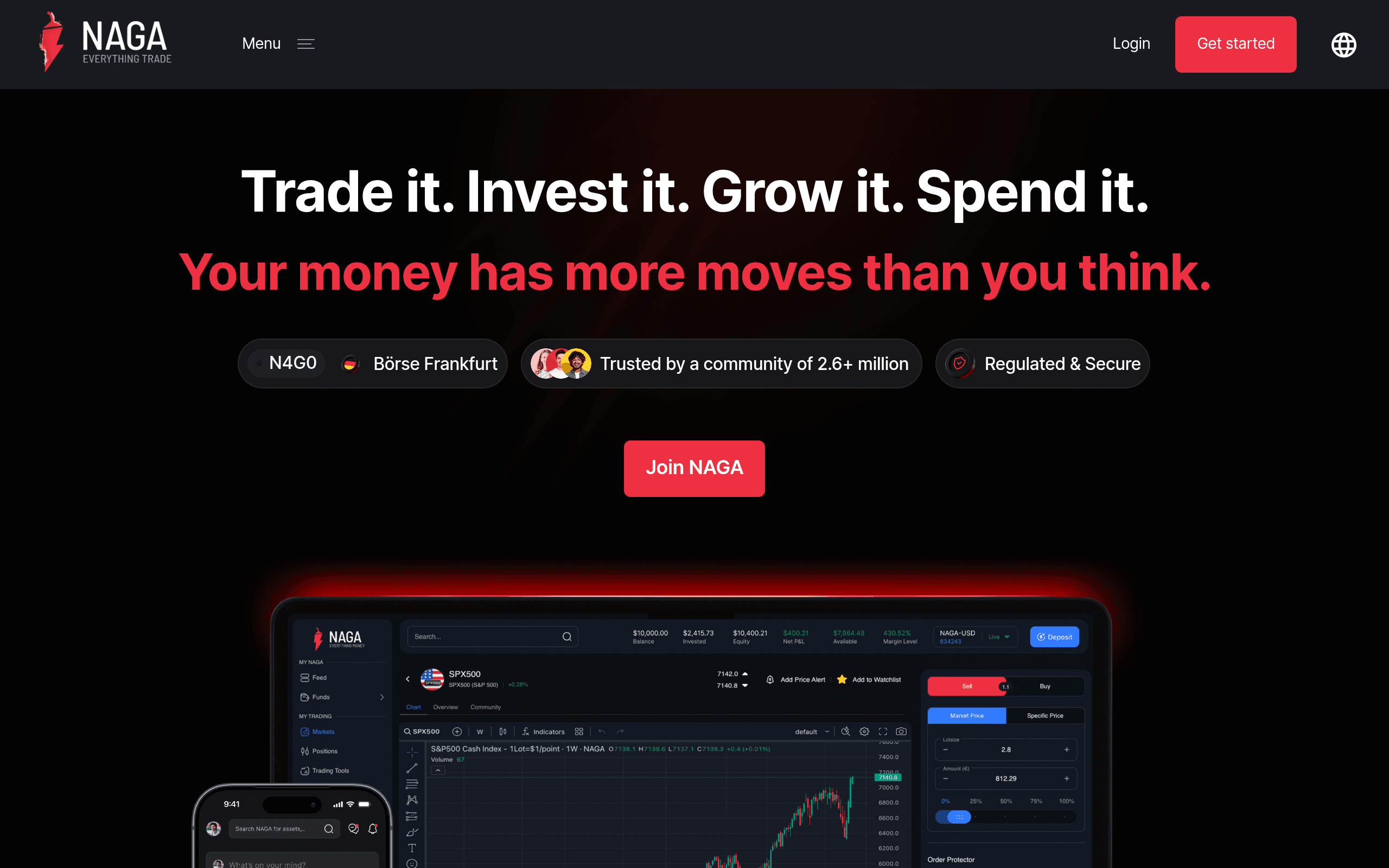
NAGA EU is the European-regulated arm of NAGA Group, a multi-asset trading and investment platform that gives retail users access to stocks, ETFs, forex pairs, cryptocurrencies, and commodities (gold, oil, indices) through a single web platform and mobile app. It's built around CFD and real-asset trading combined with a social trading layer — users can browse the profiles of other traders, see their historical performance, and use NAGA's copy trading feature to automatically mirror a trader's positions in their own account.
Beyond execution, NAGA bundles in market analysis widgets, an in-house news feed, economic calendars, and a basic education section aimed at beginners (glossary terms, short video lessons, webinars). It's positioned less as a bare-bones brokerage and more as a "trade and learn in one place" product, which puts it in direct competition with eToro's social trading model rather than with pure execution brokers.
Pricing and Account Structure
NAGA doesn't use a flat commission-per-trade model for most instruments. Instead, revenue is built into spreads (the difference between buy and sell price), plus overnight financing charges on leveraged/CFD positions and a currency conversion fee if you fund your account in a currency other than your base currency. There's no fixed monthly subscription to use the core platform.
What does carry tiered pricing is NAGA's VIP user level system (detailed at naga.com/en/vip-user-levels), which rewards account activity and deposit size with perks like tighter spreads, reduced fees, dedicated account management, and faster withdrawal processing as you move up levels. NAGA doesn't publish every tier's exact deposit threshold in a single easy-to-find table — pricing specifics for spreads by instrument are instead broken out separately at naga.com/en/pricing-and-terms/spreads, where each asset class (forex pairs, individual stocks, crypto, commodities) has its own spread schedule that can change based on market conditions and your account tier. If exact cost matters to your strategy — for example, if you're trading EUR/USD at high frequency — you'll want to check the live spread sheet before funding an account, since spreads for the same pair can shift meaningfully between the base tier and a higher VIP level.
There is also a standard inactivity fee structure common to CFD brokers in this space, and withdrawal fees can apply depending on payment method. None of this is hidden, but it's also not presented as a simple "$X per trade" headline the way Webull or IBKR Lite present their pricing.
Who NAGA EU Is Actually For
NAGA makes the most sense for:
- Beginner-to-intermediate traders who want to learn by watching and copying more experienced traders rather than building a strategy from scratch.
- Social/copy traders who specifically want a feed-based discovery experience for finding traders to mirror, similar to eToro's core pitch.
- Multi-asset CFD traders who want forex, crypto, and commodities CFDs alongside stock CFDs in one account without needing separate brokerage relationships.
- EU-based users who want a platform regulated under EU frameworks (CySEC is the relevant regulator for NAGA's EU entity) rather than an offshore or US-only platform.
It's a weaker fit for cost-sensitive long-term investors who want to buy and hold real shares/ETFs at the lowest possible cost, and for active professional traders who need institutional-grade order routing, deep Level 2 data, or ultra-tight spreads — that audience is better served by Interactive Brokers.
How NAGA EU Compares
| Feature | NAGA EU | eToro | Interactive Brokers | Webull |
|---|---|---|---|---|
| Core pricing model | Spread-based, no flat commission on most CFDs; VIP tiers reduce costs | Spread-based + $5 flat withdrawal fee | Commission-based (IBKR Lite: $0 US stocks; IBKR Pro: tiered per-share/volume pricing) | $0 commission on US stocks/ETFs, small regulatory fees |
| Social/copy trading | Yes — core feature, trader feed + copy trading | Yes — arguably the most established copy trading network | No social trading features | No social trading features |
| Asset range | Stocks, ETFs, forex, crypto, commodities (mostly via CFDs) | Stocks, ETFs, forex, crypto, commodities | Stocks, ETFs, options, futures, bonds, forex — broadest range, real assets | Stocks, ETFs, options, crypto (US-focused) |
| Best for | Beginners wanting a social, learn-by-copying experience in the EU | Beginners/intermediate traders wanting the largest copy trading community | Active and professional traders wanting low-cost execution and deep markets | Cost-conscious US-based self-directed traders wanting a clean mobile app |
| Regulation (EU users) | CySEC-regulated EU entity | CySEC-regulated EU entity | Regulated in multiple jurisdictions including EU | Primarily US-focused, limited EU availability |
The honest comparison is that NAGA and eToro are fishing in the same pond — both lead with social/copy trading and spread-based pricing rather than flat commissions. eToro has the larger, more mature trader network and a longer track record, which matters if copy trading is your main reason for signing up. IBKR wins decisively on raw cost and market depth for anyone trading real shares at volume, but it has a steeper learning curve and a less beginner-friendly interface. Webull is the simplest and cheapest option for US-listed stock trading specifically, but it doesn't offer social trading or the same breadth of CFD instruments, and its EU availability is limited.
Verdict
NAGA EU is a reasonable choice if the social/copy trading angle is genuinely what you're after and you're based in the EU — it covers the same ground as eToro with a comparable pricing structure, though eToro's larger trader community gives it an edge for copy trading specifically. Where NAGA falls short is pricing transparency: spreads vary by instrument and VIP tier, and you have to dig into two separate pages (VIP levels and the spread schedule) to understand your real cost, rather than seeing a single clear number up front the way you would with Webull's $0 commission or IBKR's published commission tables. If you're a buy-and-hold investor focused purely on minimizing cost, or an active trader who needs institutional-grade execution, you're better served by Interactive Brokers. If social trading and an all-in-one multi-asset app matter more than shaving basis points off every trade, NAGA is worth a look — just check the live spread sheet for your specific instruments before you fund the account.