nashnova: First Look at the New AI Research Workbench for Investors
By Day Zero Guides Editorial · How we produce guides
Some links in this guide are affiliate links. If you sign up through them, Day Zero Guides may earn a commission at no extra cost to you. This never affects which products we cover or what we say about them. See our affiliate disclosure for details.
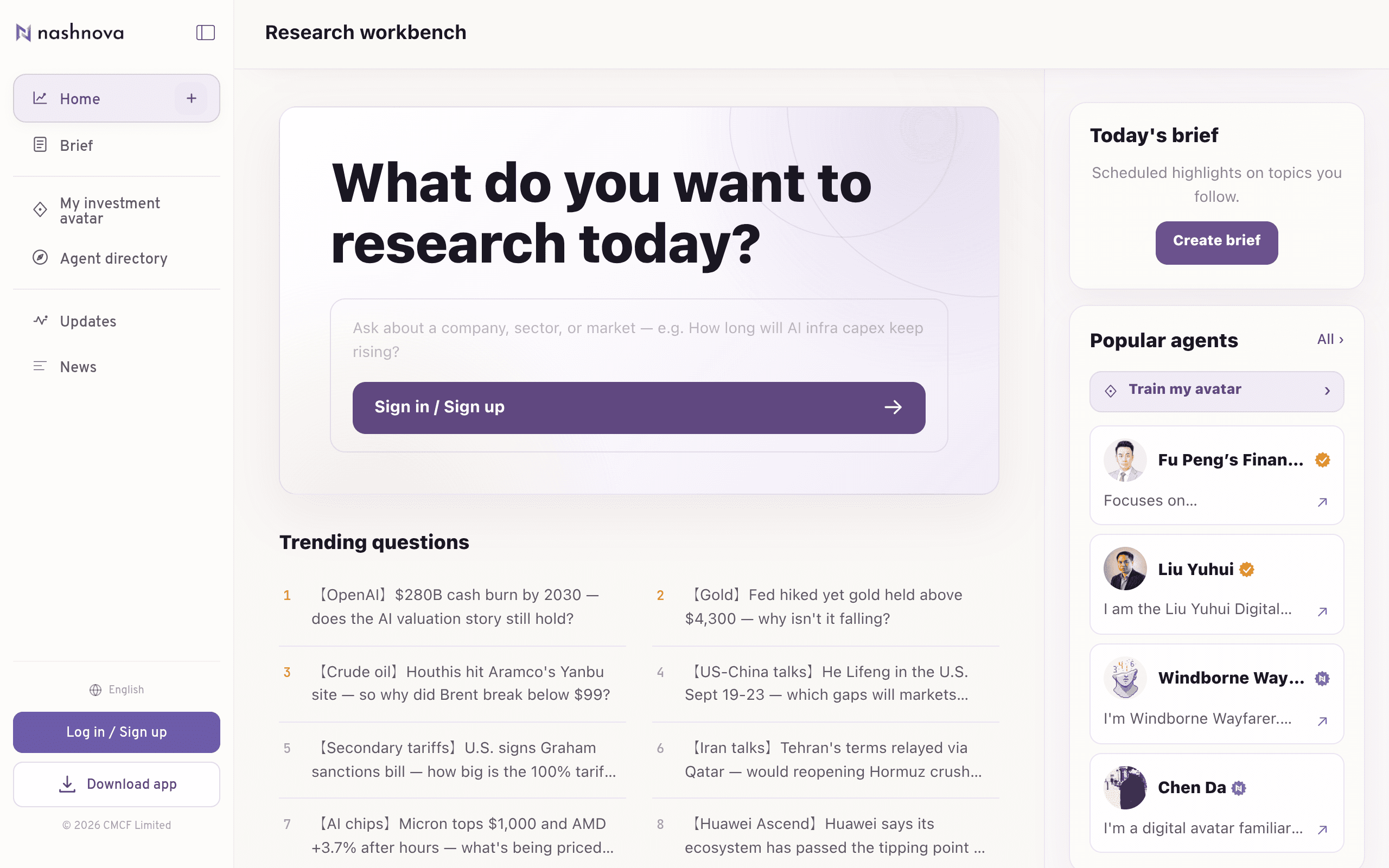
nashnova (nashnova.com) is a newly launched research workbench built specifically for investors and market watchers who want to ask questions about companies, sectors, and macro conditions and get back structured, analyst-style answers instead of a generic chatbot response. It's not trying to be a general-purpose assistant — it's positioned squarely in the investment research lane, competing for attention with people who currently bounce between Bloomberg Terminal, ChatGPT, and Perplexity AI to piece together a thesis.
What nashnova actually does
At its core, nashnova is a query interface layered on top of a set of AI agents that specialize in different parts of investment analysis. Based on what's live on the site today, the platform is built around a few distinct pieces:
- Curated trending questions — a feed of pre-written prompts (think "Is the AI capex cycle peaking?" or "How exposed are regional banks to commercial real estate?") that surface what other users or the platform itself considers timely, so you're not staring at a blank search box trying to figure out what to ask.
- Specialized analyst agents — rather than one model doing everything, nashnova routes questions to a directory of agents that appear to be tuned for specific domains: macroeconomics, global markets, and asset allocation are the three called out explicitly. The idea is that a question about Fed policy gets handled differently than a question about a single-stock earnings setup.
- Investment avatar system — a personalization layer that seems designed to let the platform tailor responses (or track a persona's stated views/positions) rather than treating every user query as a cold, context-free search. This is the most distinctive part of nashnova and the part most likely to evolve quickly post-launch.
- Company, sector, and market-level Q&A — you can ask about a specific ticker, a sector rollup, or a broader macro question and get analysis-style output rather than a list of links.
Pricing: not yet public
As of this writing, nashnova has not published pricing tiers on its site. There's no visible free-vs-paid breakdown, no usage caps listed, and no enterprise/team pricing page. If you go to nashnova.com today expecting a pricing page like Perplexity's or a self-serve checkout, you won't find one yet — access appears to be gated through sign-up rather than a transparent tier comparison.
Practically, that means: don't commit to nashnova for a workflow you need priced out in advance (e.g., justifying a team seat to a finance department). Sign up, use it against a couple of real research questions you're currently working on, and see whether the output quality justifies whatever pricing eventually shows up. Early-access products in this space (research copilots) have historically landed anywhere from free-with-limits to $20–$40/month for an individual tier, with custom pricing for institutional desks — but that's a pattern from comparable tools, not a confirmed nashnova number.
Concrete use cases
- Pre-earnings sanity check: Ask nashnova what the market is pricing into a stock ahead of an earnings print and cross-reference it against the macro agent's read on sector-wide demand trends, instead of manually reading five sell-side notes.
- Sector rotation research: Use the asset allocation agent to frame a question like "where is capital rotating within industrials in the last quarter" and get a structured take you can then verify against primary sources.
- Macro-to-portfolio translation: Ask a macro question (rate path, dollar strength, credit spreads) and immediately follow up asking how that theme maps to specific sectors or allocation tilts — this hand-off between agents is the workflow nashnova seems built around.
- Idea generation from trending questions: If you don't have a specific ticker in mind, browsing the curated question feed works like a research idea generator — useful for junior analysts or generalist investors scanning for what's moving.
- Building a repeatable research persona: The investment avatar feature is worth testing if you want the platform to remember a consistent set of assumptions (risk tolerance, sector focus, macro view) across sessions rather than re-explaining context every time.
How it compares
| nashnova | Perplexity AI | ChatGPT | Bloomberg Terminal | |
|---|---|---|---|---|
| Price | Not published (sign-up gated) | Free tier; Pro $20/mo | Free tier; Plus $20/mo, Team/Enterprise higher | ~$2,000+/month per seat, contract-based |
| Core strength | Domain-specific investment agents (macro, markets, allocation) + curated question feed | Broad web-grounded Q&A with citations | General-purpose reasoning and writing, wide plugin/tool ecosystem | Real-time market data, execution, institutional-grade terminals and messaging |
| Data grounding | Unclear/not disclosed — appears to rely on AI analysis rather than confirmed licensed real-time feeds | Live web search with source citations | Web browsing available but not finance-specialized by default | Licensed, real-time, audited financial data feeds |
| Personalization | Investment avatar system (persona-based context) | Threads/collections, no persona system | Custom GPTs, memory feature | User-configured terminal layouts, not persona-based |
| Best for | Investors wanting structured macro/sector Q&A without building their own prompt workflow | Fast, cited research across any topic including finance | General research, drafting, and analysis with broad flexibility | Professional trading desks needing real-time data and execution |
Where nashnova is genuinely useful today
If your current workflow is "ask ChatGPT a finance question and hope it's not hallucinating a stat," nashnova's narrower focus and agent routing is a meaningful upgrade in relevance, even without transparent pricing yet. The curated trending questions are also a real time-saver if you're doing generalist market scanning rather than single-name deep dives.
Where it's not ready to replace anything
nashnova is not a Bloomberg Terminal replacement — there's no indication of licensed real-time data, execution, or the compliance-grade audit trail institutional desks require. It's also not clearly better than Perplexity for anything outside its analyst-agent lane, since Perplexity's web-grounded citations are still the more transparent way to verify a claim right now. Treat nashnova as a specialized research aid to run alongside your existing tools, not a wholesale replacement for any of them — especially until pricing and data-sourcing details are public.
Verdict
Worth trying today if you do recurring macro, sector, or allocation research and want a purpose-built Q&A layer instead of generic chat. Hold off on building critical workflows around it until nashnova publishes pricing and clarifies its underlying data sources — two gaps that matter a lot for anyone making real capital decisions off the output.