PolyMart: A First Look at the New Directory for Polymarket Trading Tools
By Day Zero Guides Editorial · How we produce guides
Some links in this guide are affiliate links. If you sign up through them, Day Zero Guides may earn a commission at no extra cost to you. This never affects which products we cover or what we say about them. See our affiliate disclosure for details.
Concrete Use Cases
- You want an arbitrage bot for Polymarket but don't know which ones are still active. Instead of digging through old Reddit threads, you scan the Bots category and cross-check trending rank against recency of the tool's own changelog.
- You're building a personal dashboard and need an API. The APIs category saves you from Googling "Polymarket API wrapper" and wading through half-finished GitHub repos with no stars.
- You want to track a specific market's sentiment shift. The analytics dashboards category groups tools that pull historical odds data, which is otherwise hard to find outside of Polymarket's own limited charting.
- You're new to prediction markets entirely. The blog content is aimed at onboarding — useful if you're coming from traditional betting or options trading and need the vocabulary translated.
What PolyMart Actually Is
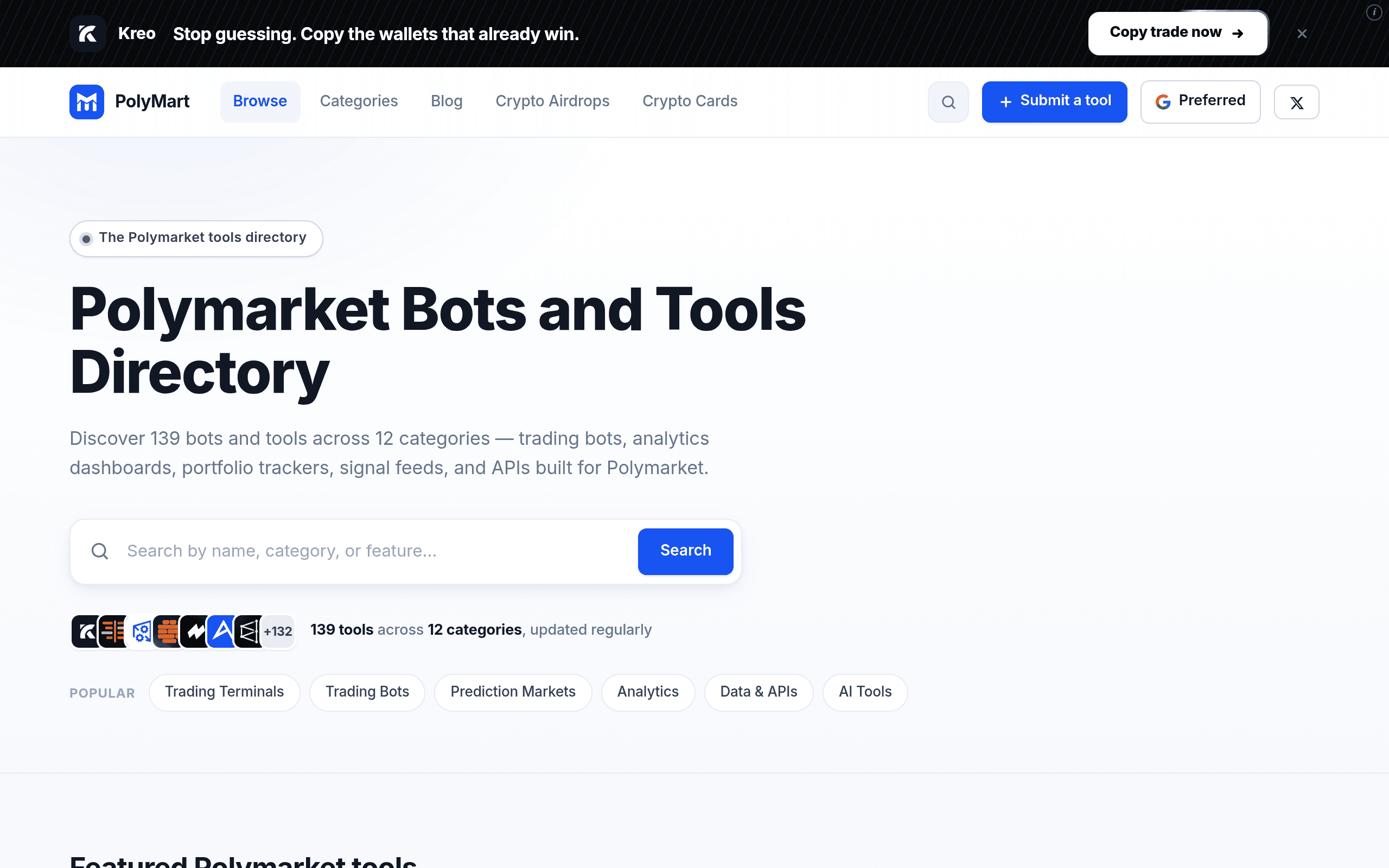
PolyMart (polymart.app) is not a trading tool itself — it's a curated directory that maps the fast-growing ecosystem of third-party software built around Polymarket, the prediction market platform. At launch, it lists 139 tools and bots sorted into 12 categories, including trading terminals, automated bots, analytics dashboards, and APIs. It also runs trending rankings (surfacing which tools are gaining attention right now) and a blog with educational content aimed at people who are new to prediction market trading.
If you've ever tried to figure out which Polymarket bot actually works, which analytics dashboard isn't abandoned, or whether a given API wrapper is still maintained, you know the problem PolyMart is solving: this ecosystem is scattered across Discord servers, GitHub repos, and X threads with almost no central index. PolyMart is essentially trying to become the "awesome-list" plus lightweight review layer for that space.
How the Directory Is Organized
The 12 categories split tools by function rather than by vendor, which is the right call for a niche this specific. Based on the current listing structure, you'll find groupings for:
- Trading terminals — desktop/web interfaces that sit on top of Polymarket's order book
- Bots — automated execution tools, including arbitrage and market-making bots
- Analytics dashboards — tools for tracking market odds movement, volume, and whale wallets
- APIs and dev tooling — wrappers and SDKs for building your own integrations
- Plus additional categories for browser extensions, alerts/notifications, portfolio trackers, research aggregators, and community bots (Discord/Telegram)
Each entry appears to include a short description and a link out to the tool itself, with trending rank acting as a de facto popularity signal rather than a verified quality score.
Pricing: What You'll Actually Pay
PolyMart itself does not publish a pricing page, and as of this writing there's no visible paywall, account tier, or "pro" version gating the directory — browsing all 139 listings and the blog is free. That said, two things are worth flagging before you rely on it:
- PolyMart doesn't charge you, but the tools it lists might. Several of the trading terminals and bots in the directory have their own subscription models or performance fees — PolyMart is an index, not a marketplace, so you'll negotiate pricing with each individual tool separately.
- No stated business model yet. Without ads, subscriptions, or affiliate disclosures visible on the site, it's unclear how PolyMart sustains itself long-term, which matters if you're bookmarking it as an ongoing resource rather than a one-time lookup.
If you need firm pricing for a specific bot or terminal, treat PolyMart as a discovery layer and confirm cost directly on the tool's own site before signing up.
How PolyMart Compares to General Software Directories
The honest comparison isn't against other prediction-market tools — it's against the general-purpose directories people would otherwise use to find this kind of software: ProductHunt, Capterra, and G2. None of them are built for a niche this small, which is exactly the gap PolyMart is filling.
| PolyMart | ProductHunt | Capterra | G2 | |
|---|---|---|---|---|
| Price to use | Free, no account required to browse | Free | Free | Free |
| Polymarket-specific listings | 139 tools, purpose-built categories (bots, terminals, APIs, analytics) | Scattered, one-off launch posts if a founder happens to submit | Essentially none — Polymarket tools are too niche for Capterra's B2B software categories | Essentially none — same issue, G2 skews toward enterprise SaaS |
| Categorization depth | 12 niche categories built specifically around prediction-market workflows | Generic tags (e.g. "fintech," "crypto") with no trading-specific structure | Broad software categories, not trading-tool specific | Broad software categories with verified buyer reviews, not relevant here |
| Trending/ranking signal | Built-in trending rank updated for this niche | Daily upvote leaderboard, but only reflects launch-day hype, not ongoing usage | Star ratings from verified reviewers, but review volume for niche crypto tools is near zero | Star ratings from verified reviewers, same low-volume issue |
| Educational content | Blog focused specifically on Polymarket trading concepts | None specific to prediction markets | None | None |
| Best for | Anyone actively trading on Polymarket who wants a single map of available tools | Discovering brand-new launches across all software categories | Comparing mainstream business software with verified reviews | Comparing enterprise software with peer reviews |
Should You Use It Today?
If you're actively trading on Polymarket and currently rely on word-of-mouth or scattered Discord recommendations to find bots and dashboards, PolyMart is worth bookmarking — it's free, it's specific, and nothing else indexes this niche with comparable depth. The trending rankings are a reasonable proxy for "what's currently getting attention," though they shouldn't be mistaken for a vetted quality score since there's no visible review or verification process behind each listing.
The caveats: pricing and business-model transparency are both absent, so treat it as a discovery tool rather than a source of truth on cost, and always verify that a listed bot or terminal is still actively maintained before connecting a wallet or API key to it. For a brand-new directory addressing a real gap, it's a solid first version — just don't skip your own due diligence on the individual tools it points you to.