Porcelain First Look: A Review Tool Built for Grading AI Agents, Not Humans
By Day Zero Guides Editorial · How we produce guides
Some links in this guide are affiliate links. If you sign up through them, Day Zero Guides may earn a commission at no extra cost to you. This never affects which products we cover or what we say about them. See our affiliate disclosure for details.
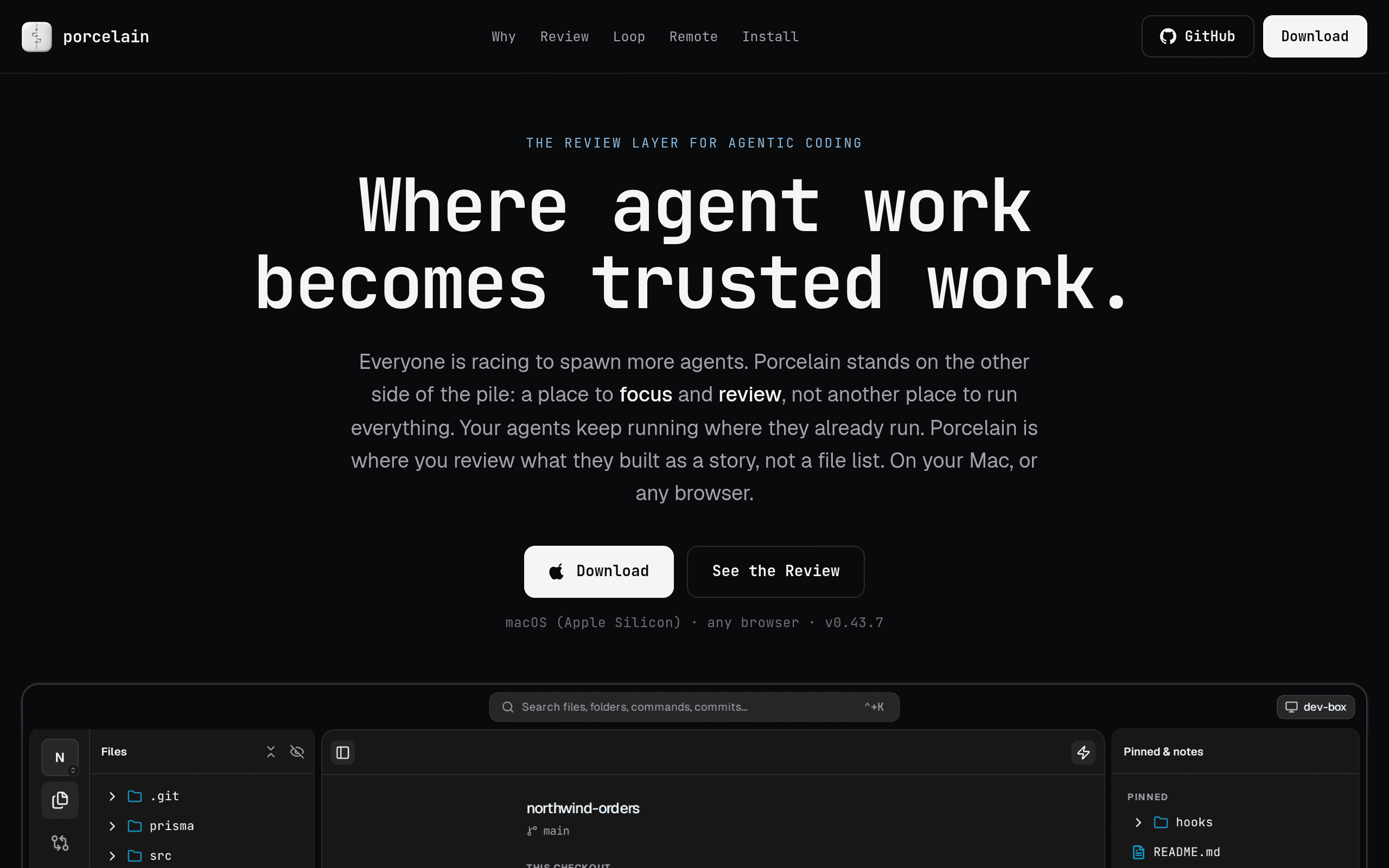
What Porcelain actually is
Porcelain is not another Git client. It's a review companion built specifically for the moment we're all quietly struggling with right now: an AI coding agent (Claude Code, Aider, Cursor's agent mode, Devin, whatever CLI you've wired up) just finished a task and produced a pile of changes across a dozen files, and you have to decide whether to trust it.
Instead of showing you a raw diff and asking you to reconstruct what the agent was trying to do, Porcelain restructures the review around three sections:
- Intent — what the agent understood the task to be
- Execution — what it actually changed, file by file
- Evidence — why it believes the change satisfies the intent (tests run, output captured, reasoning shown)
The pitch is simple: reviewing agent output is a different cognitive task than reviewing a coworker's PR. A human PR usually comes with shared context you already have. Agent output doesn't — you're often reviewing something you didn't ask for in that exact form, generated by a process that can't be interrupted mid-thought to explain itself. Porcelain tries to make that explanation structural instead of something you have to dig for in a chat transcript.
The two-way loop
The part that separates Porcelain from a diff viewer is that review isn't a dead end. You leave comments directly on the Execution or Evidence sections, and those comments get routed back to the agent CLI as follow-up instructions — the agent resolves them and the review updates in place. In practice this replaces the current copy-paste workflow most people use: read the diff, switch to the terminal, paste feedback into the agent's chat, wait, switch back, re-read the whole diff again. Porcelain keeps the review state persistent through that cycle instead of making you start over.
How it runs
Two things stand out about the deployment model:
- Runs as a native macOS app or in any browser — no separate install path required depending on your setup.
- Local-only, no accounts, no telemetry. There's no sign-up flow, no workspace to provision, no data leaving your machine. For anyone reviewing proprietary or client codebases through an AI agent, this matters more than it sounds — a lot of the current "AI review" tooling on the market is SaaS-first and phones home by default.
It connects to your existing agent CLIs rather than replacing them, so you keep whatever agent setup you already have (Claude Code, Aider, etc.) and Porcelain sits on top as the review layer.
Pricing
As of this writing, Porcelain has no published pricing page or tiers. The project is distributed from its GitHub Pages site (fabiofiorita.github.io/porcelain) with no checkout, license key, or account gate visible in the current build — consistent with the "no accounts, no telemetry" positioning. Treat it as free-to-try in its current early state, but don't assume that persists: local-first dev tools that gain traction often introduce a paid tier later (usually team features or hosted sync), so if you adopt it now, don't build a workflow that assumes today's cost stays $0 forever. Check the site directly before rolling it out to a team.
Concrete use cases
- Reviewing an overnight agent run. You kick off a long-running Aider or Claude Code session before leaving for the day. Instead of opening a 40-file diff cold in the morning, you open Porcelain and read the Intent section first to remember what you actually asked for.
- Multi-step refactors where the agent made judgment calls. When an agent renames a module and touches 15 call sites, the Evidence section is where you check whether it actually ran the test suite or just claims the change is safe.
- Handing agent output to a teammate for review. Because the review is structured rather than a raw diff, a teammate who didn't write the prompt can still evaluate the change without reading the full agent transcript.
- Iterating without re-reading everything. You leave three inline comments ("this error handling swallows the original exception," "use the existing logger instead of print"), the agent resolves them, and you re-check just those sections instead of the whole diff again.
How it compares
| Porcelain | GitHub Pull Requests | GitKraken | Tower | |
|---|---|---|---|---|
| Price | Not published (currently free, no checkout) | Free for public/private repos; Team $4/user/mo, Enterprise $21/user/mo | Free tier limited; Pro ~$4.95/user/mo billed annually | ~$79/yr per user (Basic), Pro tier higher |
| Review model | Structured: Intent / Execution / Evidence, built for agent output | Raw unified diff + inline comment threads | Visual commit graph + diff viewer, human-authored history | Visual Git client, side-by-side diff, human-authored history |
| Agent-aware feedback loop | Yes — comments route back to the agent CLI to resolve and re-review | No — comments are for humans; no agent resolution loop | No | No |
| Account/telemetry | None required, local-only | Requires GitHub account, telemetry per GitHub ToS | Requires account for sync features | Requires license, some telemetry |
| Best for | Reviewing output from Claude Code, Aider, or similar agent CLIs before merging | Standard team PR review workflows tied to GitHub-hosted repos | Visualizing branch/commit history for human-driven Git work | Mac/Windows GUI users who want a polished local Git client |
The honest verdict
GitHub PRs, GitKraken, and Tower all assume the diff in front of you was written by a person who can answer questions in Slack. Porcelain is built on the opposite assumption — that the "author" is a process that just ran, can be re-invoked, and needs its reasoning surfaced rather than inferred. If you're already running agent CLIs daily and finding that raw diffs plus copy-pasted chat feedback is your bottleneck, it's worth installing today, especially since it's local-only and currently free. If your review workflow is still mostly human-to-human PRs, this isn't a replacement for GitHub or Tower — it solves a problem you may not have yet. The biggest open question is pricing: with nothing published, early adopters should treat this as a free preview rather than a stable, long-term cost baseline.