Prelint: First Look at the GitHub Bot That Checks PRs Against Your Product Spec, Not Just Your Code Style
By Day Zero Guides Editorial · How we produce guides
Some links in this guide are affiliate links. If you sign up through them, Day Zero Guides may earn a commission at no extra cost to you. This never affects which products we cover or what we say about them. See our affiliate disclosure for details.
Concrete Use Cases Where This Makes Sense
- Fintech/insurance teams with hard compliance rules. If you have rules like "never let a PR touch KYC verification logic without a compliance-flagged reviewer," Prelint can catch a Copilot-assisted PR that refactors that path without anyone flagging it as sensitive.
- Teams shipping fast with AI-generated PRs. If a meaningful chunk of your PRs originate from Cursor/Copilot-style tools, Prelint's core bet — that generated code drifts from spec in ways linters can't catch — is most relevant to you specifically.
- Multi-market SaaS with regional business rules. Pricing tables, tax logic, feature-flag gating by region — these are exactly the "looks correct, violates a constraint" bugs that pass code review and fail in production three weeks later.
- Teams that don't want another Jira/Linear bot cluttering PR comments. If your current setup is a linked ticket plus a human skimming for context, Prelint is a bet that automated spec-checking catches more than ticket-linking does.
Where it's probably not the right tool yet: small teams with simple, stable business logic, or teams whose "spec" lives entirely in a founder's head rather than any written doc. Prelint can only check PRs against what it's been given — garbage or absent spec in, garbage check out.
What Prelint Actually Does
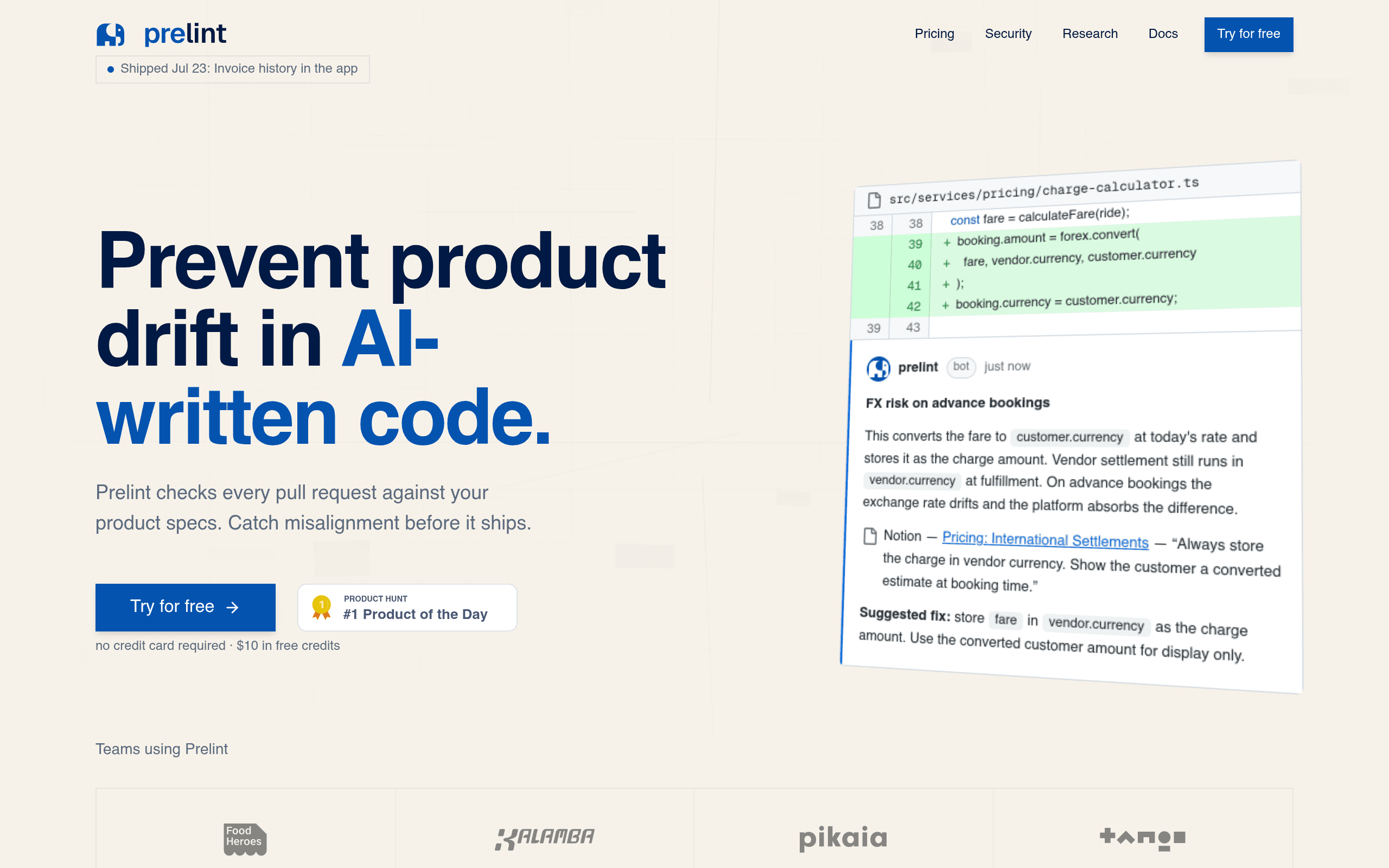
Most PR review bots — Greptile included — read your diff and tell you whether the code is good. Prelint is trying to answer a different question: does this code do what the product is actually supposed to do? It sits in your GitHub repo, ingests stored product specs, compliance rules, and business constraints (think: "refunds over $500 require manager approval," or "EU users must never see the US pricing table"), and then checks every incoming pull request against that stored context before a human ever looks at it.
The pitch is explicitly about AI-driven code drift. As more teams ship code generated or heavily assisted by Copilot, Cursor, or agentic coding tools, the failure mode isn't syntax errors — it's plausible-looking code that quietly violates a business rule nobody wrote down in the diff. A generated PR might correctly implement "add a discount field" while completely missing that discounts can't stack with promo codes per a rule buried in a spec doc from three months ago. That's the gap Prelint is aiming at.
It runs as a GitHub integration (installed like any other review app/bot on your repo), reads the spec/compliance material you feed it, and comments directly on the PR — flagging business logic violations, compliance conflicts, or strategic misalignment. The stated goal is no human required in that first pass of the loop, though in practice you'll still want someone to triage what it flags.
Setting Expectations on What's Actually Live
This is a new product, and it reads like one: the marketing is clear about the concept, less clear about mechanics you'd want nailed down before trusting it on a production repo. Specifically, before you install it, go look for answers to:
- How specs get ingested. Is this a markdown file in-repo, a wiki/Notion sync, or manual upload? This determines how much upkeep the tool needs to stay accurate.
- How "compliance rules" are defined. Free text? Structured rules? If it's free text, your results will be as good as your spec-writing discipline.
- False positive rate at scale. A bot with zero humans in the loop that's too trigger-happy will get muted fast by any team with PR velocity.
None of that disqualifies Prelint — it just means today's decision is "is this worth piloting on one repo," not "should this replace our review process."
Pricing: Free Credits, No Published Tiers Yet
As of this writing, Prelint offers $10 in free credits to get started, with no public pricing page breaking down plans, per-seat cost, or usage-based rates beyond that. That's typical for a just-launched dev tool still calibrating usage patterns (PR volume, spec size, and check frequency all likely factor into eventual cost). Practically, this means:
- You can test it on a real repo without a credit card commitment beyond the trial credit.
- You should treat any pilot as time-boxed — burn through the $10 credit deliberately on your highest-risk repo (the one with the most business logic, not the most code volume) rather than spreading it thin across everything.
- Budget for pricing to shift once tiers are published; don't build a workflow around cost assumptions you can't verify yet.
How It Stacks Up
| Prelint | Greptile | GitHub native code review tools | Linear/Jira integration bots | |
|---|---|---|---|---|
| Price | $10 free credit, no published tiers | Paid plans from ~$30-$50/seat/month (tiered, published) | Free (built into GitHub) | Varies by bot; often free tier + paid automation add-ons |
| Primary check | Business logic, compliance, spec alignment | Code quality, bugs, codebase-aware suggestions | Syntax, diffs, required approvals, CI status | Ticket linkage, status sync, workflow automation |
| Human-in-loop requirement | Designed to flag without requiring one | Assists human reviewers, doesn't replace them | Fully human-driven | Fully human-driven, bot just automates bookkeeping |
| Best for | Teams with written specs/compliance rules and AI-generated PR volume | Teams wanting deeper code-quality review across a large codebase | Every team, baseline | Teams wanting ticket-to-PR traceability, not logic checking |
| Setup effort | Requires feeding it spec/compliance content upfront | Points at repo, learns codebase automatically | Zero — native | Connects via API keys, ticket IDs in PR titles |
The honest read: Greptile and Prelint aren't quite direct competitors despite both being GitHub PR bots — Greptile is closer to a smarter linter/reviewer for code quality, while Prelint is checking against external business truth. Linear/Jira bots solve traceability, not correctness. If your PRs are already passing code review but still shipping bugs that are really "we didn't realize this violated policy X," Prelint is aimed squarely at that gap; nothing else on this list is.
Should You Try It Today
Yes, if you have a written spec or compliance doc somewhere and a repo where AI-assisted PRs are landing regularly — the $10 credit is low-risk enough to run a real pilot on one repo for a week or two and see how many flags are genuinely useful versus noise. Hold off if your specs live only in Slack threads and tribal knowledge; feed Prelint bad input and it can only give you unreliable output. Given the lack of published pricing, don't commit to it as permanent infrastructure yet — treat this as evaluation, not adoption.