Privasee First Look: Can a €290/Month Browser Extension Make ChatGPT Safe for Client Files?
By Day Zero Guides Editorial · How we produce guides
Some links in this guide are affiliate links. If you sign up through them, Day Zero Guides may earn a commission at no extra cost to you. This never affects which products we cover or what we say about them. See our affiliate disclosure for details.
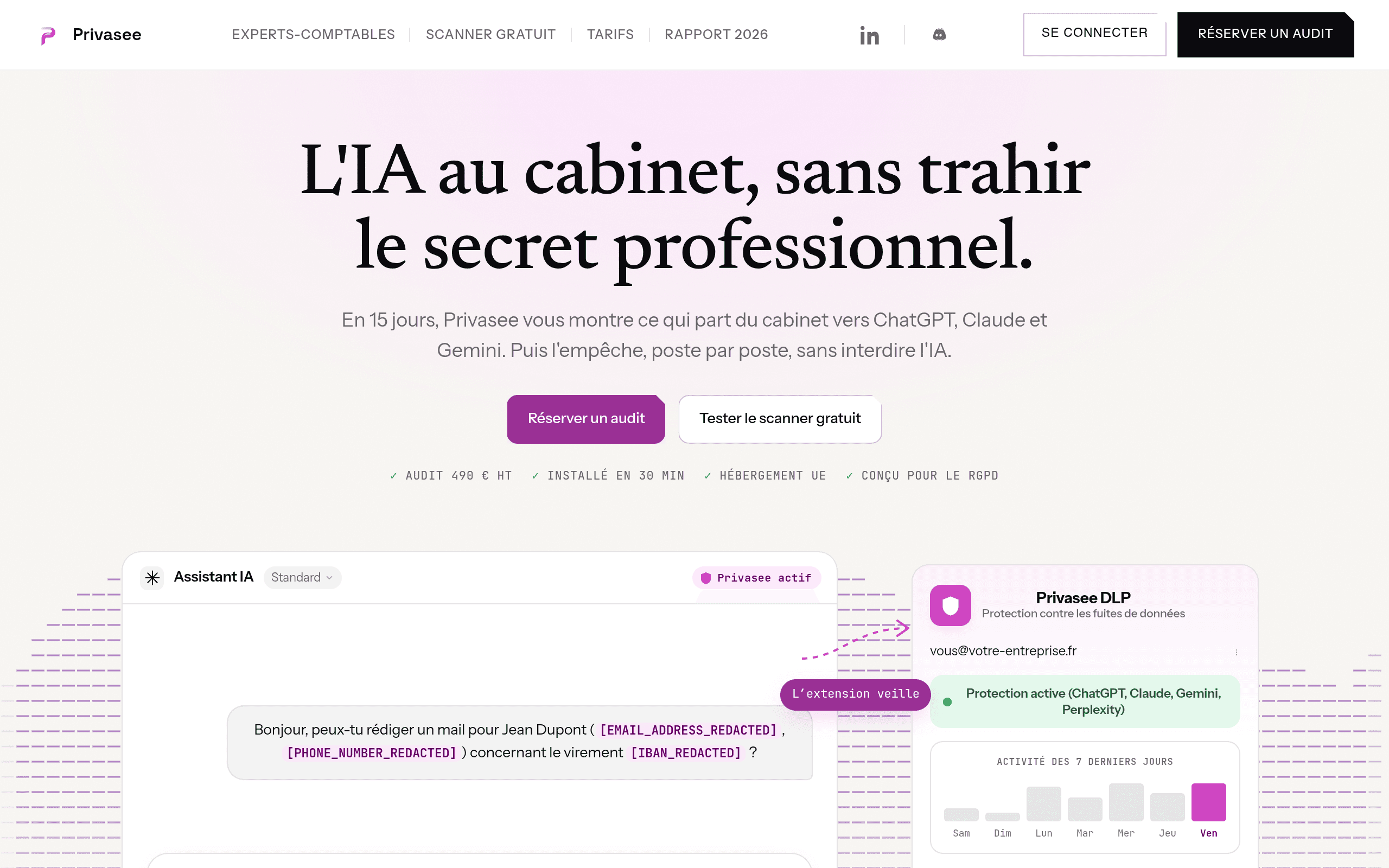
What Privasee Costs and What You Actually Get
Privasee is priced in three tiers, all quoted in euros HT (before French VAT), which immediately tells you who this is built for: French professional offices — law firms (cabinets d'avocats), accounting firms (experts-comptables), and notaries — not general enterprise IT departments.
- Audit Shadow IA — €490 HT, one-time. This is a diagnostic engagement, not a software license. Privasee scans how your office is already using AI tools (sanctioned or not — hence "Shadow IA") and reports on what sensitive data has likely already leaked into ChatGPT, Gemini, or Claude sessions. It's the entry point for offices that suspect they have a problem but don't know its size.
- Cabinet — €290 HT/month, up to 10 users. This is the core product: the browser extension itself, installed across a small office, redacting and pseudonymizing data in real time before it leaves the browser for any connected AI service.
- Cabinet 30 — €690 HT/month, up to 30 users. Same feature set, scaled for a mid-size firm or a multi-partner practice.
- Groupe — custom pricing. For networks of offices or larger firms needing centralized policy management across multiple locations.
Privasee also runs a first-month-free trial, with the catch that you need to commit (or cancel) within 30 days of signing up. For a 10-person law firm, that math works out to roughly €29/user/month if you go with Cabinet — not trivial, but cheap relative to a single data breach notification under RGPD, which is the real anxiety this product is selling against.
What that price buys you is narrow but well-targeted: a browser extension that sits between your staff and whatever AI chat interface they're using, scans outgoing text for sensitive categories (names, IBANs, social security numbers, health records, case references), masks them with placeholder tokens before the API call goes out, and then swaps the real data back into the AI's response on your screen. You never see raw personal data leave your machine; the AI never sees it either.
What Privasee Actually Does Under the Hood
The core mechanic is reversible pseudonymization, not blocking. A lot of "AI safety" tools for offices work by simply refusing to let staff paste sensitive text into ChatGPT at all — which pushes people to bypass the control entirely by using personal devices. Privasee's bet is that redaction-with-restoration is the only approach that survives contact with how lawyers and accountants actually work day to day.
Concretely: a paralegal drafts a prompt referencing "Jean Dupont, IBAN FR76 3000..." asking ChatGPT to summarize a settlement letter. Privasee's extension intercepts the outgoing request, replaces the name and IBAN with placeholder tokens (something like "CLIENT_A" and "IBAN_TOKEN_1"), sends the sanitized version to OpenAI's servers, receives the response, and re-inserts the real name and IBAN back into the text shown in the browser. The AI service itself never receives the real personal data, which matters specifically because standard ChatGPT and Gemini consumer/business tiers may retain or process conversation data in ways that don't satisfy RGPD data minimization requirements for client files.
Who This Is Actually For
A 6-partner accounting firm using ChatGPT to draft client correspondence. Staff are already using AI informally to speed up routine letters referencing account numbers and client names. The Cabinet plan (€290/month) lets the partners stop pretending this isn't happening and instead put a technical control around it without banning the practice outright.
A notary office handling succession files with health and family data. Succession and inheritance cases routinely involve medical records and family relationship details — categories Privasee explicitly flags for redaction. The Audit Shadow IA engagement is the natural first step here: find out which AI tools staff have already used on these files before deciding on an ongoing subscription.
A 25-lawyer firm standardizing AI usage policy post-incident. After a near-miss where a junior associate pasted a client's full case file into Claude for a quick summary, the firm needs both a technical fix and an auditable policy. Cabinet 30 (€690/month) plus centralized reporting covers that.
How It Compares
Privasee isn't really competing head-to-head with the big enterprise DLP suites — it's a cheaper, narrower, faster-to-deploy alternative aimed at offices too small to run a Microsoft or OpenAI enterprise rollout. The comparison is still useful because it clarifies what you're trading off.
| Privasee | Microsoft Copilot + DLP | OpenAI Enterprise (data governance) | Nightfall AI | |
|---|---|---|---|---|
| Starting price | €290 HT/month (up to 10 users) | Requires M365 E5 or Copilot add-on (~$30/user/month) plus Purview DLP licensing | Custom enterprise contract, typically five-figure annual minimums | From ~$99/month for small teams, enterprise pricing scales with data volume |
| Core mechanism | Reversible pseudonymization at the browser level before data leaves the device | Policy-based blocking/labeling across Microsoft 365 apps and Copilot prompts | Contractual data controls (no training on inputs, retention limits) rather than content redaction | Cloud-based DLP scanning across SaaS apps, Slack, email, and AI tool integrations |
| Setup time | Browser extension install, same day | Requires existing M365 E5/Purview infrastructure, IT-led rollout | Legal/procurement-led, weeks to negotiate | Cloud integration setup, days to weeks depending on app coverage |
| Best for | Small-to-mid French professional offices (law, accounting, notary) already using consumer AI tools informally | Large enterprises already standardized on Microsoft 365 and Copilot | Large enterprises with dedicated legal/compliance teams negotiating direct OpenAI terms | Mid-size to large companies needing DLP across many SaaS tools, not just AI chat |
| RGPD/local fit | Purpose-built for French cabinets, RGPD framing baked into product language and audit offering | General-purpose, requires configuration for RGPD-specific categories | Governed by enterprise contract terms, not French-specific by default | General-purpose, configurable but not France/profession-specific |
The honest read: if you're a 50,000-seat enterprise already paying for Microsoft 365 E5 or negotiating directly with OpenAI, Privasee isn't for you — you have (or should have) DLP infrastructure already. But if you're a 12-person law firm whose partners just found out three associates have been pasting client names into free ChatGPT, Privasee's combination of low entry price, French-specific framing, and same-day browser install is a materially faster path to "we did something about this" than standing up Purview policies or waiting on an OpenAI Enterprise sales cycle.
The Catch Worth Knowing Before You Sign Up
Privasee's redaction only covers what passes through the browser extension. If staff use a desktop AI app, a mobile app, or an API integration outside the browser, it won't see or protect that traffic — worth confirming directly with their team if your office's AI usage goes beyond browser-based chat interfaces. The 30-day free-trial-to-paid conversion window is also tight for a professional office that needs partner sign-off before committing to a recurring line item, so loop in whoever controls the budget before day one of the trial, not day twenty-five.