Profenor Deduction Checker: First Look at the New Shopify Tax Deduction Tool
By Day Zero Guides Editorial · How we produce guides
Some links in this guide are affiliate links. If you sign up through them, Day Zero Guides may earn a commission at no extra cost to you. This never affects which products we cover or what we say about them. See our affiliate disclosure for details.
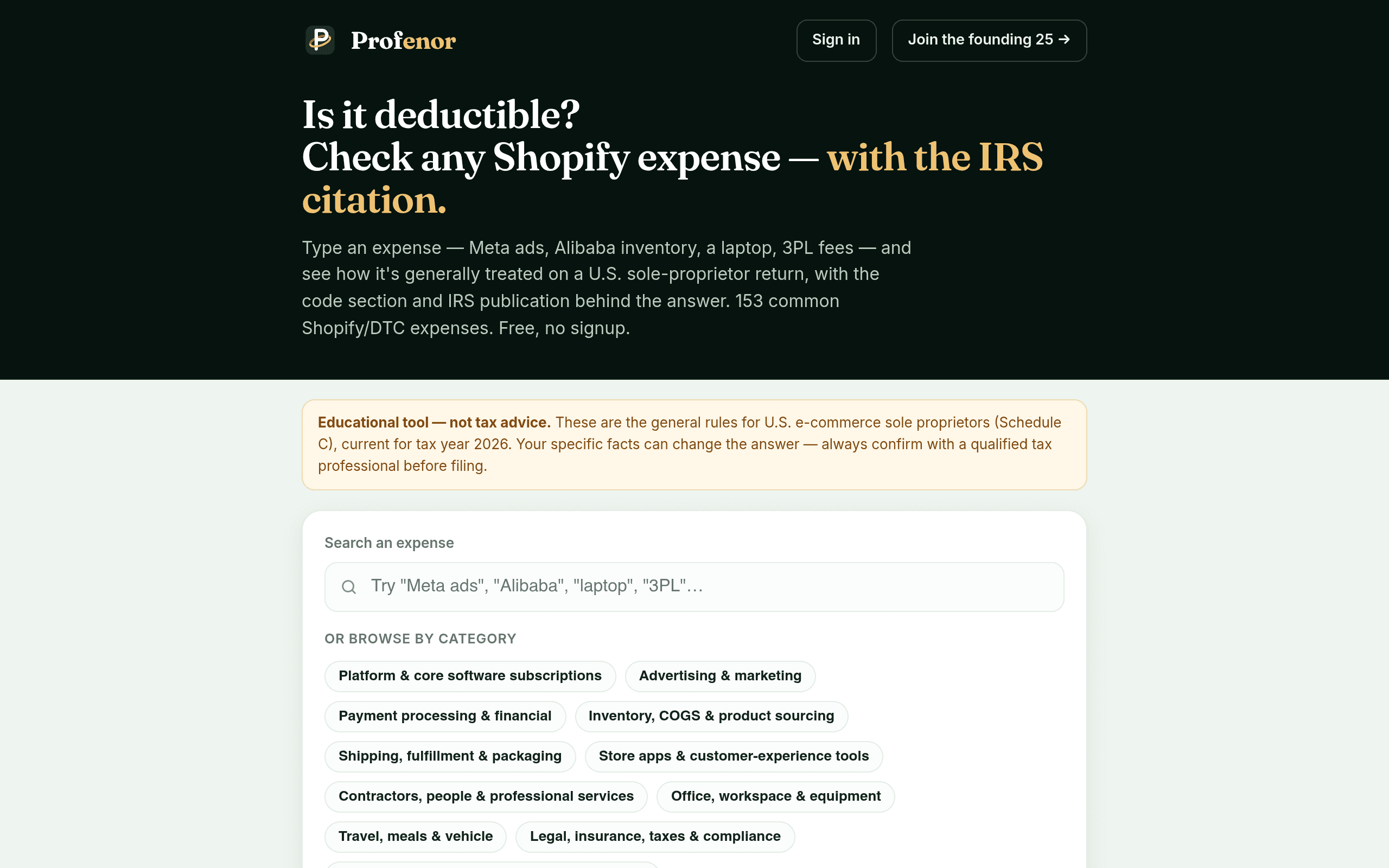
What Profenor Deduction Checker Actually Is
Profenor Deduction Checker is the entry point into a larger product called Profenor, built specifically for U.S. e-commerce sole proprietors — think one-person Shopify stores selling candles, apparel, or print-on-demand goods, filing a Schedule C with their personal return. The Checker itself is the free-to-try, educational layer: you tell it what you spent money on, and it tells you whether that expense is plausibly deductible and which IRS code or publication backs it up (think Publication 535 for business expenses, Publication 587 for home office use, and the Schedule C instructions for categorization).
It is explicitly not a tax filing tool and not a substitute for a CPA. It's positioned as a "figure out what you're missing" tool before you either hand things to an accountant or plug numbers into your own return.
The bigger pitch is what happens after the Checker hooks you: connect your Shopify store, and Profenor moves from "here's what might be deductible" to automatically categorizing your real transactions, calculating profit per order (revenue minus COGS, shipping, ad spend, and platform fees), generating a P&L statement, and watching your sales tax nexus exposure across all 50 states as your order volume grows in new states.
Who This Is Actually For
- A solo Shopify seller doing $80k–$400k a year in revenue who has never itemized business expenses beyond "whatever my accountant asks for in January."
- Someone running ads on Meta or TikTok who isn't sure if ad spend, influencer payments, or software subscriptions (Canva, Klaviyo, apps) count as deductible and under what category.
- A seller who just crossed into economic nexus territory in a second or third state and has no idea they might owe sales tax there.
- Someone working from a spare bedroom who wants to know if the home office deduction is worth the audit risk versus the tax savings.
It is not built for LLCs with employees, multi-member partnerships, or sellers who already have a bookkeeper doing monthly categorization — QuickBooks Online or an actual bookkeeper covers that ground better.
How It Works, Concretely
You answer a short intake (roughly: business structure, platform used, rough annual revenue, and a list of expense categories you're unsure about — home office, mileage, packaging, returns/refunds, software, contractor payments, inventory storage). For each item you flag, it returns a plain-language explanation, the specific IRS code or publication section it's citing, and a rough note on documentation you'd need to defend the deduction (mileage logs, a dedicated-use photo of your home office, invoices for contractor payments over $600 triggering 1099-NEC requirements).
The full connected product (Shopify OAuth integration) is where it starts doing real bookkeeping work: pulling actual order and expense data, auto-tagging transactions against the categories the Checker taught you about, and rolling everything into a profit-per-order view and a P&L you could hand to an accountant.
Pricing: What's Published and What Isn't
As of this writing, Profenor has not published a pricing page for the Deduction Checker or the full Shopify-connected product. There's no visible free tier limit, no listed monthly fee, and no annual plan comparison — you sign up and use the Checker, and pricing for the connected features (Shopify integration, P&L generation, nexus monitoring) appears to be revealed later in the funnel or on request.
That's worth flagging plainly: if you're comparing tools by dollar cost today, Profenor is the one line item you can't fill in yet. Everything below is based on what's actually published for the competitors, and an honest "unknown" for Profenor.
How It Compares
| Profenor Deduction Checker | QuickBooks Online | TaxJar | FreshBooks | |
|---|---|---|---|---|
| Price | Not published | $35–$235/mo (Simple Start to Advanced) | Starts ~$19/mo, scales with order volume; $99+/mo for API-based multi-state filing | $19–$60/mo (Lite to Premium) |
| Core focus | Deduction discovery mapped to IRS codes + Shopify profit/P&L tracking | Full double-entry bookkeeping and accounting | Sales tax calculation, nexus tracking, and filing | Invoicing, time tracking, expense logging for service businesses |
| Sales tax nexus monitoring (50 states) | Yes, built in to the connected product | Not native — requires an add-on like Avalara | Yes, this is TaxJar's core feature | No |
| Native Shopify integration | Yes | Via third-party connector app | Yes | Via app/Zapier, not native |
| Best for | Solo Shopify sellers who don't know what they're allowed to deduct yet | Businesses needing full books, payroll, and multi-user accounting | Multi-state sellers who need nexus tracking and automated filing | Freelancers and service businesses invoicing clients |
Where It Actually Helps Today
- Catching missed deductions before tax season: running your ad spend, packaging costs, and software stack through it before you file is faster than reading IRS Publication 535 cover to cover.
- A gut check before hiring a CPA: walking into a first accountant meeting with a list of "here's what I think is deductible and why" saves billable hours.
- Early nexus awareness: if you've never checked where you have economic nexus, the monitoring feature (once connected) is the kind of thing that prevents a nasty back-tax surprise in a state you didn't know you owed in.
Where It Falls Short Right Now
- No published pricing means you can't budget for it against QuickBooks or TaxJar before signing up — a real friction point for a tool aimed at cost-conscious solo sellers.
- It's explicitly educational, not a filing tool, so it doesn't replace TaxJar for actual sales tax remittance or QuickBooks for real books your accountant will want at year-end.
- As a new product, there's no track record yet on how accurate the IRS-code citations stay as tax law changes year to year — worth independently verifying anything it tells you before relying on it.
Should You Try It Today
If you're a solo Shopify seller who has never sat down and mapped your actual expenses to IRS categories, running through the Deduction Checker costs you fifteen minutes and could surface a few hundred to a few thousand dollars in deductions you weren't taking. It's a reasonable first step precisely because it's narrow and free to start. But don't cancel QuickBooks or TaxJar based on this — Profenor is aiming to eventually replace pieces of both for sole proprietors, but until pricing and the Shopify-connected feature set are public and battle-tested, treat it as a smart pre-check, not your bookkeeping system of record.