RankTent First Look: Can One Tool Replace Your GSC-to-Content-Brief Workflow?
By Day Zero Guides Editorial · How we produce guides
Some links in this guide are affiliate links. If you sign up through them, Day Zero Guides may earn a commission at no extra cost to you. This never affects which products we cover or what we say about them. See our affiliate disclosure for details.
The scenario that makes RankTent click
You pull up Google Search Console and find a page ranking at position 14 for a keyword with real volume — close enough to page one that it's maddening, far enough that you know the content is thin. Normally this means: export the query data, open a rank tracker to confirm the opportunity, open another tab to manually read the top 10 competing pages, take notes on what they cover that you don't, and then start drafting a brief in a doc before finally writing the update. That's four or five tools and an hour of grunt work before you've typed a single sentence of actual content.
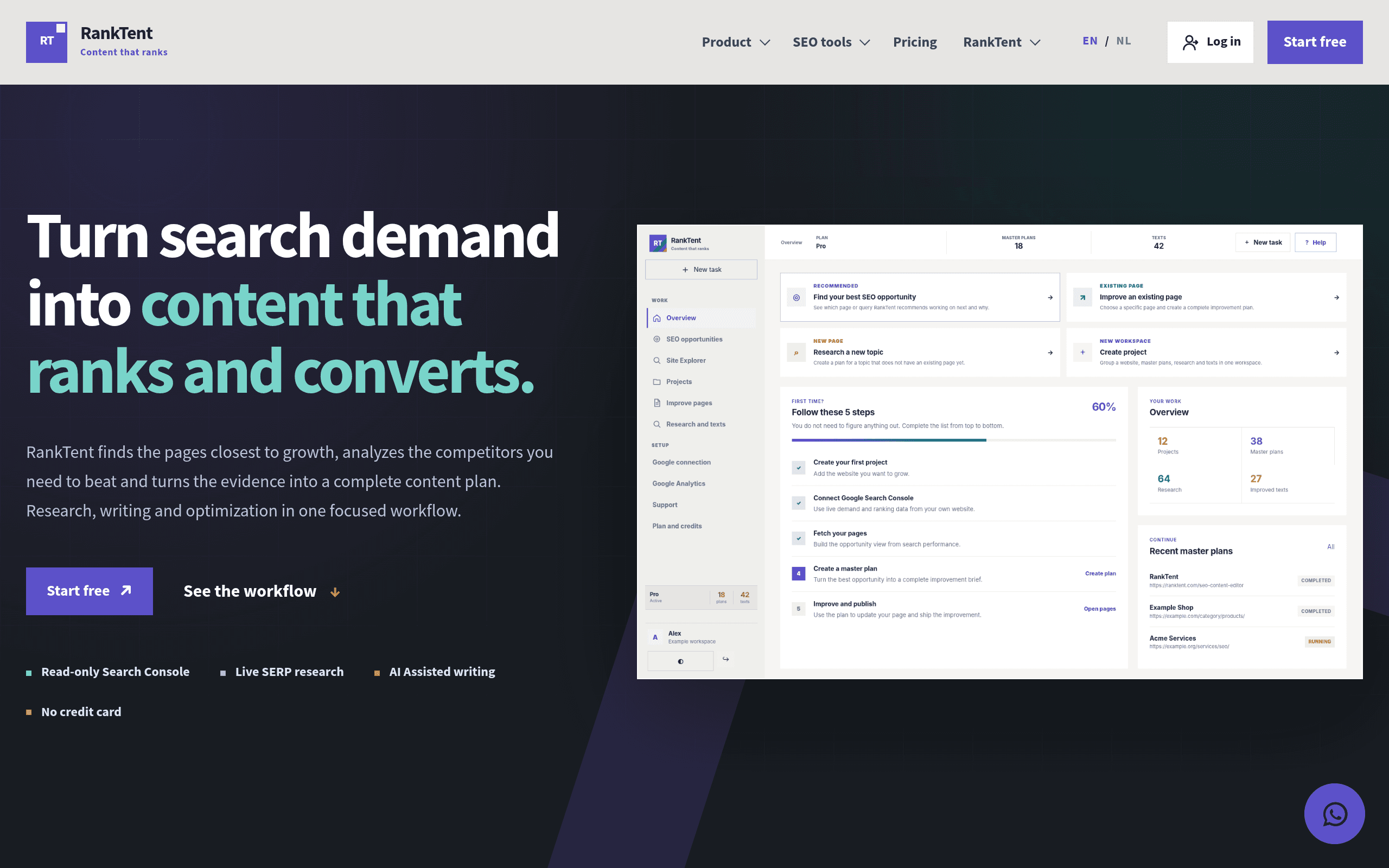
RankTent is built specifically to collapse that sequence. You connect Search Console, it surfaces that position-14 page itself (not just the keyword), pulls the current top-ranking competitors for the query, diffs what they cover against your existing content, and hands you a structured brief — then lets you generate a draft from that brief in the same screen. If that "GSC page stuck on page two, what do I add to push it to page one" moment is a weekly occurrence for you or your content team, this is the exact job RankTent was built to do.
What RankTent actually is
RankTent is an SEO content planning platform that sits on top of your Google Search Console data. Instead of starting from keyword lists (the Semrush/Ahrefs starting point), it starts from your actual indexed pages and their actual query performance, then layers on:
- Site Explorer — search and surface pages/queries from your connected GSC property
- SERP and competitor analysis — pulls who's currently ranking for a target query and what their content covers
- Master Plans — a content brief/plan built from the evidence gathered (gaps, subtopics, structure)
- AI-assisted writing — generates draft content from the brief, using AI text credits
The pitch isn't "better keyword data than Ahrefs" — it's fewer tool switches between finding an opportunity and shipping an optimized page.
Pricing: what's actually published
RankTent's free plan is the only tier with concrete, published numbers on the homepage:
- 1 project
- 1 master plan credit
- 3 AI text credits
- 10 Site Explorer searches
That's enough to run the exact scenario above once or twice — connect one property, find one opportunity, generate one brief, draft one page — but not enough to run an ongoing content operation.
Paid tiers exist but RankTent doesn't publish flat dollar pricing on the site. Instead, plans scale along three levers: number of projects, number of master plans, and number of AI text credits. In practice this means you pick a plan based on how many sites you manage and how many briefs/drafts you need per month, rather than picking from a fixed Starter/Pro/Enterprise price list. If you're evaluating this for a team or agency with multiple client sites, expect to go through a pricing/sales conversation rather than a self-serve checkout — worth flagging before you assume you can budget this in five minutes the way you can with Semrush.
How it compares
| RankTent | Semrush | Ahrefs | Jasper | |
|---|---|---|---|---|
| Starting price | Free (1 project, 1 master plan, 3 AI credits, 10 Site Explorer searches); paid tiers usage-based, pricing not public | $139.95/mo (Pro) | $129/mo (Lite) | $49/mo (Creator) |
| Core data source | Your connected Google Search Console property | Independent keyword/backlink index | Independent keyword/backlink index | None — text generation only, no SEO data |
| Key feature | GSC-driven opportunity detection + auto-generated content briefs in one workflow | Broadest all-in-one SEO toolkit (keywords, backlinks, site audit, PPC) | Deepest backlink/crawl data, strongest for technical + link analysis | Strongest long-form AI writing with brand voice controls |
| Content brief/plan generation | Yes, built-in ("Master Plans"), evidence-based from competitor diffing | Limited (SEO Content Template, basic) | No native brief builder | No — writes from your brief, doesn't build one |
| AI drafting | Yes, credit-based, tied directly to the brief it generated | No | No | Yes, this is its core function |
| Best for | Teams who already have GSC data and want fewer tool switches from opportunity to draft | Teams needing comprehensive SEO + competitive research across many tools | Link builders, technical SEOs, agencies needing deep crawl/backlink data | Writers/marketers who need high-volume AI content, SEO-agnostic |
The honest read: Semrush and Ahrefs are research-and-data platforms that happen to offer thin brief/content features bolted on. Jasper is a writing platform with no SEO data layer at all. RankTent is the only one of the four built around the specific loop of your existing rankings → what's missing → a brief → a draft. It's narrower than Semrush or Ahrefs (no backlink index, no rank tracking across arbitrary keyword lists, no site audit) and less powerful as a pure writing tool than Jasper (fewer brand-voice/tone controls, no long-form style training). It's a specialist tool for a specific workflow, not a Swiss Army knife.
Concrete use cases where this is the right tool
- Weekly "page 2" triage: A content lead with 200+ indexed pages wants a recurring process to find pages ranking 11–20 and decide which 3 to update each week. RankTent's Site Explorer plus Master Plans is purpose-built for this; Semrush/Ahrefs require manually exporting GSC data and cross-referencing it yourself.
- Solo blogger or small SaaS site: Someone with one GSC property and a handful of underperforming posts can run the free plan's single master plan to test the workflow on their single highest-opportunity page before paying for anything.
- Agency doing content refreshes, not net-new research: If the job is "improve existing client pages" rather than "discover brand-new keyword universes," RankTent's GSC-first approach is more direct than starting from Ahrefs' Keywords Explorer and manually matching to client URLs.
Where it's not the right tool
- No existing GSC history or a brand-new site — RankTent's whole model depends on having query/page performance data to mine; a site with no search traffic yet gets little value from Site Explorer.
- Backlink analysis, technical audits, or PPC/competitor ad research — not in scope here; Semrush or Ahrefs remain necessary for that work.
- High-volume AI content production unrelated to SEO briefs — Jasper's broader writing toolkit (templates, brand voice, team workflows) will serve better if content generation volume matters more than the SEO-brief tie-in.
Should you try it today
If you can name a specific page in Search Console right now that's ranking 11–20 for a keyword you care about, that's the test: connect it, run one Site Explorer search, spend the single free master plan credit on it, and see if the generated brief tells you something you didn't already know from eyeballing the SERP yourself. The free plan is stingy enough (one master plan, three AI credits) that it's really a one-shot trial rather than a workable ongoing plan — so treat it as a proof-of-concept run, not a long-term free tier. If that one brief saves you the hour of manual competitor reading described above, the usage-based paid tiers are worth a pricing conversation; if it doesn't, you likely already have enough coverage from Semrush or Ahrefs plus a writer and don't need a fourth tool in the stack.