ShipStation Review: Pricing, Features, and How It Compares to Shippo, EasyPost, and Pirate Ship
By Day Zero Guides Editorial · How we produce guides
Some links in this guide are affiliate links. If you sign up through them, Day Zero Guides may earn a commission at no extra cost to you. This never affects which products we cover or what we say about them. See our affiliate disclosure for details.
Who Should Actually Use ShipStation
- A Shopify + Amazon + eBay seller shipping 100–5,000 orders/month who wants order management and label printing in one screen.
- A small warehouse team that needs batch printing, pick lists, and shipping rules to speed up daily fulfillment.
- A brand that wants branded tracking pages and a structured returns workflow without building it themselves.
What ShipStation Actually Does
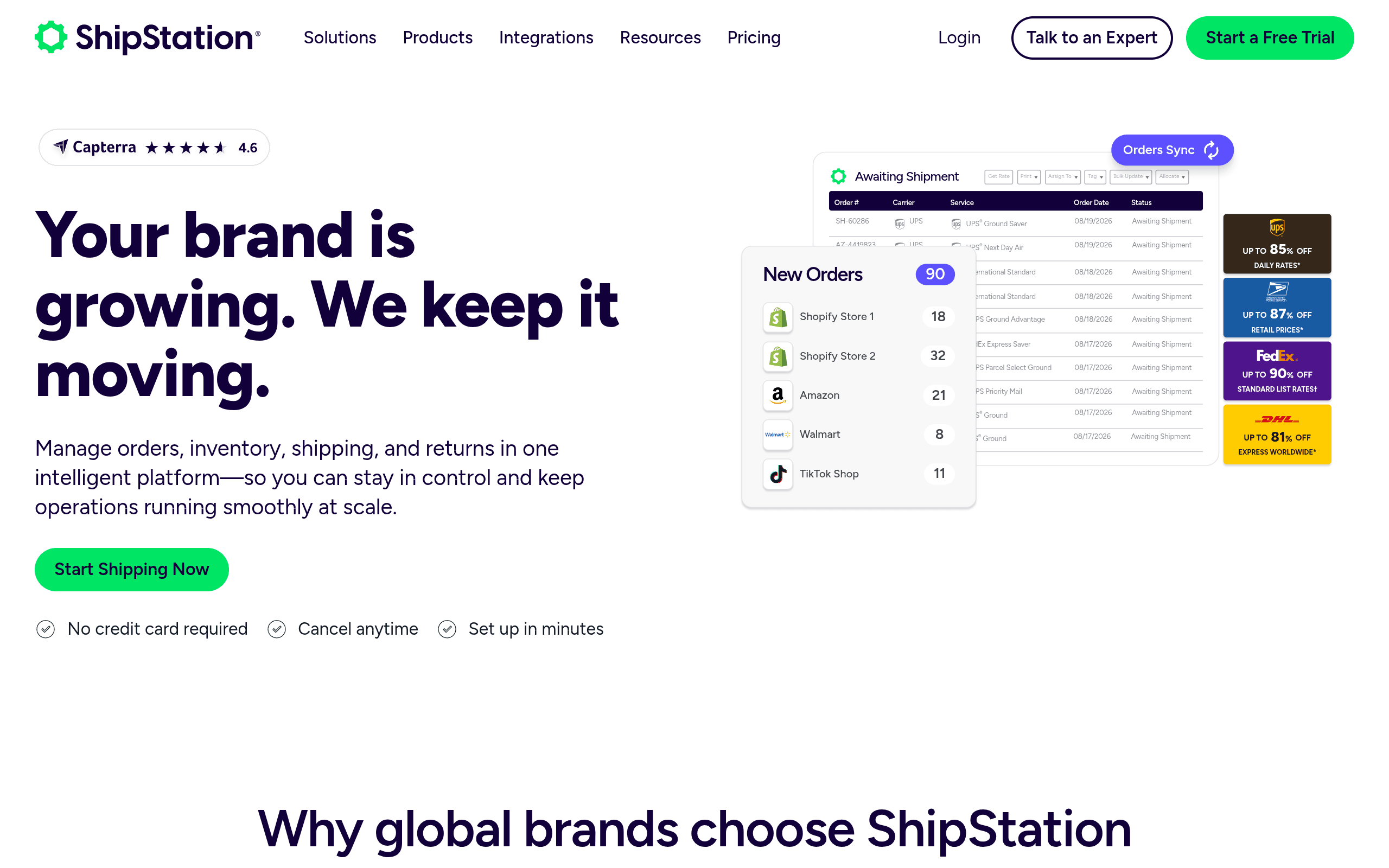
ShipStation is order and shipping management software built for merchants who sell across multiple channels — Shopify, Amazon, eBay, Walmart, WooCommerce, Etsy, and dozens more — and need one place to pull in orders, print labels, and apply shipping rules without logging into ten different dashboards. It's been a staple in ecommerce operations for well over a decade, and it's owned by Auctane, the same parent company behind Stamps.com and Endicia.
If you're comparing shipping tools today, ShipStation sits in a specific niche: it's less of a raw carrier-rate API (like EasyPost) and more of a full operations layer — order syncing, batch label printing, branded packing slips, automation rules, returns management, and reporting — with discounted carrier rates bundled in as a feature rather than the entire product.
Pricing: What You'll Actually Pay
ShipStation doesn't publish a fully itemized price list on its marketing pages the way Shippo or Pirate Ship do — pricing is presented in tiers that scale with monthly shipment volume, and the exact dollar amounts have shifted over the years as the company has repackaged plans. As of this writing, the structure works roughly like this:
- Entry-level plans (sometimes labeled Starter/Bronze-tier) start in the neighborhood of $9.99–$29.99/month and cap you at a few hundred shipments per month, with limited users and automation rules.
- Mid-tier plans (Silver/Gold-equivalent) run roughly $49.99–$99.99/month, unlocking higher shipment caps, more users, and full automation/branding features.
- Platinum and Enterprise tiers are usage- and negotiation-based, aimed at businesses shipping thousands of packages a month, and pricing is quoted directly by a sales rep.
All plans include a free trial (historically 30 days), and carrier rates (USPS, UPS, FedEx, DHL, etc.) are billed separately at ShipStation's discounted rates, not included in the subscription fee. Because ShipStation periodically restructures these tiers and doesn't always list current numbers publicly, treat any specific figure — including the ones above — as directional, and get a live quote before budgeting.
The practical takeaway: ShipStation is a paid, tiered SaaS product with a real monthly cost that grows with volume. That's fundamentally different from Pirate Ship (free software) and closer to Shippo's paid tiers, but with a steeper learning curve and more enterprise-oriented feature depth.
Where ShipStation Is Genuinely Good
- Multi-channel order consolidation. If you sell on five marketplaces plus your own Shopify store, ShipStation pulls every order into one queue automatically, which is where it earns its keep.
- Automation rules. You can set rules like "if order weight > 2 lbs and destination is West Coast, use UPS Ground and apply this packing slip" — genuinely useful once volume gets past a few dozen orders a day.
- Batch printing. Print 200 labels in one pass instead of one at a time — a real time-saver for warehouse-style fulfillment.
- Returns and branded tracking pages. Built-in return label generation and customizable tracking/notification emails are a step up from bare-bones tools.
- Carrier breadth. Deep integrations with USPS, UPS, FedEx, DHL Express, and regional/international carriers, plus negotiated rate discounts that are often competitive without needing your own carrier contracts.
Where It Falls Short
- Pricing opacity. Not being able to see exact current tier pricing without trialing or talking to sales is a real friction point compared to Pirate Ship's dead-simple "it's free" model or Shippo's published per-tier pricing.
- Overkill for very low volume. If you're shipping 20 packages a month, paying a recurring SaaS fee for automation you don't need is a bad trade — Pirate Ship costs nothing and gets you the same USPS/UPS discounts for casual sellers.
- Steeper setup than Shippo or Pirate Ship. The interface is powerful but not always intuitive; expect a real onboarding curve if you've never used a WMS-adjacent tool before.
- Not developer-first. If you need a lightweight shipping API to embed rate-shopping into your own app, EasyPost is built for that use case; ShipStation is built for people using its interface directly, not around its API.
Who Should Look Elsewhere
- A solo Etsy or eBay seller shipping under 50 packages a month — Pirate Ship gets you the same discounted USPS/UPS rates with zero monthly fee and a much simpler interface.
- A developer building shipping logic into a custom app or marketplace — EasyPost's API-first design is a better fit than trying to bend ShipStation's UI-centric platform into a backend service.
- A budget-conscious small business that wants transparent, published pricing tiers without a sales call — Shippo publishes its plan pricing directly and is easier to evaluate without demoing.
How It Compares
| ShipStation | Shippo | EasyPost | Pirate Ship | |
|---|---|---|---|---|
| Monthly cost | Tiered, ~$9.99 to $99.99+/mo depending on volume; custom Enterprise pricing (exact current pricing not fully published) | Published tiers: free pay-as-you-go option, paid plans roughly $10–$40/mo, custom Premier tier | Usage-based API pricing; no monthly software fee for base API, enterprise plans negotiated | Free — no software fee, ever |
| Best for | Multi-channel sellers needing order management + automation at moderate-to-high volume | Small-to-mid sellers wanting simple, published pricing and solid marketplace integrations | Developers embedding rate-shopping/label generation into their own apps | Low-volume sellers who just want cheap labels with no software cost |
| Order/channel integrations | Extensive (Amazon, eBay, Shopify, Walmart, Etsy, dozens more) with deep automation rules | Strong marketplace integrations, simpler rule engine | Minimal — it's an API, not an order management UI | Basic marketplace import (Etsy, eBay, Shopify) but no advanced automation |
| Carrier rate discounts | Yes, negotiated USPS/UPS/FedEx/DHL discounts | Yes, discounted USPS/UPS rates | Access to carrier rates via API, discounts vary by carrier account setup | Yes, notably strong USPS Commercial Plus-level discounts for casual users |
| Learning curve | Moderate to steep — powerful but dense UI | Low to moderate | High if you're not a developer; low if you are | Very low — built for simplicity |
Bottom Line
ShipStation earns its reputation as one of the more capable multi-channel shipping platforms on the market, but it's built for businesses with real order volume and multiple sales channels to juggle — not for someone mailing a handful of packages a week. The lack of transparently published pricing is a legitimate downside when you're trying to compare options quickly, and it's worth getting a direct quote before committing rather than assuming any published figure (including the ranges here) is current.
If your operation has outgrown Pirate Ship's simplicity and you don't need EasyPost's raw API access, ShipStation is a reasonable default — just go in expecting a subscription cost that scales with your shipping volume, and expect to spend a few hours in onboarding before it feels intuitive.