Trading.io First Look: A Gamified Broker Comparison Tool Worth Bookmarking?
By Day Zero Guides Editorial · How we produce guides
Some links in this guide are affiliate links. If you sign up through them, Day Zero Guides may earn a commission at no extra cost to you. This never affects which products we cover or what we say about them. See our affiliate disclosure for details.
What Trading.io Actually Is
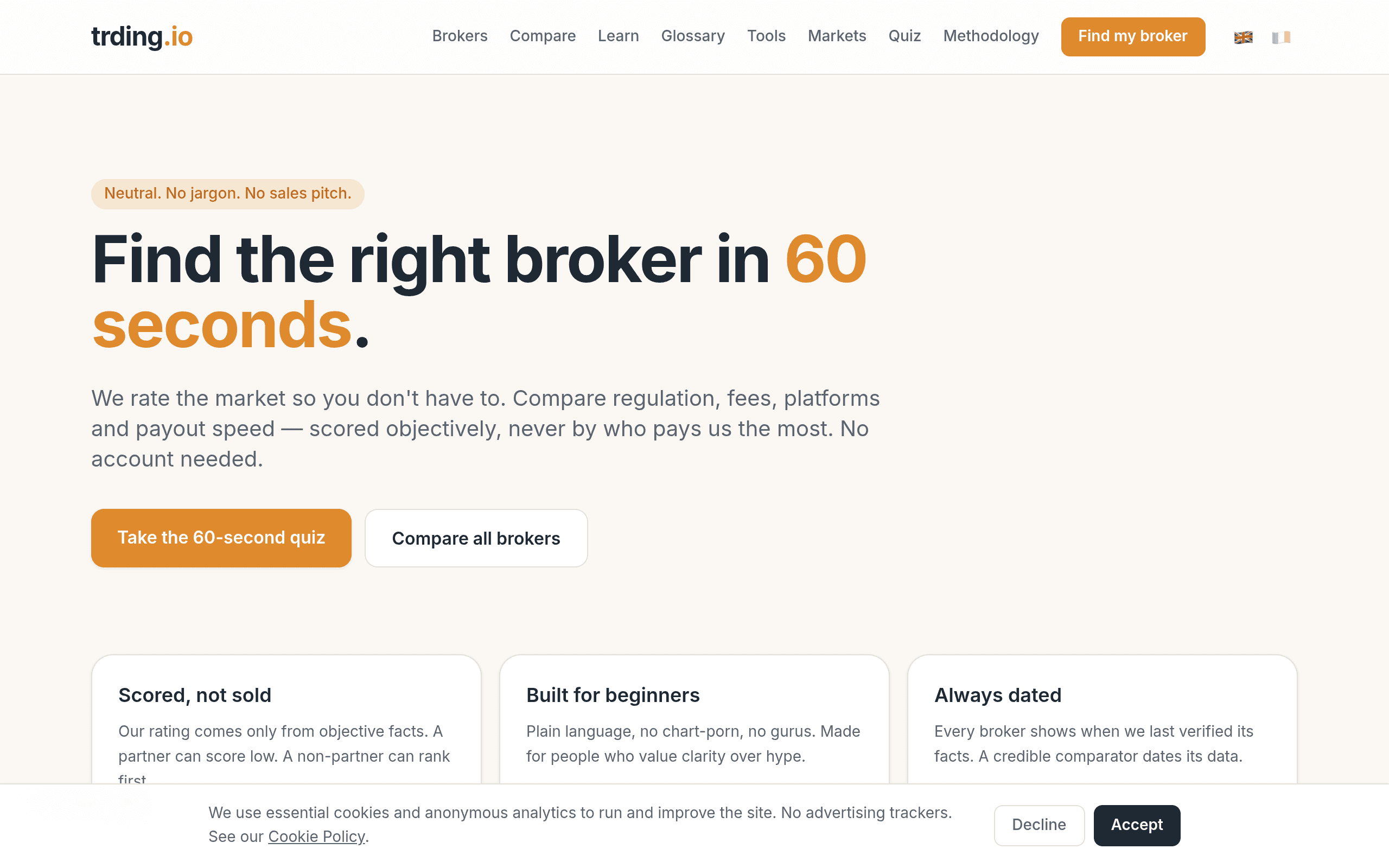
Trading.io (at trding.io) is a broker comparison and rating platform aimed at people trying to pick a forex, stock, or CFD broker without wading through fifty tabs of affiliate blog spam. Instead of the usual "Top 10 Brokers 2024" listicle format, it scores brokers against four hard criteria: regulation, fees, platform quality, and payout/withdrawal speed.
The standout feature — and the thing that separates it from the rest of the broker-review category — is a gamified "wheel" mechanic. You spin it, land on a broker, and see that broker's welcome offer and score breakdown immediately. No email capture, no account creation, no "sign up to see full comparison" wall. That's a real point of difference in a niche where most sites gate the useful data behind a lead-capture form built for affiliate tracking.
How the Scoring Works
Trading.io's model leans on categories rather than star ratings pulled from anonymous reviews:
- Regulation — which licensing bodies actually oversee the broker (tier-1 regulators like the FCA or ASIC score differently than an offshore registration)
- Fees — spreads, commissions, and hidden costs bundled into one comparable score
- Platforms — whether the broker runs proprietary software, MetaTrader, or web-only access, and how stable it is
- Payout speed — how long withdrawals actually take, which is the metric most review sites ignore entirely and the one traders complain about most
This is the part worth paying attention to: most broker "review" sites are really just SEO wrappers around affiliate links, with ratings that correlate suspiciously well with commission size. Trading.io's pitch is that its scoring is criteria-based rather than sentiment-based, which is a meaningfully different approach from review aggregators.
Pricing: What We Know (and What We Don't)
Trading.io has not published a pricing page at launch. Based on how the site currently functions, it appears to be free for traders to browse, compare, and use the wheel — there's no paywall on the comparison data itself. Like most broker-comparison platforms, the likely revenue model is referral/affiliate commissions from the brokers listed, not subscription fees charged to users. If you're a broker wondering what it costs to get listed or featured, that pricing isn't public either — you'd need to contact them directly. We'll update this guide once Trading.io publishes formal pricing or a partner program.
Concrete Use Cases
- You're opening your first live trading account and want to sanity-check a broker's regulatory status before wiring money, without reading a 4,000-word "review" that's actually an ad.
- You already have a broker and want a second opinion on withdrawal speed before moving more capital there — this is the metric traditional star-rating sites bury.
- You want to browse welcome offers/promotions across multiple brokers quickly without triggering a dozen retargeting pixels by submitting your email to each broker's site individually.
- You're comparing 2-3 shortlisted brokers side by side on fees and platform type rather than relying on subjective review scores that can be gamed with fake reviews.
How It Compares
| Trading.io | Trustpilot | BrokerChooser | Finder | |
|---|---|---|---|---|
| Price | Free to use; pricing for broker listings not published | Free for consumers; businesses pay for verified review tools | Free to use; monetized via broker referrals | Free to use; monetized via affiliate/referral links |
| Core method | Criteria-based scoring: regulation, fees, platforms, payout speed | Crowd-sourced star ratings from any submitted user review | Editorial scoring plus fee calculators and quizzes | Editorial comparison tables across finance products broadly |
| Signup required to see data | No — wheel and comparisons are open, no account needed | No, but leaving a review requires an account | No for basic comparisons | No for basic comparisons |
| Scope | Trading/investing brokers only | Any business or service (not finance-specific) | Trading/investing brokers only | Broad — brokers, banks, loans, insurance, credit cards |
| Standout feature | Gamified wheel for discovering welcome offers | Massive review volume, but vulnerable to fake/incentivized reviews | Deep fee and regulation breakdowns per broker | Wide category coverage beyond just trading |
Where It's Weaker Than the Alternatives
BrokerChooser has been doing regulation-and-fee-based broker scoring for years and has a larger catalog with deeper per-broker breakdowns — Trading.io's broker list is currently thinner by comparison, since it's brand new. Trustpilot has far more raw review volume, which matters if you specifically want to see real complaint patterns (delayed withdrawals, support issues) rather than a computed score. Finder covers a broader swath of financial products, so it's a better single stop if you're comparing brokers and say, a business bank account, in the same session.
What Trading.io does better than all three right now is friction: you can get to broker offers and scores in a couple of clicks with zero signup, which is genuinely rare in this space.
Should You Try It Today?
If you're actively broker-shopping this week, spend 10 minutes on Trading.io's wheel and scoring pages alongside — not instead of — BrokerChooser or a Trustpilot search for the specific broker you're eyeing. Trading.io is worth bookmarking for the no-signup convenience and the payout-speed metric specifically, but because the broker catalog is still young and pricing/business model transparency is thin, it shouldn't be your only source before you fund an account. Cross-check regulatory claims directly on the regulator's own register (FCA, ASIC, CySEC, etc.) regardless of which comparison site you use — that step is non-negotiable no matter how good the scoring engine is.