Yondry First Look: The Mood-Based Day Planner That Turns Your Instagram Saves Into an Actual Itinerary
By Day Zero Guides Editorial · How we produce guides
Some links in this guide are affiliate links. If you sign up through them, Day Zero Guides may earn a commission at no extra cost to you. This never affects which products we cover or what we say about them. See our affiliate disclosure for details.
Yondry First Look: The Mood-Based Day Planner That Turns Your Instagram Saves Into an Actual Itinerary
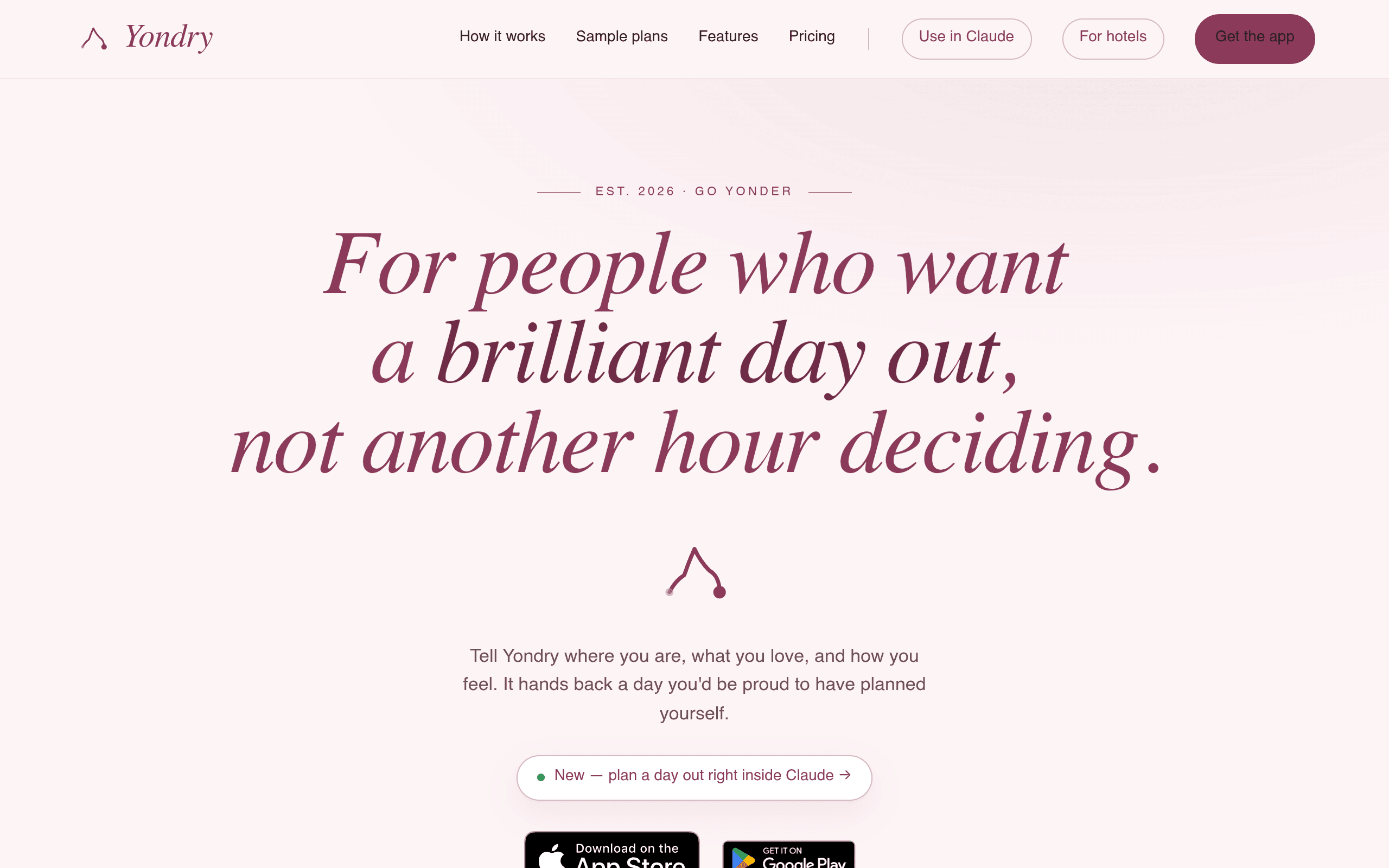
Most people have a graveyard of saved places on their phone — a folder of TikTok cafes, an Instagram collection called "NYC ideas," a Google Maps list from a trip you never fully planned. Yondry's whole pitch is that this graveyard is usable, you just need something to sequence it. You tell the app how you're feeling — its example is "bookish and rainy" — and it builds a day plan out of your saved spots (or its own suggestions) that accounts for walking distance, weather, and realistic timing.
We spent a week testing it against how we'd normally plan a day out — a mix of Google Maps Timeline, a Notes app list, and vibes — to see if it's actually faster or just a novelty.
What Yondry actually does
Yondry sits between three things you already do: saving places from social media, checking the weather, and mentally sequencing a day so you're not zigzagging across a city. Specifically:
- Import saves: You can forward Instagram Reels/posts and TikToks directly into Yondry, or paste links, and it extracts the place. It also lets you add places manually or search fresh ones.
- Mood input: Instead of picking categories (coffee, museums, shopping), you type a mood or vibe — "bookish and rainy," "lazy Sunday, need vitamin D," "impress a first date." This is the actual differentiator versus a plain itinerary builder.
- Plan generation: Yondry builds a sequenced day plan from your saved places (prioritizing ones that match the mood) filling gaps with its own recommendations, and orders stops by walking distance and opening hours, adjusting for that day's weather.
- White-label for hotels: Yondry also sells a version of this to hotels and boutique properties so guests get a branded "day out" generator instead of a laminated concierge card. This is a B2B angle we didn't test directly, but it's a real part of the roadmap, not just an app-store afterthought.
Pricing
Yondry is freemium, and the free tier is genuinely usable, not a one-day trial dressed up as a tier:
| Tier | Price | What you get |
|---|---|---|
| Free | £0 | Unlimited saved places, 3 generated day plans per month |
| Yondry Plus | £4.99/month or £39.99/year | Unlimited day plans, presumably faster regeneration and priority support (billing page doesn't break out further feature gating beyond plan limits) |
The annual price works out to £3.33/month, a ~33% discount over paying monthly — a fairly standard SaaS annual incentive rather than an aggressive one. For context, three plans a month on the free tier is enough for someone using this occasionally on weekends, but not enough for someone traveling and wanting a new plan every day of a trip — that's where Plus becomes necessary, not optional.
Concrete use cases we tried
- A rainy Saturday in an unfamiliar neighborhood: We saved four bookshop/cafe TikToks over a month without visiting any. Typing "bookish and rainy" produced a three-stop plan (bookshop → nearby cafe → a saved-but-forgotten record store) ordered by an 8-minute walk between each, timed around a 2pm rain forecast. This is the scenario Yondry is obviously built for, and it's the strongest result we got.
- A city we'd never been to, with zero saved places: With an empty save list, Yondry falls back to its own suggestions for the mood/location. This worked, but it felt closer to a generic "things to do" list than the personalized version — the app is noticeably better when you feed it your own saves first.
- Planning around a hotel stay: If a hotel has adopted Yondry's white-label version, guests get this same mood-based planning branded to the property. We didn't have access to test a live hotel deployment, so we can't verify how differentiated it feels from the consumer app.
- A date-night plan: "Impress a first date, budget-conscious" produced a plan skewing toward free/cheap stops (a park, a viewpoint, one paid coffee stop) rather than assuming a big dinner budget — a small but noticeable sign the mood parsing isn't purely aesthetic keywords.
How it compares
| Yondry | Google Maps (Timeline + Saved Places) | Citymapper | Wanderlog | |
|---|---|---|---|---|
| Price | Free (3 plans/mo) or £4.99/mo Plus | Free | Free | Free, with a paid Pro tier (~$40/year) for offline maps and route optimization |
| Core input | Mood/vibe description + saved places | Manual list browsing, no sequencing by mood | Real-time transit routing, not itinerary planning | Manual trip building, some AI itinerary suggestions |
| Social media import | Yes — Instagram/TikTok saves parsed directly | No native support | No | Limited/manual |
| Sequencing logic | Walking distance + weather + opening hours + mood match | None — you build the order yourself | Transit-optimized, not walkability/mood based | Distance-based, no weather or mood factor |
| Best for | Turning saved social content into a same-day plan without you doing the sequencing | People who just want a static list of saved pins | Getting from A to B fast in a big city via transit | Multi-day trip planning with manual control |
The honest read: Google Maps and Citymapper aren't really competitors so much as adjacent tools solving different problems — Maps is a place to dump pins, Citymapper is for transit, neither sequences a day around how you feel or what's saved on TikTok. Wanderlog is the closest real competitor since it also does AI-assisted itinerary building, but it's built around multi-day trip planning rather than a single mood-driven day, and it doesn't ingest Instagram/TikTok saves directly.
Where it falls short
- Cold-start problem: If you haven't been saving places to Yondry, day one output is generic. The product's value compounds with your saved-places library, which means the first session undersells it.
- Three free plans a month is a real limit: fine for occasional weekend use, tight for anyone trying to use this while actually traveling.
- No transit routing: Yondry sequences by walking distance, not public transit — so in sprawled-out cities, you'll still want Citymapper or Google Maps alongside it, not instead of it.
Verdict
Yondry is worth trying today specifically if you already have a backlog of saved Instagram/TikTok places you've never acted on — that's the exact problem it solves, and the free tier (3 plans/month) is enough to test whether the mood-matching is actually useful for you before paying £4.99/month. If you don't save places from social media and mostly need transit directions or multi-day trip logistics, this isn't replacing Citymapper or Wanderlog — it's solving a narrower, more specific problem: what do I do today, with what I've already saved, given how I feel and what the weather's doing.