ZeFi: A Crypto Wallet Assistant That Tells You What It Can't Verify
By Day Zero Guides Editorial · How we produce guides
Some links in this guide are affiliate links. If you sign up through them, Day Zero Guides may earn a commission at no extra cost to you. This never affects which products we cover or what we say about them. See our affiliate disclosure for details.
Concrete use cases
- You're about to approve a token spend from an unfamiliar dApp. Instead of a generic MetaMask warning ("this may be risky"), ZeFi explains what the approval actually authorizes — unlimited spend vs. capped amount — and whether the contract has verified source code.
- You're sending a large stablecoin transfer to an address you haven't used before. ZeFi checks the address against chain history and tells you plainly if it can't confirm ownership or prior activity, rather than just showing a green checkmark.
- You're a DAO treasury operator moving funds across three chains. This is Routefold's lane — sequencing the deployment (which chain first, what bridge, what gas buffer) rather than validating one transaction at a time.
- You're debugging why a transaction reverted. ZeFi's explanation layer overlaps here with what Tenderly does for developers, but ZeFi is framed for a wallet user checking a transaction before signing, not a developer stepping through a simulation trace after the fact.
What ZeFi actually does
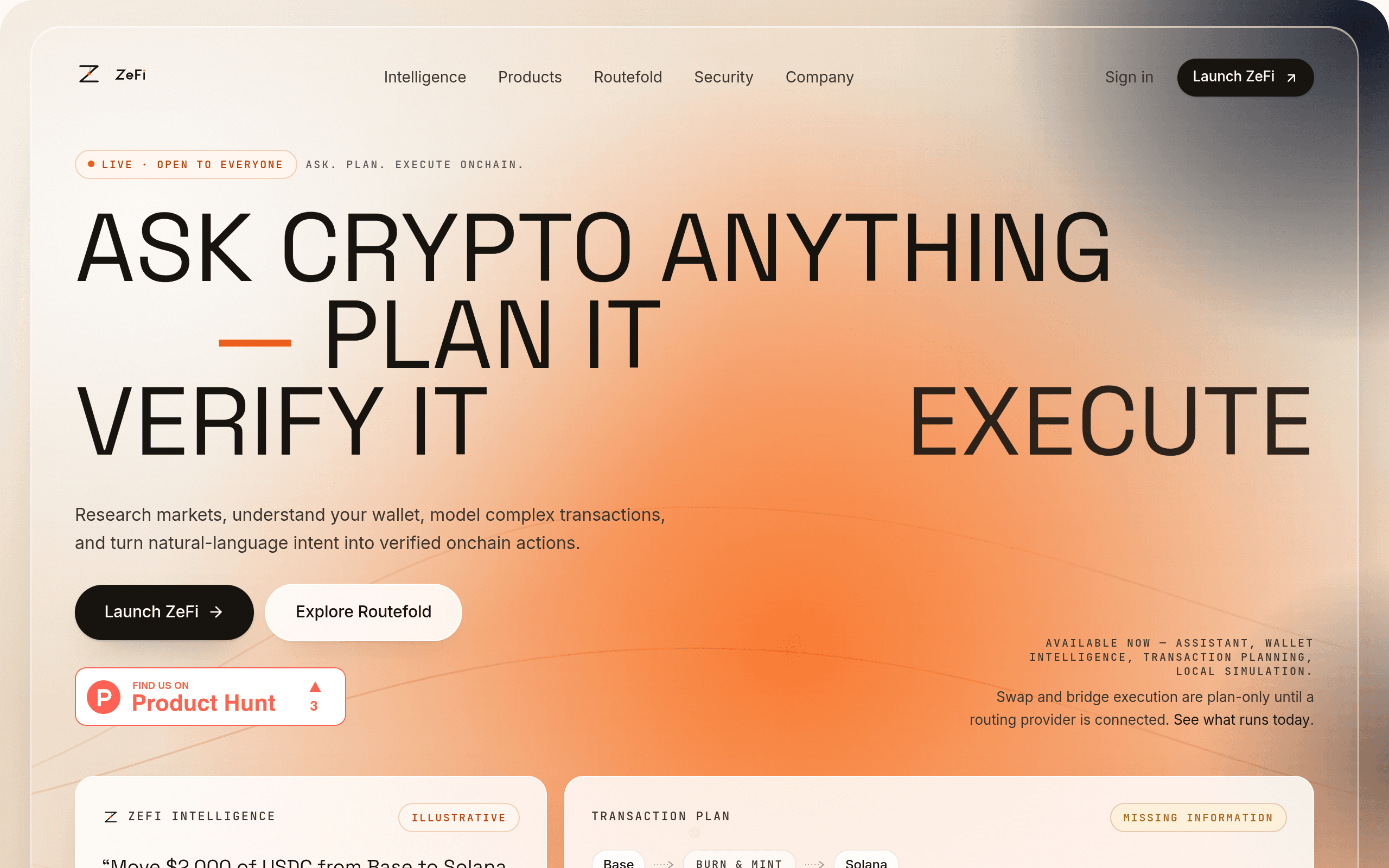
ZeFi Intelligence sits between you and your wallet. You connect a wallet (the flow mirrors MetaMask/WalletConnect-style connection prompts), and ZeFi reads on-chain data from chain registries to do three things before you sign anything:
- Explain the transaction in plain language — what a contract call actually does, which functions it's invoking, what approvals it's requesting, and what token movements will result.
- Plan transfers — if you're moving funds across addresses or chains, it maps out the route and flags gas costs, slippage exposure, and approval scope.
- Validate before signing — it cross-checks the transaction against chain registries and known contract data, then explicitly tells you what it cannot confirm (e.g., off-chain intent, unverified contract source, or a destination address with no on-chain history).
That last part is the notable design choice. Most wallet tooling either stays silent about its blind spots or oversells its safety guarantees. ZeFi puts the "I can't verify this" language directly in the flow, which matters if you're signing something you don't fully understand.
The companion product, Routefold, is aimed at a different job: planning multi-chain deployment strategies — deciding how to split liquidity, contracts, or treasury funds across chains and in what sequence, rather than checking a single transaction.
Pricing
ZeFi has not published pricing at the time of this guide. There's no public tier list, no free/pro split documented, and no billing page live on zefi.ae as of writing. If you're evaluating this today, treat it as early-access/waitlist territory rather than a priced SaaS product — expect to request access and find out pricing during onboarding rather than upfront. We'll update this guide once tiers are published.
How it compares
| ZeFi | Etherscan | MetaMask | Tenderly | |
|---|---|---|---|---|
| Price | Not published (early access) | Free | Free (Portfolio/Snaps free; some premium features via partners) | Free tier; paid plans from ~$50/mo for team simulation/monitoring |
| Core function | Explains transactions in plain language, validates before signing, flags what it can't verify | Block explorer — raw transaction, contract, and address data | Wallet + signing interface, basic transaction previews | Transaction simulation, debugging, and monitoring for developers |
| Explains "why," not just "what" | Yes — natural-language reasoning on contract calls | No — raw data only, you interpret it | Partial — shows simulated outcome, minimal explanation | Partial — detailed trace, but built for developers reading stack traces |
| Multi-chain planning | Yes, via Routefold | No — single-chain lookups | Limited — chain switching, no strategy layer | No — per-chain simulation, no cross-chain planning |
| Best for | Wallet users who want a second opinion before signing | Anyone verifying a contract or transaction manually | Everyday wallet use and signing | Developers debugging contract behavior pre/post deploy |
Should you try it today
If you already read Etherscan comfortably and understand calldata, ZeFi won't teach you much you don't know — it's solving a problem you've already solved manually. Where it's genuinely useful is the gap between MetaMask's terse "this transaction may fail" style warnings and Etherscan's raw data dump: people who want an explanation of a transaction in sentences, plus an honest flag when the tool itself is unsure.
The lack of published pricing is the real friction point right now. Without knowing whether this lands as a free tool, a subscription, or something gated behind wallet size or transaction volume, it's hard to recommend committing workflow around it yet. Worth requesting access if you're regularly signing transactions from unfamiliar contracts and want a second check beyond MetaMask's default prompt — just go in expecting an early-access product, not a finished, priced platform. Routefold is even earlier-stage in terms of what's publicly documented, so treat multi-chain deployment planning as the more experimental half of the offering.