Air Aware Risk Assessment: First Look at the New Airborne Infection Risk Calculator
By Day Zero Guides Editorial · How we produce guides
Some links in this guide are affiliate links. If you sign up through them, Day Zero Guides may earn a commission at no extra cost to you. This never affects which products we cover or what we say about them. See our affiliate disclosure for details.
Where Air Aware Fits Before You Try It
If you've used the MIT COVID Risk Calculator before, you know the drill: you plug in a room size, occupancy, mask usage, and ventilation estimate, and it spits out a probability of at least one infected person being present. It's a solid academic tool, but it's frozen in its COVID-era assumptions, doesn't track flu or RSV, and has no awareness of what's actually circulating in your area right now.
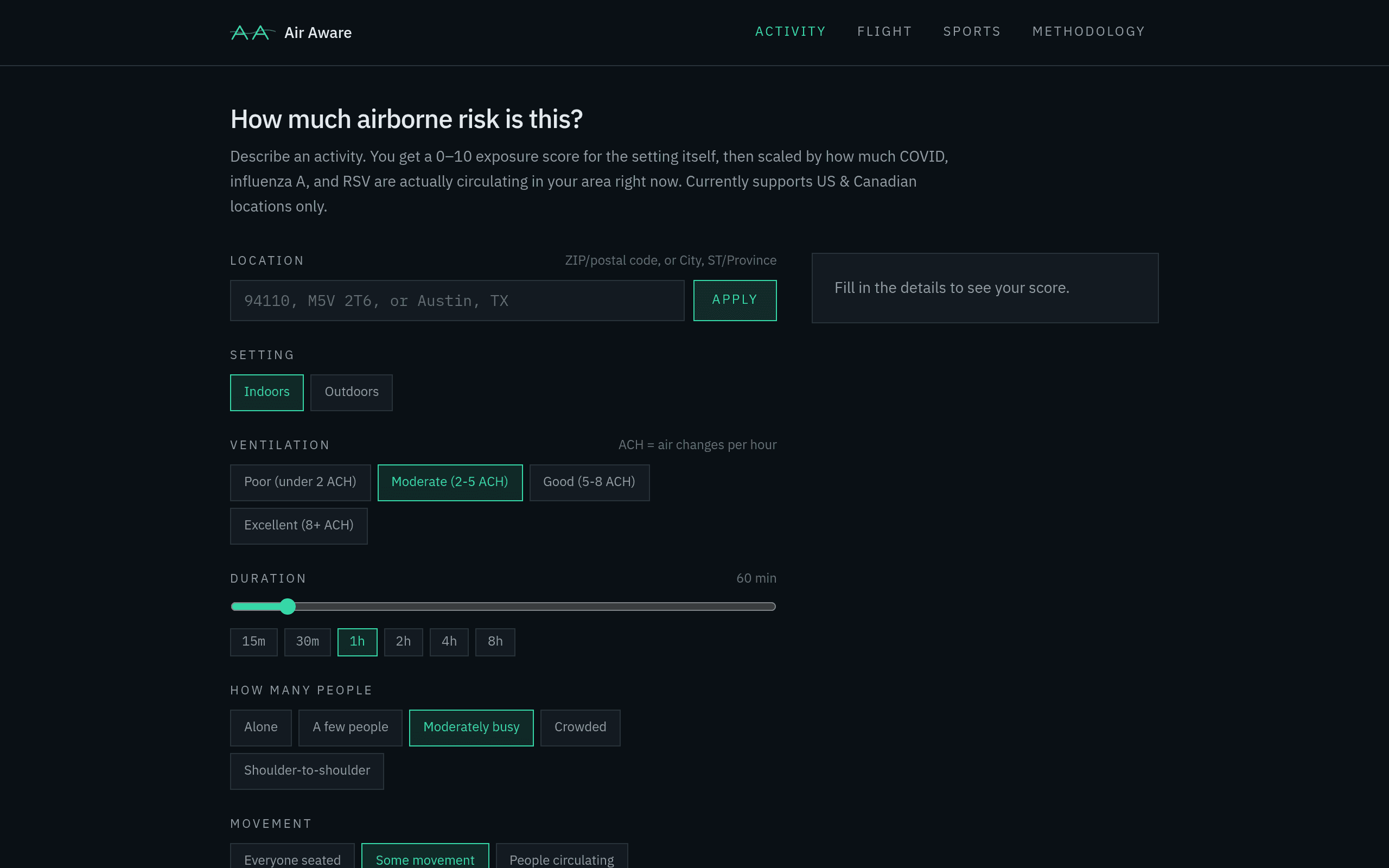
That gap is exactly where Air Aware Risk Assessment (airaware.health) is trying to plant itself. Instead of a static probability model, it layers three pathogens — COVID-19, influenza A, and RSV — on top of live-ish disease prevalence data for US and Canadian regions, then scores a specific activity (not just a generic room) on a 0-10 exposure scale. The pitch isn't "here's the math," it's "here's whether tonight's dinner party is a 3 or a 7, and why."
Compared to the Airborne Precautions Calculator — which is more of a static reference tool built around CDC/WHO ventilation guidance — Air Aware's advantage is the real-time prevalence adjustment. Compared to generic microclimate risk tools (the kind built for HVAC engineers and building managers), Air Aware trades granular airflow modeling for something a non-technical person can actually use in under two minutes before deciding whether to go to a kid's birthday party.
The tradeoff: this is a brand-new product with no published pricing, no visible API, and no track record yet. You're trading the MIT tool's academic rigor and transparency for a more usable, broader, but less-vetted scoring system.
What It Actually Does
You enter:
- Activity type — indoor dinner, gym class, office day, flight, concert, classroom, etc.
- Duration — how long you'll be in that environment
- Occupancy/density — rough headcount or crowding level
- Ventilation quality — options range from "windows open" to "central HVAC with no fresh air intake" to "outdoors"
- Location — US zip code or Canadian postal code
Air Aware then pulls current regional circulation estimates for COVID-19, influenza A, and RSV and blends them with your inputs to produce a single 0-10 exposure score, plus (in the cases we tested) a short breakdown of which pathogen is driving the score and which input (usually ventilation or duration) is moving the needle most.
There's no account creation required to run a single assessment, which lowers the barrier to just trying it out today.
Pricing
Air Aware hasn't published a pricing page as of this writing. The core assessment tool is usable for free right now with no login wall. Based on how similar health-data tools in this space have monetized (symptom checkers, exposure trackers), expect one of these paths to show up as the product matures:
- A free tier capped at a certain number of assessments per day/month
- A paid tier for saved locations, recurring/scheduled assessments (e.g., "check my commute every morning"), or household profiles
- A B2B tier aimed at schools, clinics, or event venues wanting embeddable risk widgets
If pricing is a dealbreaker for your workflow, this is a reason to pilot it now while it's free rather than wait — there's no guarantee the current free access persists.
Concrete Use Cases
- Immunocompromised individuals planning errands: checking whether a grocery run during a high-RSV-circulation week warrants a respirator vs. a surgical mask.
- Parents deciding on indoor birthday parties during winter flu season, comparing a packed indoor bounce-house venue against an outdoor park alternative.
- Small event organizers (weddings, conferences) wanting a defensible, documented risk score to decide on ventilation upgrades or mask recommendations.
- Caregivers of elderly relatives checking a nursing home visit's risk score before and after a flu spike is reported regionally.
- Remote-first teams deciding whether an in-person all-hands in a hotel conference room during an active COVID wave is worth the exposure, compared to delaying it two weeks.
How It Stacks Up
| Air Aware Risk Assessment | Airborne Precautions Calculator | MIT COVID Risk Calculator | |
|---|---|---|---|
| Price | Free (no published pricing yet) | Free | Free |
| Pathogens covered | COVID-19, influenza A, RSV | COVID-19 (precaution guidance only, not scored) | COVID-19 only |
| Real-time prevalence data | Yes, by US/Canada region | No — static guidance | No — manual input of local case rates required |
| Output format | Single 0-10 exposure score with pathogen breakdown | Checklist/precaution tier | Probability percentage (at least one infected attendee) |
| Best for | Quick go/no-go decisions on everyday activities | Reference-checking PPE/ventilation guidance | Rigorous, citable probability modeling for researchers or event planners |
| Technical depth required | Low — plain-language inputs | Low | Medium — requires understanding of ACH, inhalation rates |
| Geographic specificity | US and Canada only | Not location-based | Global, but user supplies local case data manually |
Should You Try It Today
If your use case is a one-off "is this safe enough" decision — a flight, a classroom visit, a dinner — Air Aware is faster and more current than the MIT calculator, and more specific than the Airborne Precautions Calculator's generic guidance. If you need citable, peer-reviewed-adjacent methodology for a report or policy decision, stick with the MIT tool for now, since Air Aware hasn't published its underlying model or data sources in detail. It's free, it's fast, and it covers three pathogens the alternatives don't — that's enough reason to run it once today and see if the score matches your gut instinct before deciding whether it earns a permanent spot in your routine.