Programmdle: A Daily Wordle Clone for Guessing Programming Languages by Attribute
By Day Zero Guides Editorial · How we produce guides
Some links in this guide are affiliate links. If you sign up through them, Day Zero Guides may earn a commission at no extra cost to you. This never affects which products we cover or what we say about them. See our affiliate disclosure for details.
The Scenario: You're a Backend Dev Killing Five Minutes Before Standup
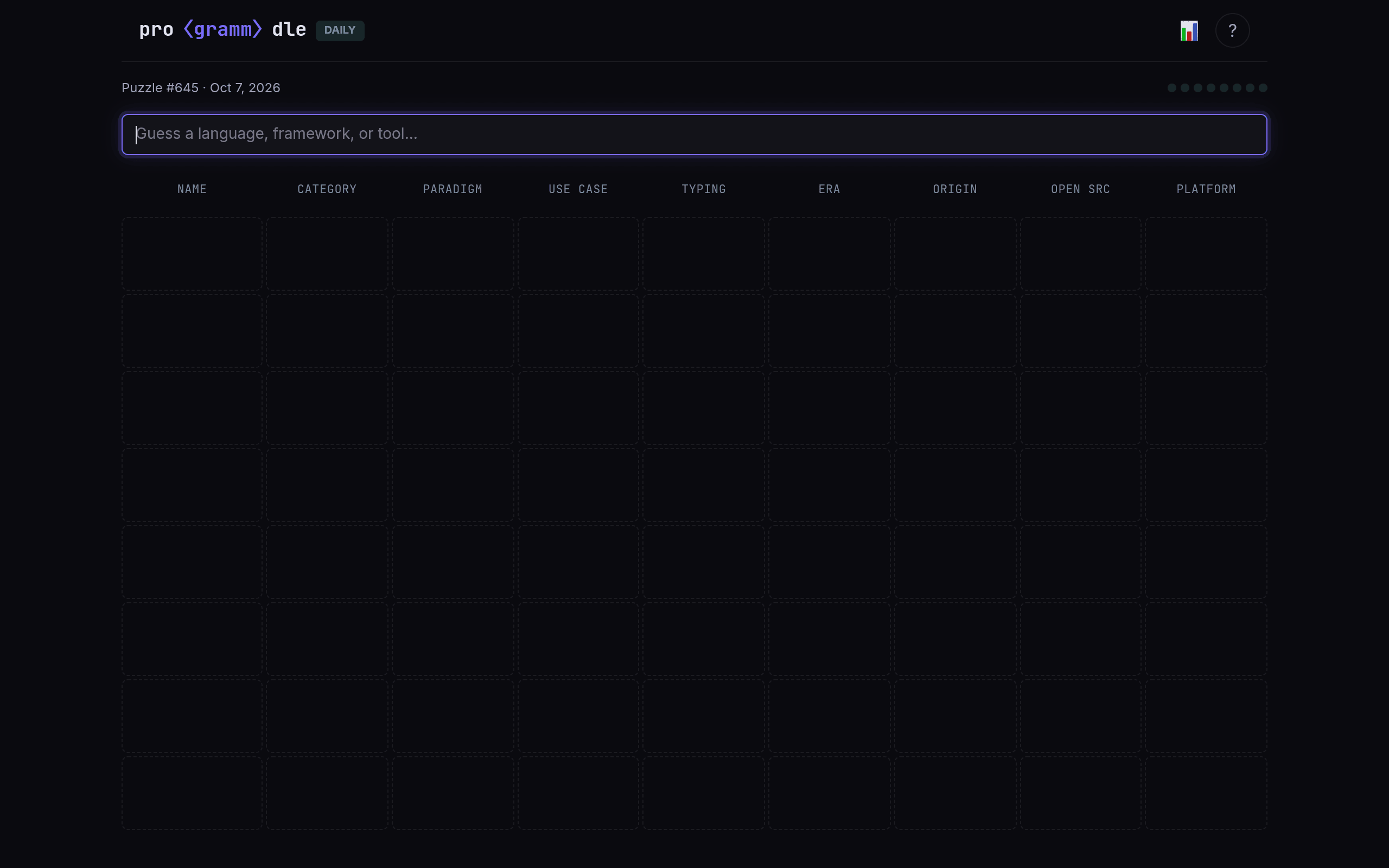
It's 9:55 AM. Standup is at 10. You've got your coffee, your IDE is still loading the last project you touched, and you want something that scratches the same itch as your morning Wordle but feels like it belongs to you — a developer, not just anyone with a vocabulary. You open Programmdle, get a blank guess grid, and start typing language names: "Rust." Wrong, but you get back partial signal — category matches (it's a language, not a framework), paradigm is close (multi-paradigm, and Rust is too, so that cell lights up), but typing is off (yours guessed dynamic, the answer is statically typed). By guess three, you've narrowed it to a compiled, statically-typed, systems-level language from the 2010s that's open source. You type "Go." Correct. Standup starts. You've already won today — this is the exact moment Programmdle is built for.
That's the core loop: a once-daily puzzle for people who think in tech stacks instead of five-letter words.
What Programmdle Actually Is
Programmdle is a Wordle-style daily guessing game, but instead of letters and words, you're guessing a hidden programming language or technology (think Python, React, Docker, Haskell, PostgreSQL) using feedback across eight attributes:
- Category (language, framework, database, tool, etc.)
- Paradigm (object-oriented, functional, declarative, multi-paradigm)
- Use case (web dev, systems programming, data science, mobile, etc.)
- Typing (static vs. dynamic)
- Era (the decade it emerged)
- Origin (company or individual credited with creating it)
- Open source status (yes/no)
- Platform (where it primarily runs or targets)
Each guess fills a row and returns color-coded feedback per attribute — matched, partially matched, or wrong — similar to how Wordle colors letters green, yellow, and gray. You get eight attempts per day (more than Wordle's six, which matters because the guess space here — thousands of possible languages, frameworks, and tools — is much larger than five-letter English words). One puzzle per day, and presumably a new tech entry picked each cycle, though the site doesn't publish its selection pool or source list.
Concrete Use Cases
- Pre-standup or pre-meeting filler for developers who want a tech-flavored break instead of generic word games.
- Teaching tool for bootcamp or CS101 cohorts — instructors could use it as a 5-minute icebreaker to reinforce vocabulary like "paradigm" or "statically typed" in a low-stakes, game-ified way.
- Trivia-night warm-up for developer meetups or hackathon downtime.
- Onboarding icebreaker for new engineering hires — guessing well signals you actually know the ecosystem, guessing badly is a harmless icebreaker joke.
- Twitter/Slack bragging rights — like Wordle's green-square share grids, a satisfying immediate niche flex if the game supports shareable results (common in this genre, though Programmdle doesn't yet advertise a formal share-card feature).
Pricing
Programmdle does not publish any pricing, tiers, or paywall information on its site as of this writing. There's no visible "Pro," "Premium," or subscription prompt, no account creation gate, and no archive paywall mentioned anywhere on the page. Functionally, it behaves like a free, ungated single-puzzle-per-day web app — the same model Wordle used before The New York Times acquired it (and before NYT folded it into its paid Games bundle). Whether Programmdle monetizes later via ads, a bundle subscription, or an archive paywall is unknown; there's no evidence of any of that today.
How It Compares
| Programmdle | Wordle | Nerdle | Semantle | |
|---|---|---|---|---|
| Price | Free (no tiers published) | Free; NYT Games bundle ~$5.99/mo or ~$44.99/yr for full archive + other puzzles | Free, ad-supported on nerdlegame.com | Free |
| Core mechanic | Guess a tech/language via 8 attribute clues (category, paradigm, typing, era, etc.) | Guess a 5-letter English word via letter position/color feedback | Guess a valid math equation via digit/operator position feedback | Guess a secret word via semantic (meaning) similarity score, not spelling |
| Guesses allowed | 8 | 6 | 6 | Unlimited guesses, ranked by closeness |
| Best for | Developers and CS students who want a niche, tech-literate daily puzzle | General audience wanting a quick universal word puzzle | Math/logic fans who like numeric reasoning over vocabulary | Word nerds who enjoy embedding/semantic reasoning over spelling |
| Niche depth | Very narrow (programming ecosystem only) — rewards domain knowledge | None — broad vocabulary only | Narrow (arithmetic only) | Broad vocabulary, but unusual mechanic |
| Archive access | Not available (single daily puzzle, no visible history) | Available only via NYT Games subscription | Free archive of past puzzles on-site | Free, playable any past day via URL |
Should You Try It Today?
If you already have a Wordle habit and write code for a living, Programmdle is a low-friction, zero-cost add to your morning rotation — it's testing a different kind of knowledge (ecosystem trivia, not spelling), so it won't feel repetitive even if you also play Wordle and Nerdle the same day. The eight-attribute clue system is genuinely more information-dense than Wordle's letter grid, which makes early guesses feel more like real debugging than word-guessing luck. The catch: it's a brand-new, single-developer-feeling project with no published roadmap, no stated puzzle source list, and no monetization info, so don't expect an archive, stats tracking, or guaranteed daily uptime the way you would from NYT-backed Wordle. For a free five-minute daily puzzle built specifically for people who know the difference between Rust and Go, it's worth bookmarking today.