Indoor Dog Park: A First Look at the New Directory for Climate-Controlled Dog Facilities
By Day Zero Guides Editorial · How we produce guides
Some links in this guide are affiliate links. If you sign up through them, Day Zero Guides may earn a commission at no extra cost to you. This never affects which products we cover or what we say about them. See our affiliate disclosure for details.
Indoor Dog Park: A First Look at the New Directory for Climate-Controlled Dog Facilities
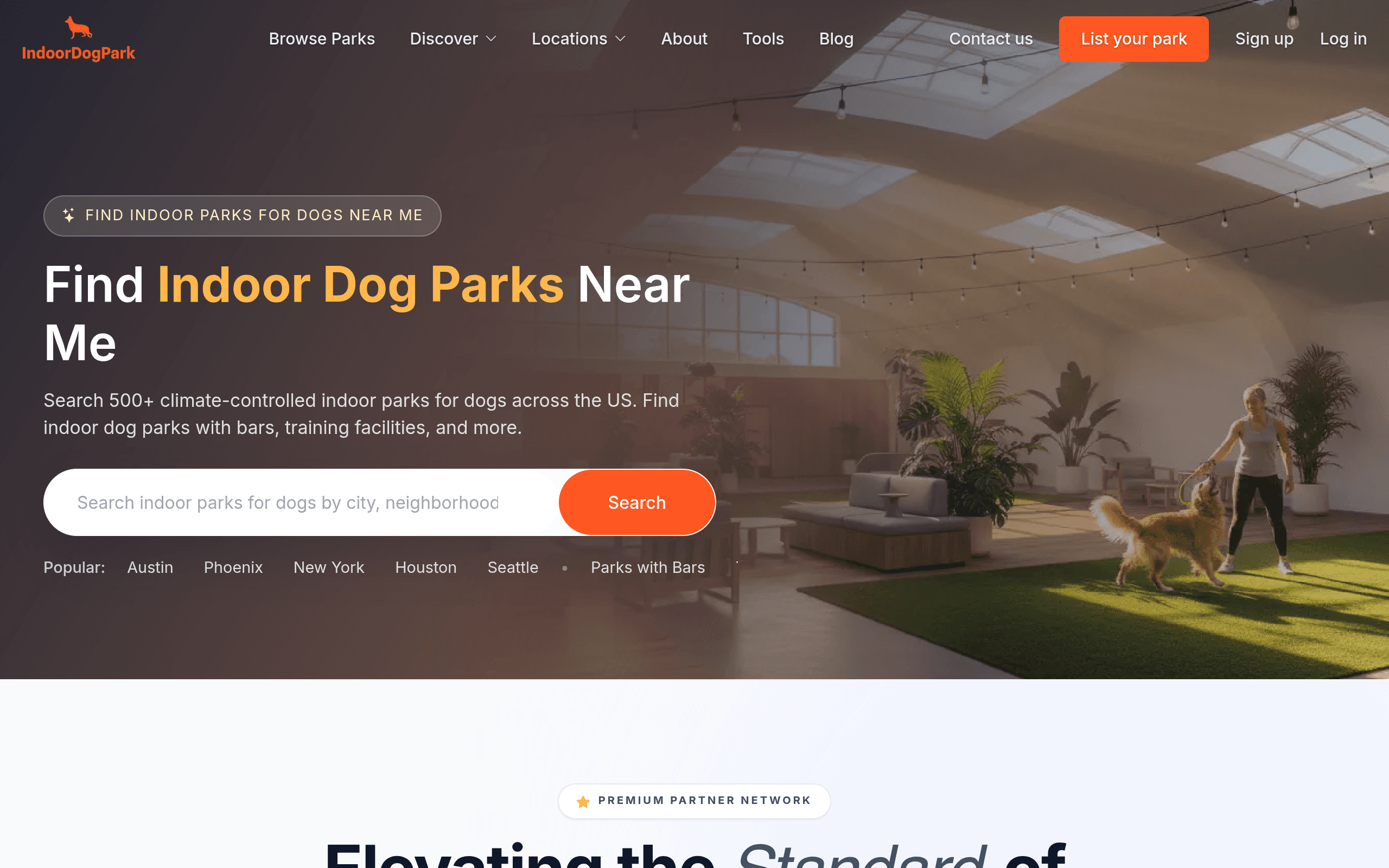
If you've ever tried to find an indoor dog park during a July heat wave or a January cold snap, you know the search usually ends with a scroll through Google Maps results that are half outdoor dog runs, half dog groomers, and one abandoned Yelp listing from 2016. Indoor Dog Park is a new, narrowly-scoped directory trying to fix exactly that problem: it only lists climate-controlled indoor facilities across the US, and it layers on a couple of genuinely useful tools you won't find on general-purpose platforms.
Here's what it actually does, what it costs (as far as we could find out), and whether it's worth your time today.
What Indoor Dog Park Actually Is
At its core, this is a search-and-directory site, not a booking platform. You search by location and it surfaces indoor dog parks near you — the kind with rubber flooring, HVAC systems, and separate play areas by dog size, rather than a fenced field. Listings appear to include amenities like:
- On-site dog bars (water, treats, sometimes beer/coffee bars for humans)
- Training classes and sessions run out of the facility
- Structured socialization or "playgroup" programs
- Membership or day-pass options at the facility level
Two features stand out as differentiators rather than directory boilerplate:
Paw heat safety calculator. You plug in your location (or current temperature), and it estimates whether pavement or ground conditions are safe for your dog's paws — a real, practical reason to route your dog to an indoor facility instead of an outdoor walk during heat spikes. This is the kind of niche utility that justifies the site's existence beyond "just another directory."
Premium partner network for facility owners. Indoor dog park owners can apparently pay to get elevated visibility in search results, plus access to some kind of performance insights dashboard (presumably traffic to their listing, click-throughs, that sort of thing). This is the monetization engine for the site — more on pricing below.
Pricing: What We Found (and Didn't)
For pet owners searching the directory, the site appears to be free to use — there's no paywall on browsing or searching listings, and the paw heat calculator is accessible without an account.
For facility owners considering the premium partner network, pricing is not published anywhere on the site. There's no pricing page, no tiered plan comparison, and no self-serve checkout that we could find. If you're a dog park owner interested in the premium listing, expect to go through a contact or signup form to get a quote rather than seeing a price upfront. That's worth flagging as a limitation for anyone trying to budget before reaching out — you'll need to submit an inquiry to find out what "premium" actually costs.
Concrete Use Cases
- You live somewhere with a real winter and a real summer. If your dog can't be outside for more than 10 minutes in August or January, this is a faster way to find a viable indoor option than digging through Yelp categories that weren't built for this.
- You're traveling with your dog and need socialization, not just a walk. Searching by city before a trip to find an indoor facility with playgroups beats guessing from a generic map pin.
- You're deciding whether today is a heat-safe day for a walk at all. The paw heat calculator gives you a quick yes/no before you even think about the directory.
- You own or manage an indoor dog park and want visibility beyond your own website and a static Google Business Profile. The premium partner network is aimed squarely at you, though you'll need to inquire for pricing.
How It Compares
| Indoor Dog Park | Rover.com | Yelp | Google Maps | |
|---|---|---|---|---|
| Price (for pet owners) | Free to search | Free to browse; pay per booking (sitting/walking) | Free | Free |
| Core focus | Directory of indoor, climate-controlled dog parks only | Marketplace for booking dog sitters/walkers | General local business reviews | General local business/place search |
| Niche tools | Paw heat safety calculator | Sitter/walker matching, booking, payments | Review filtering, photos | Directions, hours, reviews |
| Listing depth for indoor dog parks specifically | High — purpose-built category | None — not a category Rover addresses | Low — mixed in with general pet services | Low — no dedicated filter for "indoor" or climate-controlled |
| Best for | Finding a climate-controlled facility fast, checking paw-safety conditions | Booking a sitter or walker for your dog | Reading reviews on any local business, pets included | Quick proximity search when you don't care about facility type |
| Owner monetization | Premium partner network (pricing not published) | Sitter subscription/service fees | Yelp Ads | Google Business Profile / Local Services Ads |
The honest takeaway: Rover, Yelp, and Google Maps aren't really competing head-to-head with Indoor Dog Park — they solve adjacent problems (booking a sitter, reading reviews, general search) but none of them let you filter specifically for indoor, climate-controlled dog parks, and none of them tell you whether the pavement outside is currently too hot for your dog's paws. Indoor Dog Park's value is in that narrow specificity, not in trying to out-feature the bigger platforms.
Should You Try It Today?
If you're a pet owner in a climate with extreme summers or winters, it's worth a five-minute test: search your city, see how many listings actually populate, and run the paw heat calculator once just to see how it handles your local weather. Because it's free to use and doesn't require an account, there's no real downside to checking coverage in your area before you need it.
If you're a facility owner evaluating the premium partner network, go in expecting to request a quote rather than compare published tiers — and ask directly what "performance insights" includes before committing, since that detail isn't spelled out publicly yet.
The biggest open question, as with any new directory, is listing density. A directory is only as useful as its coverage, and since this just launched, coverage in smaller or mid-size markets may still be thin. Worth checking your specific city before assuming it'll replace your usual Google Maps search entirely.