LLMs.txt File Generator: First Look at the Free Tool for Building AI-Ready Site Manifests
By Day Zero Guides Editorial · How we produce guides
Some links in this guide are affiliate links. If you sign up through them, Day Zero Guides may earn a commission at no extra cost to you. This never affects which products we cover or what we say about them. See our affiliate disclosure for details.
Who should actually use this today
- Docs sites (Docusaurus, Mintlify, ReadMe, GitBook setups) that already publish a sitemap and want a quick first draft pointing AI assistants toward API references and guides instead of marketing pages.
- SaaS marketing teams experimenting with AI visibility — wanting tools like Perplexity or ChatGPT's browsing mode to cite their pricing page and comparison pages instead of a random blog post.
- Agencies doing technical SEO audits who want to hand clients a defensible-looking AI-readiness deliverable without hand-building the file for every client site.
- Content-heavy blogs that want to curate which 20–30 posts represent the site well, rather than exposing everything indiscriminately.
If your site doesn't have a working sitemap.xml, this tool has much less to work with — it leans on the sitemap as its primary data source, so a broken or missing sitemap means a thin or empty draft.
What this tool actually does
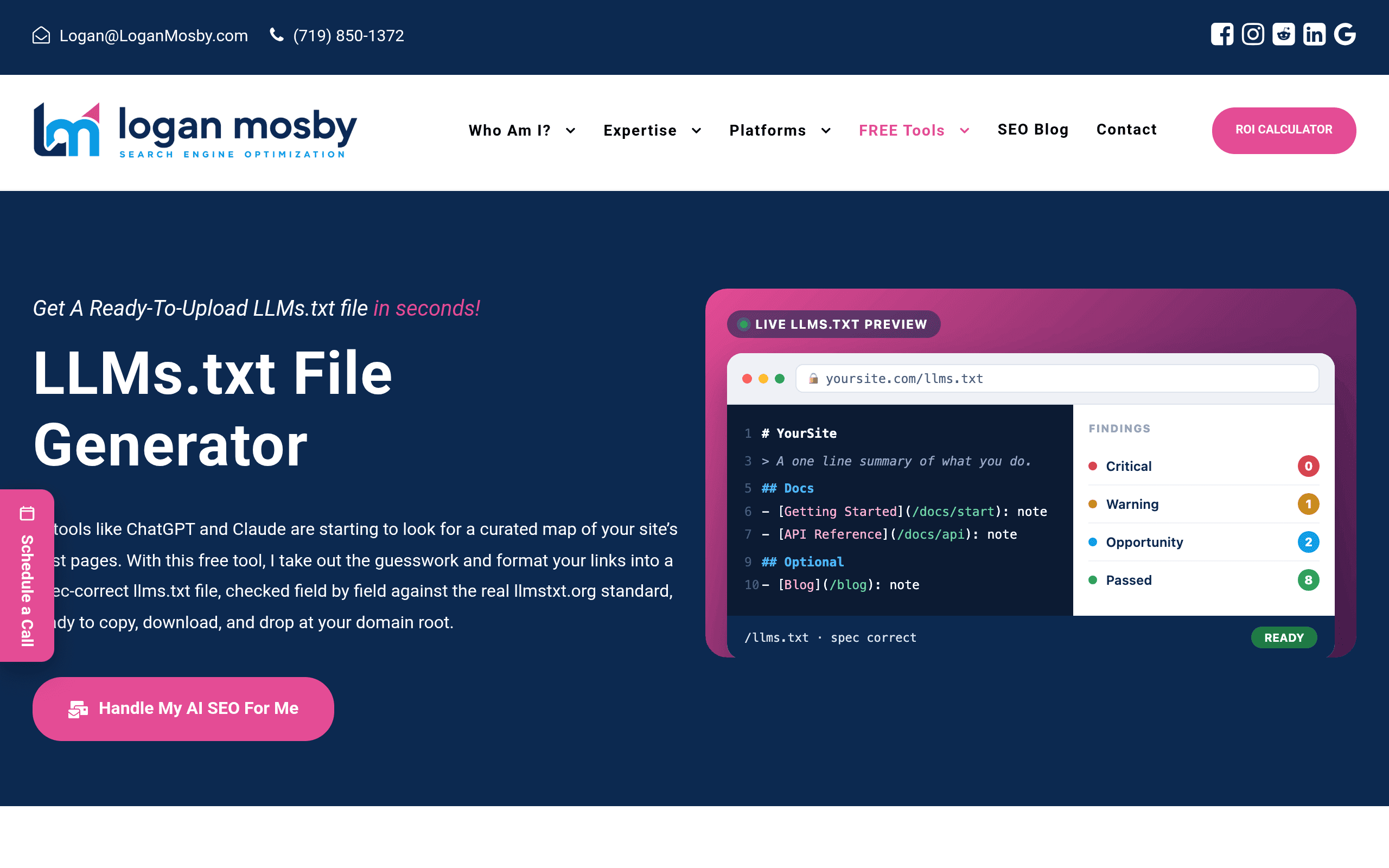
LLMs.txt File Generator is a free web app that builds a llms.txt file for your site — a plain-Markdown manifest, served from your domain root (yourdomain.com/llms.txt), that's meant to give large language models a curated, low-noise index of your most important pages. The format comes from the spec at llmstxt.org, proposed by Jeremy Howard's Answer.AI team in late 2024: an H1 title, a one-line blockquote summary, then H2 sections with bullet-point links and short descriptions pointing to your docs, pricing page, blog, changelog, etc.
Writing one of these by hand means manually picking URLs, writing descriptions, and formatting Markdown correctly. This tool automates that: you give it a URL, it finds your sitemap.xml, pulls the list of pages, scrapes <title> and meta description tags for each one, groups them, and outputs a draft llms.txt file. Before you download, it runs the output through a validator that checks it against the official spec — correct H1 structure, valid blockquote, properly formatted link lines — and flags anything that would fail a strict parser.
There's no account, no login wall, and no paid tier. You paste a URL, wait for the crawl, edit the draft in a text box if you want to trim or rewrite descriptions, and hit download.
Pricing
It's free, full stop. No usage cap mentioned, no "pro" version, no email-gate to unlock the download. That puts it in the same bucket as most single-purpose SEO utility generators — a tool built to be useful and shareable rather than monetized directly.
What's missing
- No hosting or auto-deploy. You still have to manually upload the generated file to your site's root directory (or add a route if you're on a framework that needs one). No FTP/CMS integration, no verification that it's live.
- No ongoing sync. If you add new pages next month, you re-run the whole process manually — there's no scheduled re-crawl or webhook.
- No traffic or crawl analytics. You won't get any signal from this tool about whether any AI crawler has actually fetched your
llms.txtfile, because that visibility doesn't really exist anywhere yet. - Adoption is still unproven. As of now, no major LLM vendor (OpenAI, Anthropic, Google) has publicly confirmed they crawl or prioritize
llms.txtfiles. You're building for a spec that's gaining developer mindshare, not a confirmed crawler behavior.
How it compares to adjacent tools
LLMs.txt File Generator doesn't really compete with SEO meta tag tools or robots.txt generators — it sits next to them, covering a gap none of them address. Here's how the four differ in practice:
| LLMs.txt File Generator | SEO Meta Tag Generators | Sitemap Generator Tools | Robots.txt Generators | |
|---|---|---|---|---|
| Price | Free, no tiers | Mostly free; some (like Meta Tags by Metatags.io) free with pro add-ons | Free for small sites; XML-Sitemaps.com caps free crawl at 500 pages | Free (Google's own generator, Yoast's built-in tool, etc.) |
| Output | Markdown llms.txt manifest, spec-validated | HTML <meta> tags for title/description/OG/Twitter cards | sitemap.xml listing all crawlable URLs | robots.txt with allow/disallow rules for crawlers |
| Primary audience | LLMs and AI assistants reading a curated page list | Traditional search engines and social share previews | Search engine crawlers (Google, Bing) indexing your full site | Search engine and bot crawlers, to restrict access |
| Automation depth | Pulls from sitemap, scrapes titles/descriptions, validates format | Usually manual field entry per page | Auto-crawls site structure, some support scheduled regeneration | Manual rule-building, occasional site-import for path detection |
| Best for | Sites wanting AI tools to reference curated, high-value pages | Improving click-through from Google/social previews | Getting full site indexed by traditional search engines | Blocking bots from admin/staging pages or setting crawl rules |
The practical takeaway: you likely need a sitemap tool and a robots.txt file already — this generator is additive, not a replacement, and it's the only one of the four actually built around the llms.txt spec rather than adapting an existing standard.
Verdict
As a first-generation tool for a six-month-old spec, this does exactly what it should: takes the manual tedium out of drafting a compliant llms.txt file and validates it so you're not guessing whether the format is right. It's not a platform, it's not going to monitor anything for you, and it won't tell you whether the effort is paying off in AI citations. But since it costs nothing and takes about two minutes to run against a sitemap you already have, there's very little reason not to generate a draft today, review the description text it pulls, and manually drop the file at your root — especially if you're already publishing docs or comparison content you'd want an AI assistant to surface accurately.
Update — 2026-08-19
The tool's core functionality has shifted from automatic sitemap crawling to a manual, multi-section builder interface. The original version automatically fetched sitemaps and scraped page data; the current version requires users to manually add sections and either paste URLs or select sitemaps per section, with optional auto-fetching of titles/descriptions.