Raychis First Look: An Offline Plant ID App That Skips the Account Wall
By Day Zero Guides Editorial · How we produce guides
Some links in this guide are affiliate links. If you sign up through them, Day Zero Guides may earn a commission at no extra cost to you. This never affects which products we cover or what we say about them. See our affiliate disclosure for details.
What Raychis Actually Does
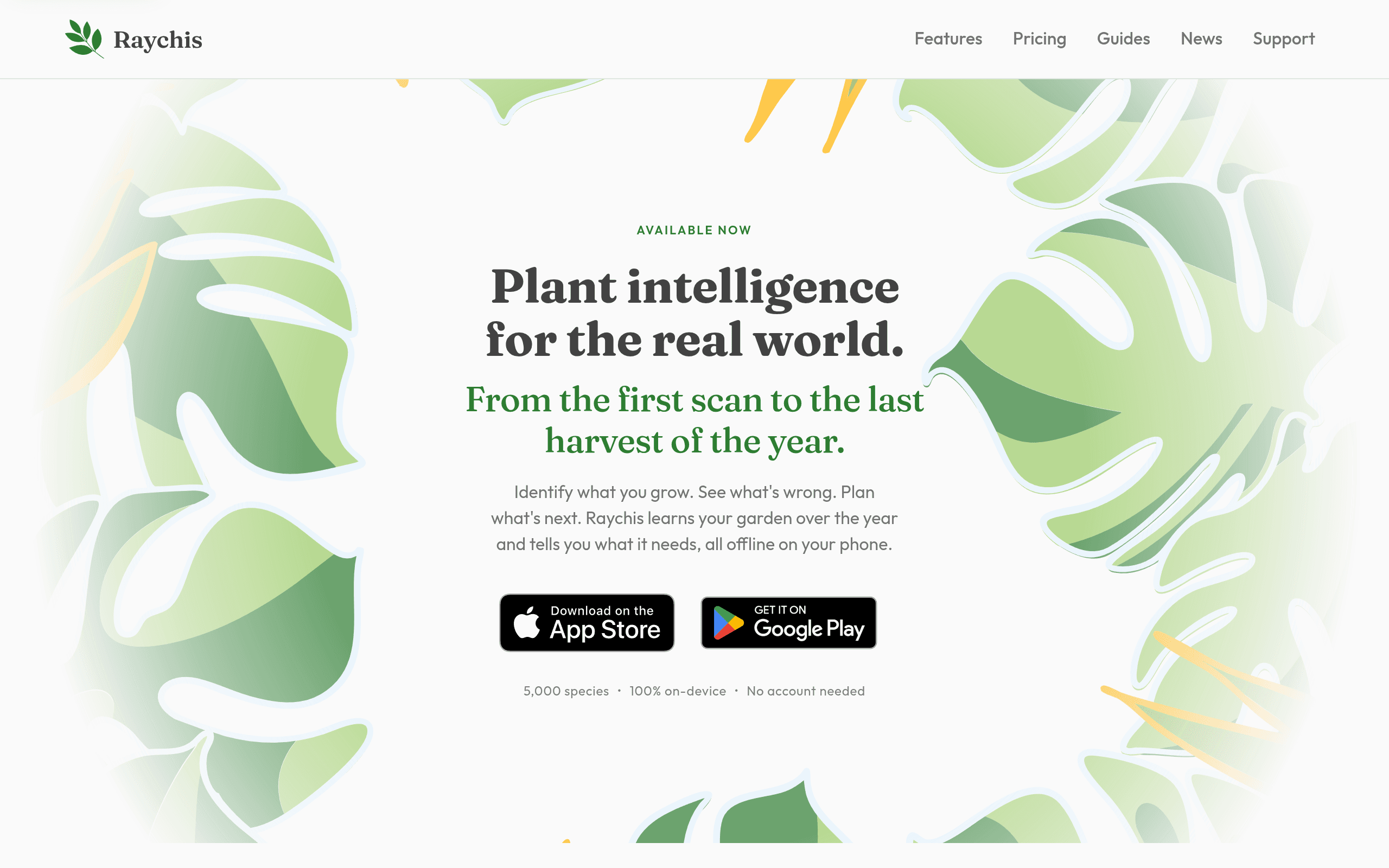
Raychis is a mobile app that identifies plants from a photo, tells you whether the plant looks healthy or stressed, and gives you seasonal care reminders for the plants you choose to track. The pitch that separates it from the crowded plant-ID app field is architectural, not cosmetic: the identification model runs entirely on-device. There's no upload to a server, no waiting on a spinner while your photo round-trips to the cloud, and — notably — no account creation required to use any of it. You download the app, point your camera at a plant, and get a result.
The species database covers 5,000 plants, which is a meaningful number for a mobile-first, offline tool, though it's smaller than the crowdsourced libraries some competitors draw on (more on that below). Beyond straight identification, Raychis adds two features aimed at people who actually own the plants they're photographing rather than just cataloging things on a hike: a health assessment (visual cues suggesting under-watering, pest damage, or nutrient issues) and seasonal care guidance that adjusts recommendations as the calendar changes — think "reduce watering frequency going into winter" style prompts for plants you've added to your personal tracker.
Setting Expectations on Day One
Because Raychis just launched, there isn't yet a long public track record on identification accuracy across edge cases — hybrid cultivars, juvenile growth stages, or look-alike species within the same genus, which is where every plant-ID app (including the established ones) tends to stumble. The on-device model is the headline feature, but on-device also means the identification logic is whatever shipped with the app version you downloaded; it won't benefit from the kind of continuous crowdsourced correction that a community-driven database gets. Worth knowing going in, especially if you're identifying anything beyond common houseplants and garden species.
Pricing
Raychis is free to download, and as of launch there is no paid tier, subscription, or in-app purchase structure publicly listed. That's unusual in this category — PlantSnap and Leafsnap have both leaned on subscriptions for unlimited scans or ad removal in the past. Whether Raychis introduces a premium tier later (a common path once a free app builds a user base) isn't something this first look can predict, but at the time of writing, the entire feature set — identification, health checks, seasonal care tracking — is available at no cost.
Concrete Use Cases
- You just bought a plant at a hardware store with a generic "assorted tropical" tag. Snap a photo, get the species, then use the care guidance instead of guessing at watering frequency.
- You're hiking somewhere with no signal and want to know what you're looking at right now. Because it's fully offline, Raychis works in a dead zone the same way it works on wifi — no queued uploads, no "waiting for connection" screen.
- You have a windowsill of houseplants and keep forgetting which ones need repotting or dormancy adjustments. The tracked-plant list plus seasonal reminders is built for this exact low-stakes maintenance problem, not for scientific documentation.
- A leaf looks off and you're trying to figure out if it's a pest, a light issue, or overwatering before you do something drastic. The health assessment gives a quick first-pass diagnosis rather than requiring a forum post and a two-day wait.
- You don't want another app asking for your email before you can use it. If account fatigue is a real reason you've avoided plant apps before, Raychis's no-signup model directly addresses that friction.
What It's Not For
If you're doing citizen science, contributing observations to research datasets, or you want your identifications cross-checked by a community of naturalists, Raychis isn't built for that job — there's no social layer, no observation feed, and no data contribution back to a shared research database. That's a deliberate tradeoff for privacy and offline speed, but it means the app is a personal tool, not a research instrument.
How It Compares
| Raychis | PlantSnap | Leafsnap | iNaturalist | |
|---|---|---|---|---|
| Price | Free, no paid tier at launch | Free with ads; Pro subscription ~$19.99/year for unlimited ID and ad removal | Free | Free (nonprofit-backed, no paid tier) |
| Works offline | Yes — full on-device AI, no connection needed | No — requires connection to identify | Partial — some identification works offline, but full database access needs connection | No — identification and uploads need connection |
| Account required | No | Yes, for saving collections and syncing | Yes, for saved plant records | Yes, tied to iNaturalist/GBIF community account |
| Species coverage | 5,000 species | Claims 600,000+ plants, flowers, and trees globally | Focused mainly on tree species (originally North American trees) | Millions of observations across all taxa, community-verified, not just plants |
| Health/care guidance | Built-in health assessment and seasonal care reminders | Limited care info, mostly identification-focused | Minimal — identification-focused, little ongoing care support | None — it's an observation and identification community, not a care tool |
| Best for | Quick, private, offline ID plus ongoing houseplant/garden care | Broadest species coverage when you have signal | Tree identification specifically | Scientific-grade community verification and biodiversity tracking |
Should You Download It Today
If your use case is "I have houseplants and a garden, I want to know what's wrong with a leaf, and I don't want to make an account or lose signal in the backyard," Raychis is worth trying today — it's free, there's no signup cost in time or data, and the offline-first design solves a real annoyance with cloud-based competitors. If you need the widest possible species net (PlantSnap's claimed 600,000+ database) or you want your sightings to feed into actual biodiversity research (iNaturalist), those apps still do those specific jobs better. Raychis is a narrower, more personal tool — and for the plant-owner-not-botanist crowd, that narrowness is the point.