ServerVault: First Look at the New Per-Server, Per-App PHP Panel Undercutting Forge on Price
Some links in this guide are affiliate links. If you sign up through them, Day Zero Guides may earn a commission at no extra cost to you. This never affects which products we cover or what we say about them. See our affiliate disclosure for details.
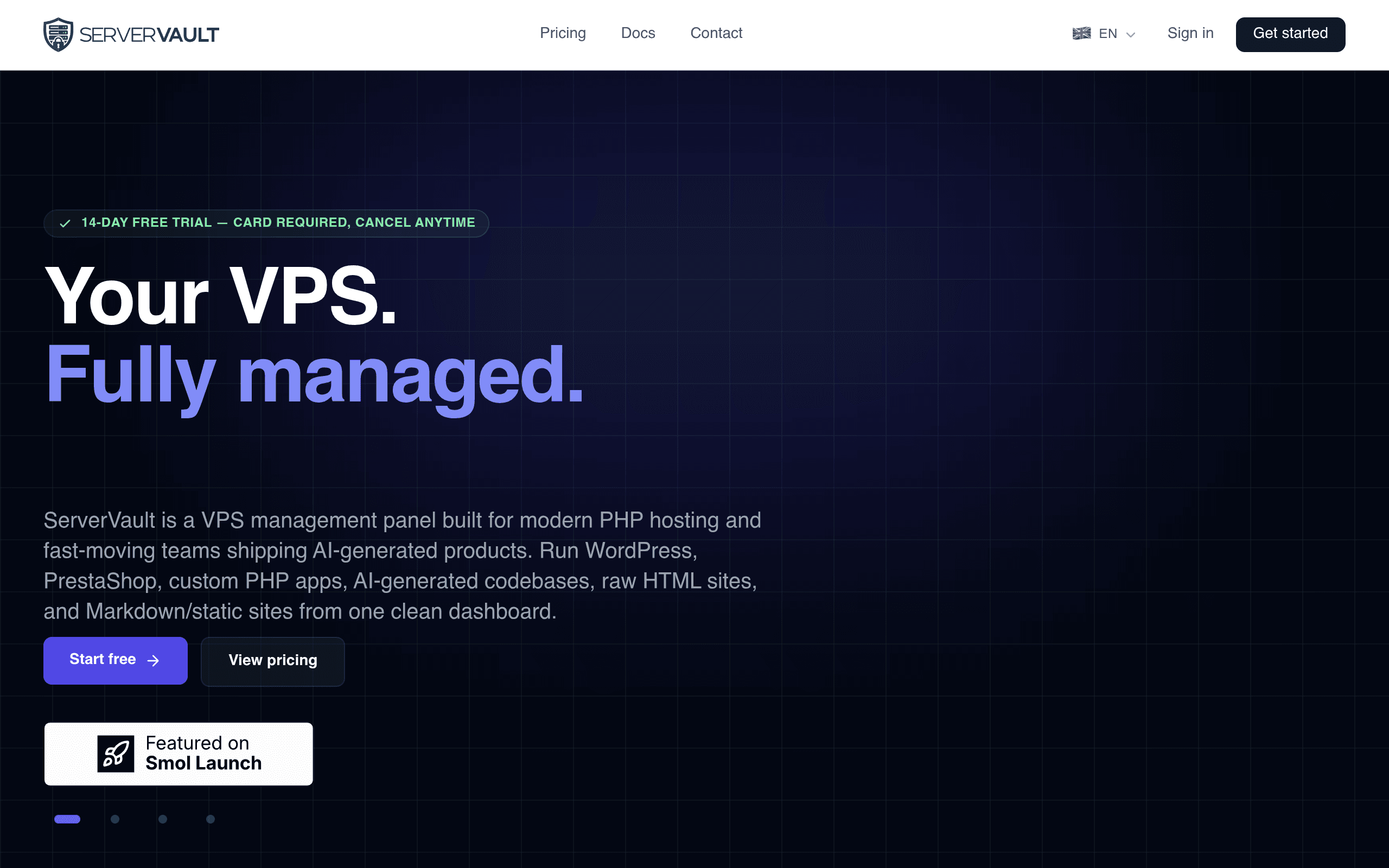
What ServerVault actually is
ServerVault (servervault.dev) is a browser-based control panel that turns a bare Ubuntu VPS — DigitalOcean, Hetzner, Vultr, Linode, whatever you point it at — into a working PHP host. You paste in SSH credentials or a root API key, it runs its bootstrap script, and roughly 5-8 minutes later you have Nginx, PHP-FPM, MySQL/MariaDB, and a firewall configured. From there you add "apps" (their term for sites) on top of that one server, each with its own PHP version, its own git-based deploy pipeline, and its own free Let's Encrypt certificate.
It's aimed squarely at the same buyer as Laravel Forge, RunCloud, and ServerPilot: developers who don't want to pay for managed hosting but also don't want to hand-configure Nginx vhosts and PHP-FPM pools every time they ship a client site.
Pricing, in actual dollars
This is the part ServerVault is clearly leading with, because it's unusually granular:
| Plan | Server fee | Per-app fee | Notes |
|---|---|---|---|
| Starter | $3/mo per server | $1/mo per app | Basic deploy pipeline, shared job queue, community support |
| Pro | $5/mo per server | $2/mo per app | Priority deploy queue, staging environments, faster support SLA |
| Mailboxes (add-on) | — | $2/mo per mailbox | Stacks on either plan, gives you a managed inbox tied to a domain on that server |
So a realistic small agency setup — one Hetzner box running three client WordPress sites and one Laravel app — comes out to $3 (server) + $4 (4 apps × $1) = $7/mo on Starter, or $5 + $8 = $13/mo on Pro. Add two mailboxes and you're at $17/mo. That's meaningfully cheaper than most competitors once you're running more than one or two apps per box, because ServerVault is the only one of the four billing per-app rather than a flat per-server rate.
There's a 14-day free trial, but it requires a card up front — no sandbox mode to kick the tires without giving them billing info, which is a minor friction point compared to panels that let you connect a server for free first.
What you get for that price
- One-command bootstrap: point it at a fresh VPS and it provisions the full stack unattended.
- Git-based auto-deploy: push to a branch, ServerVault pulls, runs your build/composer/artisan commands, and reloads PHP-FPM. Deploy hooks are editable per app.
- Per-app PHP versions: run PHP 8.1 for a legacy WordPress install and PHP 8.3 for a new Laravel app on the same box, with no manual pool juggling.
- Browser-based terminal and file manager: enough to tail a log or edit a .env file without opening a separate SSH client.
- Free SSL: automatic Let's Encrypt issuance and renewal per app/domain.
- Optional managed email: mailbox hosting tied to the same domain, billed separately per mailbox.
Where it actually fits
- Freelancers hosting 3-10 WordPress sites on one $6/mo VPS. The per-app pricing keeps costs proportional instead of paying a flat panel fee that assumes you're running one big app.
- Small agencies mixing WordPress and custom PHP/Laravel work on the same servers, who need different PHP versions per site without spinning up separate boxes.
- Solo developers deploying side projects via git push who want Forge-style auto-deploy without Forge's flat monthly minimum.
- Static site hosting for marketing pages or docs sites bundled onto an existing PHP server, since ServerVault treats static sites as a lightweight app type.
It's not aimed at teams that need Kubernetes-style orchestration, multi-region failover, or enterprise compliance features — there's no mention of SOC 2, audit logs, or team role-based permissions in what they've shipped so far.
How it compares
| ServerVault | Laravel Forge | RunCloud | ServerPilot | |
|---|---|---|---|---|
| Entry price | $3/server + $1/app | $12/mo flat (Hobby, unlimited sites/servers on that tier) | $8/mo (Basic, 1 server) | $10/mo per server (Standard) |
| Pricing model | Per-server + per-app | Flat monthly per account | Per-server tiers | Per-server tiers |
| Multi PHP version per server | Yes, per app | Yes | Yes | Yes (Business plan only) |
| Git auto-deploy | Yes, included all tiers | Yes, included | Yes, included | No (manual deploy only) |
| Managed email add-on | Yes, $2/mailbox | No | No | No |
| Free trial | 14 days, card required | No free trial (refund policy instead) | Free trial available | Free tier exists (1 app) |
| Best for | Agencies running many small apps per box | Laravel-heavy shops wanting one flat bill | Teams wanting a mature UI and staging tools | Simple single-app WordPress hosting |
The honest takeaway on pricing: if you're running a single app on a single server, Forge's flat $12/mo or ServerPilot's $10/mo might actually be cheaper or comparable to ServerVault's Pro tier ($5 + $2 = $7, so ServerVault still wins there too). But ServerVault's advantage grows specifically as app count per server grows, and it's the only one of the three with a built-in mailbox product — with RunCloud and Forge you'd need a separate service like Google Workspace or Migadu for email.
What's missing or unproven
As a brand-new product, ServerVault doesn't yet have the multi-year uptime track record Forge has (Forge has been running production sites for Laravel shops since 2014). There's no public status page history to check, no visible changelog of past incidents, and no mention of team/role permissions for agencies with multiple staff logging into the same panel. If you're managing client billing or need audit trails for who deployed what, that's not there yet.
Verdict
If you're already comfortable running your own VPS and just want a panel to stop hand-editing Nginx configs, ServerVault's per-app pricing makes it worth the 14-day trial — especially if you're stacking multiple small sites on one server, where it undercuts Forge, RunCloud, and ServerPilot in raw monthly cost. If you run a single large app per server, or you need team permissions and a longer track record, Forge or RunCloud remain the safer default today.