SpecKit: First Look at the AI Tool That Turns Product Ideas into Technical Blueprints
By Day Zero Guides Editorial · How we produce guides
Some links in this guide are affiliate links. If you sign up through them, Day Zero Guides may earn a commission at no extra cost to you. This never affects which products we cover or what we say about them. See our affiliate disclosure for details.
What SpecKit Actually Does
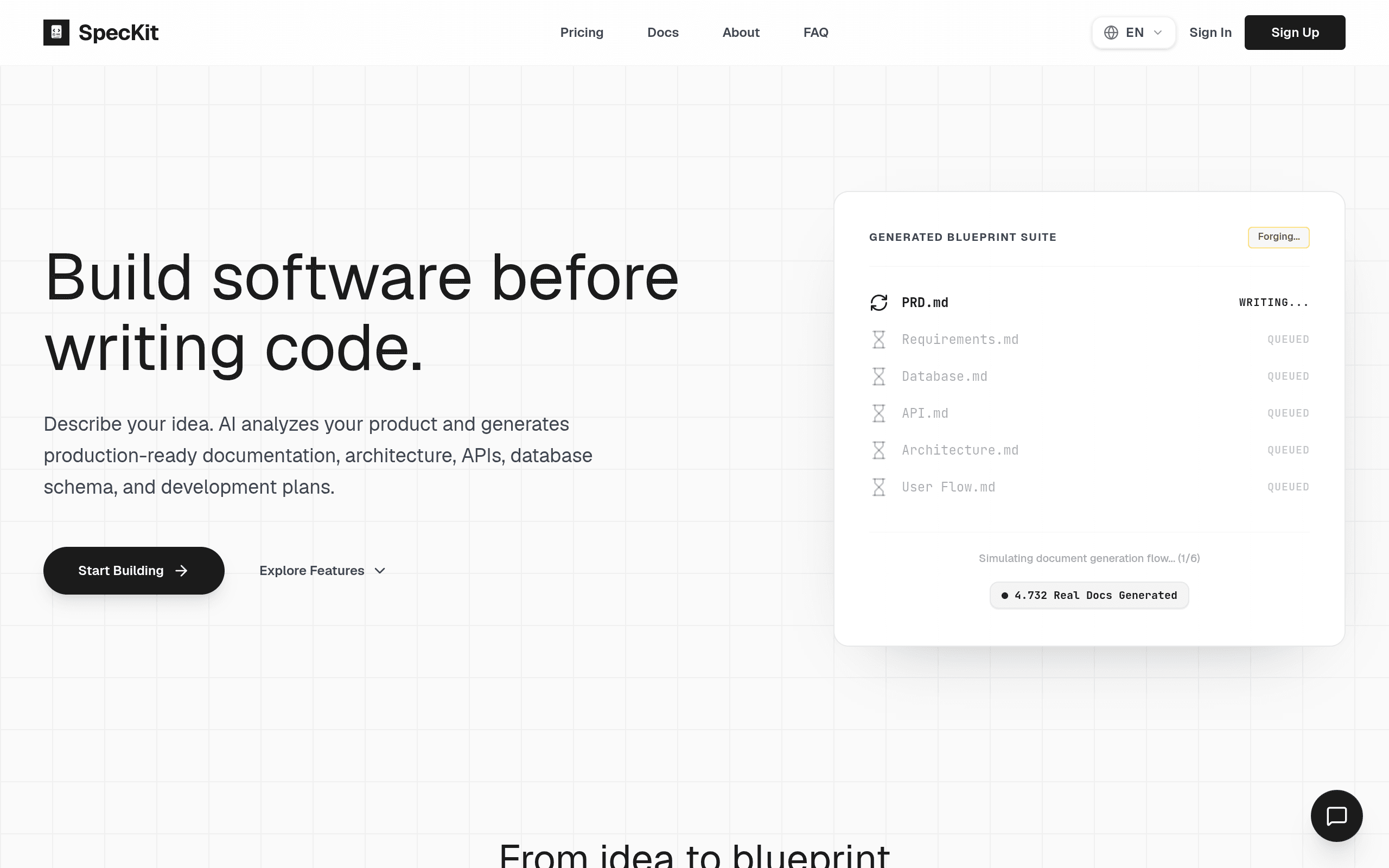
SpecKit (speckit.tech) is a new AI tool built around a narrow but genuinely useful job: turning a half-formed product idea into a technical specification you could actually hand to a developer. You don't start with a blank canvas or a prompt box — you go through an adaptive interview where the AI asks follow-up questions about your idea (who it's for, what data it touches, what it needs to integrate with), and it uses your answers to progressively build out a blueprint: architecture diagrams, API specs, database schemas, and a development roadmap.
The pitch is aimed squarely at people who have the vision but not the spec-writing chops — solo founders, PMs without a technical co-founder yet, agencies scoping client work, or engineers who'd rather review a draft than write one from scratch.
Pricing, in Detail
SpecKit's pricing is unusually granular for an AI tool — it's metered by blueprints and chats rather than a flat seat price:
| Plan | Price | Blueprints | AI Chats |
|---|---|---|---|
| Free | $0/month | 1/month | 4/month |
| Retail (pay-as-you-go) | $0.99/blueprint | 1 per purchase | — |
| Starter | $3.99/month | 6/month | 60/month |
| Pro | $9.99/month | 20/month | 200/month |
A few things worth noting before you commit:
- The Free tier is genuinely usable for testing the product on one real idea — one blueprint and four chat exchanges is enough to see the interview flow and get a finished spec, but not enough to iterate much.
- The Retail option at $0.99/blueprint is a smart middle ground if you only need a spec once or twice a year — cheaper than a subscription if your usage is that light.
- Starter ($3.99/mo) works out to roughly $0.66 per blueprint if you use all six, which is the plan most solo builders will land on.
- Pro ($9.99/mo) is clearly built for agencies or consultants scoping multiple client projects a month — 20 blueprints is a lot unless you're doing this professionally.
There's no annual discount listed at launch, and no team/seat-based tier yet, which suggests SpecKit is currently built for individual use rather than shared workspace collaboration.
Where It's Actually Useful
- Solo founder validating an idea before hiring a developer. You get an architecture diagram and API spec to bring to a freelancer instead of a paragraph of vague requirements.
- PM writing a technical brief for engineering without wanting to fake expertise in database schema design.
- Agency doing early-stage client scoping where a $9.99 Pro subscription is trivial next to what a scoping call normally costs in billable hours.
- Engineer bootstrapping a side project who wants a second opinion on schema design before writing migrations.
Where it's less useful: ongoing collaborative design work, ideation with a team in real time, or projects that need deep customization of the AI's underlying prompting logic.
How It Compares
SpecKit doesn't have a direct one-to-one competitor yet — it sits in a gap between conversational design tools, collaborative whiteboards, and raw AI API access. Here's how it stacks up against the tools people are likely to consider instead:
| | SpecKit | Botpress / Rasa | Figma / Miro | OpenAI API + custom prompts | |---|---|---|---| | Price | $0.99/blueprint or $3.99–$9.99/mo | Free (open-source) to $500+/mo enterprise (Rasa); Botpress free tier + usage-based | Figma: $0–$15/editor/mo; Miro: $0–$16/user/mo | Pay-per-token, ~$0.01–$0.03 per 1K tokens depending on model | | Core strength | Structured output: schemas, API specs, roadmaps from an interview flow | Building conversational agents/chatbots, not product specs | Visual collaboration and diagramming, no AI-driven spec generation built in | Total flexibility — you can build the exact same thing SpecKit does, if you build the prompts and interview logic yourself | | Setup effort | None — answer questions, get a document | Moderate to high — you're building a bot, not getting a spec | Low, but manual — you draw the diagrams yourself | High — requires prompt engineering and your own scaffolding | | Best for | Fast, structured technical specs from a non-technical starting point | Teams building actual chat/voice interfaces | Teams that want to collaboratively design and iterate visually | Developers who want full control and are comfortable building their own tooling |
The honest takeaway: if you compare SpecKit to Figma or Miro, you're really comparing a document generator to a canvas — they don't do the same job. Compared to the OpenAI API directly, SpecKit is paying for the convenience of a pre-built interview flow and consistent output structure rather than a blank prompt box. Compared to Botpress or Rasa, SpecKit isn't a chatbot framework at all — it just happens to use a conversational interface to gather requirements.
Should You Try It Today?
If you have a product idea sitting in a notes app and no spec to show a developer, the free tier costs you nothing and takes maybe 15–20 minutes to test. The real decision point is whether $3.99/month (Starter) is worth it for six blueprints — for most solo builders and PMs, that's cheap enough to justify trying for a month before deciding if the output quality holds up across a few real projects. Agencies scoping multiple clients a month should go straight to the $9.99 Pro tier and treat it as a line item, not an experiment.
What we can't yet verify from the outside is output consistency across complex, multi-service architectures — the demo-friendly case (a straightforward CRUD app or MVP) is very different from specifying a system with multiple integrations and edge cases. Worth stress-testing with your messiest idea, not your cleanest one, before trusting a Pro subscription.