Toldari: A First Look at the App That Remembers Your Friends' Lives So You Don't Have To
By Day Zero Guides Editorial · How we produce guides
Some links in this guide are affiliate links. If you sign up through them, Day Zero Guides may earn a commission at no extra cost to you. This never affects which products we cover or what we say about them. See our affiliate disclosure for details.
Where It's Actually Useful
- Before a coffee catch-up, pulling up a friend's profile to remember that their sister just had a baby, or that they were nervous about a doctor's appointment last time you spoke — so you don't have to ask "so what's new" and get nothing.
- Long-distance friendships that fade by default. The reach-out reminder is the core mechanic here: instead of relying on guilt or algorithm-driven "you haven't talked in a while" prompts from social apps, Toldari nudges you on your own schedule.
- Planning group hangouts (Premium) — the meeting helper is aimed at the logistics of getting 4-6 friends in the same place, which is otherwise scattered across group texts.
- Gift-giving and life-event tracking — logging a friend's kid's birthday or an anniversary once, then getting reminded a week out instead of finding out the day after.
What it's not good for: managing hundreds of professional contacts, sales pipelines, or anything that needs to look like a CRM dashboard. That's a different category, and Toldari isn't trying to compete there.
What Toldari Actually Does
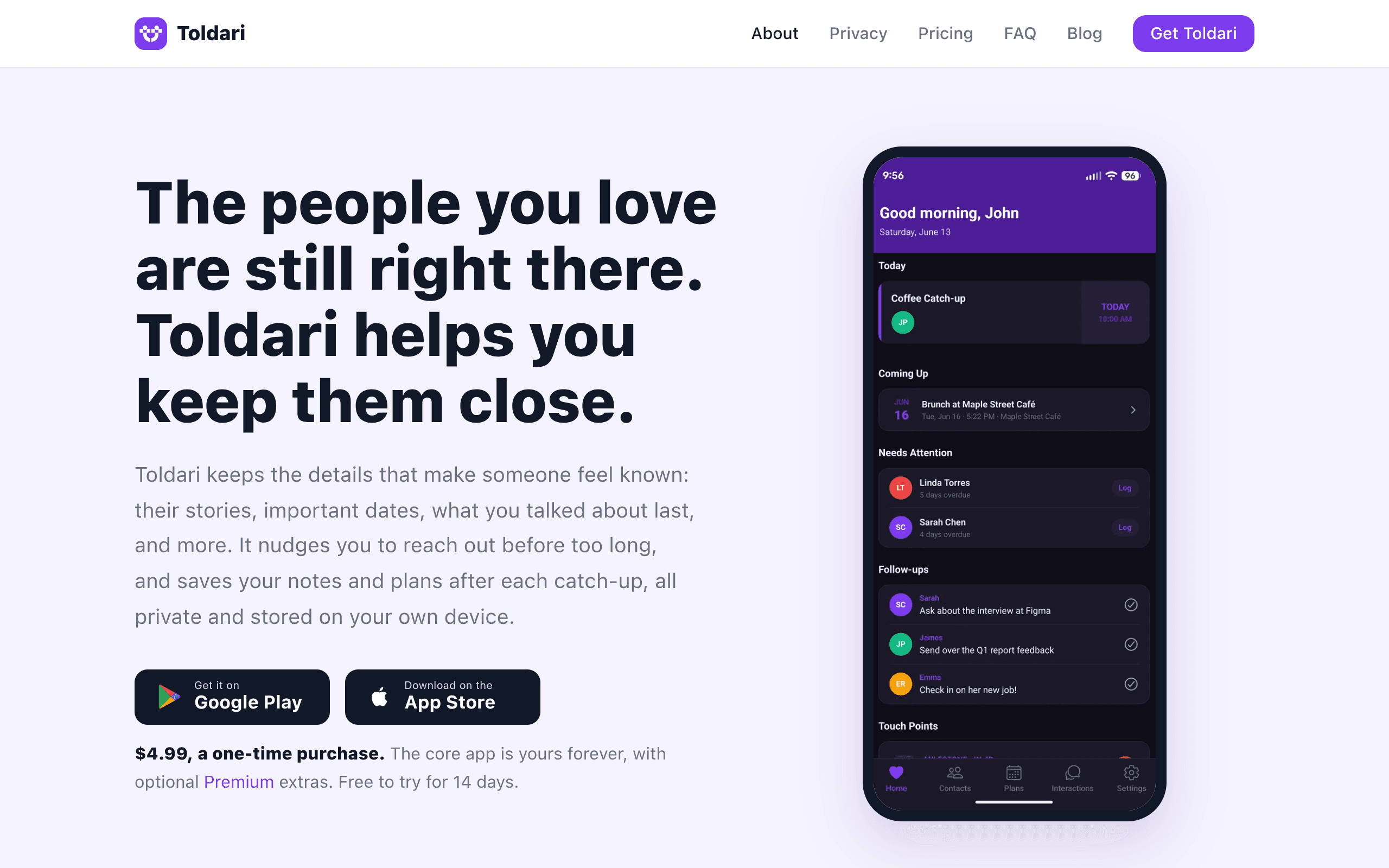
Toldari is a mobile app built around a specific, narrow problem: you care about your friends, but you forget the details that make you a good one. Their kid's name. That they mentioned a work deadline last Tuesday. The fact that it's been four months since you last talked. Toldari lets you log this stuff — stories, important dates, notes from conversations — against each person's profile, then sends you gentle reminders to reach out before too much time passes.
The part that separates it from the "personal CRM" category it's adjacent to: everything is stored locally on your device by default. No feed, no follower counts, no activity graph, no algorithmic nudge to post something. It's closer to a private notebook with alarms attached than a social tool.
Pricing, Broken Down
Toldari uses a two-tier model that's unusual for 2024 — a one-time purchase option still exists alongside a subscription:
- Standard: $4.99 one-time purchase, with a 14-day free trial. This covers the core functionality — friend profiles, notes, dates, and reach-out reminders — stored locally on your phone.
- Premium: $5.99/month or $49.99/year (billed annually), with a 7-day free trial. This adds encrypted backup (so you don't lose everything if you drop your phone in a lake), a group meeting helper for coordinating hangouts with multiple people, and private profile sharing, which lets you send a friend a curated view of what you've noted about them — useful if you're the one organizing a surprise party and need a co-conspirator to see your notes.
The math is worth sitting with: if you never need backup or the group features, $4.99 once is genuinely cheap compared to nearly every competitor in this space, all of which are subscriptions. If you want your data backed up and synced, you're paying $49.99/year, which puts it in the same range as Dex's cheaper tiers.
How It Compares
| Toldari | Clay | Dex | HubSpot (Free CRM, repurposed for personal use) | |
|---|---|---|---|---|
| Price | $4.99 one-time (Standard) or $49.99/yr (Premium) | Subscription, roughly $10-12/month or discounted annually | Subscription, roughly $12/month or ~$8/month billed annually | Free tier available; paid tiers scale into hundreds/month for sales features |
| Data storage | Local-first on device; cloud backup only on Premium, encrypted | Cloud-based, syncs across devices by default | Cloud-based, syncs across devices | Cloud-based (HubSpot's servers), built for team access |
| Core focus | Personal relationships — friends, notes, reach-out reminders | Personal CRM with contact enrichment pulled from email/social/calendar | Personal CRM with reminders and LinkedIn-style contact import | Sales/business contact management; personal use is a workaround, not the design intent |
| Reminders | Reach-out nudges based on your own notes and cadence | Reminders tied to contact activity and enrichment data | "Keep in touch" reminders with adjustable frequency | Task/deal reminders, not relationship-specific |
| Group coordination | Built-in meeting helper (Premium) | Not a core feature | Not a core feature | Meeting scheduling exists but tied to sales workflows |
| Best for | People who want a private, low-tech way to remember friend details without cloud sync by default | People who want automated contact enrichment and don't mind cloud sync | People managing a larger, mixed network of personal and professional contacts | People already inside HubSpot for work who want to jam personal contacts into the same tool |
The Honest Take
Toldari's biggest selling point isn't a feature — it's an omission. There's no feed, no metrics, no sense that your friendships are being gamified or measured against anyone else's. For a certain kind of person (introverted, a little burned out on social apps, genuinely trying to be a better friend rather than a better networker), that's the whole pitch, and it's a good one.
The tradeoff is the local-first design: if you lose your phone and haven't paid for Premium's encrypted backup, your notes are gone. That's a real risk for a $4.99 app that's asking you to store sentimental, sometimes sensitive information. If you're going to use Toldari seriously, budget for Premium rather than treating the one-time purchase as the endpoint.
Compared to Clay and Dex, Toldari is doing less — no contact enrichment, no auto-pulled data from email or LinkedIn, no cross-device sync unless you pay up. That's by design, not a gap, but it means the app lives or dies on whether you're willing to manually enter details about people you care about. If you already journal or keep notes on friends somewhere, that's not a big ask. If you were hoping for something that does the remembering for you automatically, Clay or Dex will feel more capable out of the box.
Worth trying today if: you've felt the specific guilt of forgetting something a close friend told you, and you want a tool that treats that as a private problem to solve rather than a social metric to optimize.